I read in one of my books on writing that the middle of the novel is where most writers face the demon. The beginning is a gallop, the end is a relief, but the middle wiggles in and out of your grasp. The middle of our lives reflects this same obscurity.
The middle of a life span reflects all we have accomplished and all we have left incomplete. This is what they call a mid-life crisis. I get it every year. This year it is more comical. I’ve finally accepted that my constant relocating, reinventing, and being restless are not going to be solved. I am going to keep doing these. At the bottom of the restlessness is the fear of finding rest more enjoyable than movement. This flotation of comedy rotated around me last night while I was standing out on the porch observing the peacefulness. The scenery of Santa Fe is a comforting, ethereal beauty that comes at all times of the day and night, and the flow of people is integrated and festive. All I could think of was where I should go next. The discomfort of mid-life comes from trying to assimilate what you have and what you want.
Many years ago, in the summer of 1987, I was seated in a café in Monaco, truly, and a man that I was traveling with told me, “You have to make a choice.” He embarked on a long discussion about choices we make in life and how everything depends on these choices: how you live and with whom, and what you do. He pointed out to me over my first really authentic Salad Niçoise that I was an oblivious example of a woman refusing to choose. I was more interested in the salad, the yachts, the casino around the corner, and the fact that I didn’t have an evening gown to wear to dinner. I listened without argument or insult, but I was disturbed by what he said. I didn’t understand completely, but he was older and had much experience and conviction. That conversation now fits into the mid-life crisis, the comedy of errors in my life, and maybe in yours, and just how much travesty we can ignore. For my fault, as it is, I do not want to sign, commit, or make final decisions. I want it all to be a temporary placement that allows me the freedom to change.
I have lost track of my European friend, but if he met me today, he would say, “You have not changed at all.” So that is why I was standing there in the darkness on the porch and laughing like a silly girl, because it is true. I have not changed at all.
The choice facing us at mid-life is making a change now, risking losing all we have accomplished, compiled, and attached, or throwing the dice.
Beyond the obvious changes in activity, relationships, and scenery are the internal travels. They are not so easily booked. You cannot wake up one day and say, “I ‘m off to become more compassionate, or more practical, or more generous.” These journeys are taken when other factors play into our lives, such as when we get sick, demoted, or experience a trauma.
It is a very subtle inconsistency. When I unplug all the voices and listen to the one that understands, that is when I write. The middle of the story and the middle of life are the same. We and our characters have to make a choice.
About the Santa Fe travel narrative I was going to write, when the New York Times beat me to it. It was in the Sunday Travel Section, “ Is Santa Fe Ready For a Makeover.?” 8/06/2007. If you read it then you know, that mod is flowing through the alleys and walkways of Santa Fe, more so than adobe mud. Lofts have landed at The Railyard, and once they open, then comes the attachment to more mod café’s, shops, movie theaters and people. I add this ancedote, four years later, it didn’t get too mod.
My answer is yes, Santa Fe is already under the mask of revival. My perspective comes from the duality of being a tourist and a resident. I have not lived here long enough to shed the distinctive air of a gambler who has just won the jackpot. It feels very much like a home that I left years ago. Beginning in 1984, I used to come here regularly, wearing a two piece blue suit, and carrying a leather briefcase. I was a commercial property manager based in San Diego, and one of my portfolio buildings was in Albuquerque. The second trip out here I took the company rental car and zipped over to Santa Fe and stayed at La Posada. Every month my trip to Albuquerque included a weekend in Santa Fe. I invited friends, family, and co-workers to travel along. After I left that position I returned less frequently, but it was never crossed off the list.
Today, I live across the street from La Posada. I still walk through the Plaza once a day to see the groove of live bands on the stage and snap internal photographs of the multitude of activities, conversations, expressions, and festivities surrounding Spanish and Indian Market month. On the park benches, moldy hippies sing along. Children scatter between the adults, while families sit under trees, sipping thermoses of cool aid and eating home made tamales. As you cross over to San Francisco Street and pass Starbucks, you will step over the hillbilly from Arkansas, whose sidewalk show includes a dog, cat, and several mice playing nicely. His message is, animals get along why can’t people? You will never read this sort of description in the travel narrative.
Just before dusk, the city streets empty for about an hour, and the shinning light spreads evenly over the adobe walls and rooftops. That is, if it’s not raining. This summer, it is not just a thundershower. The rain pounds the earth, the lighting and thunder shake the windows, and the cats run under the bed. I stand on the porch and watch, mostly because summer rain is the most romantic of all weather moods. That comes from a distant memory under raps. If you have a balcony, or find your way to the Rooftop of La Fonda, or Coyote Café, take a seat. Just watch and listen to the operatic electrical storm. They do not last too long.
The best time to walk is early morning. There are several roads to hike just beyond Canyon Road that lead you to the Audubon Society. From there, you can choose from a dozen rated hikes. From beginners to Aztec tribal strength. When in Santa Fe walk as much as possible, bring a pocket umbrella, and keep your eyes on the road. There are dazzling surprises everywhere you look.
The travel narrative always ends with, What To See, Where to Go, Where to Eat, and Where to Stay.
WHAT TO SEE & WHERE TO GO.
IAIA MUSEUM. 108 CATHREDRAL PLACE. The museum exhibitions have a purity of purpose rarely seen in museums today. It is unpretentious. The staff is undeniably the most receptive, and the gift shop is stocked with worthwhile purchases.
GEORGIA O’ KEEFE: 217 JOHNSON STREET. Not only a museum, a place of worship. Do not go through the salons until you’ve seen the short documentary film about her life, it runs continuously. The outdoor Café is where you will see many local art setters and sponsors having lunch beneath a canopy of umbrellas.
SHIDONI SANTA FE: OLD BISHOP’S ROAD: 5 MILES FROM THE PLAZA. Imagine a bronze art foundry, sculpture garden, and gallery representing over 100 artists spread out over 8 acres of apple orchard. You can spend the day there without too much effort.
TEN THOUSAND WAVES:` A resplendent way to begin the adventure is at this hillside sanctuary wrapped in bonsai and green tea leaves. Guests tiptoe in Kimonos across stone steps, into private and public outdoor baths, treatment rooms, and get kissing close to Nirvana. If you are in need of bodily rearrangement, ask for Wayne, he will delicately remove your head.
SANTA FE OPERA: TESUQUE: 5miles from the Plaza. I have heard thunder and seen lighting crack the horizon, during the arias of Madam Butterfly. For ticket less visitors you can actually buy a $10.00 leaning ticket. I know from my friend, Little sister that it is a unique experience, and you can leave at any time.Always provocative, cutting edge adaptations to stir your imagination.
WHERE TO EAT :
NEW MEXICAN: MARIA’S KITCHEN THE SHED GUATALUPE CAFE
LOCALS GO TO THE COWGIRL HALL OF FAME:: 319 S. GUADALUPE. Known for it’s bronco busting burrito breakfast, it is also a very well-heeled bar for cowboys, music, laughter, barbeque, and skateboarding. It reminds me of the Venice Boardwalk.
THE COMPOUND: 653 CANYON. My choice for lunch because it suits the poor little rich girl. It feels faraway, and the outdoor garden is a tantalizing backdrop for imagining you are faraway. Seasonal creative food at the hands of a celebrity chef. Bar is great for delicacies and cocktails, and the rooms, with shiny mud-packed floors, white washed beams and walls gives you a lift up, to the surreal.
WHERE TO STAY:
LA POSADA RESORT & SPA : 330 E. Palace Av. The scene is very eclectic, it draws people from the Texas ranch, Hollywood, and the Silicone Valley. Favorite pastime, cocktails on the outdoor lounge at dusk, and dinner on the patio facing the theater of events, where performance, music, and weddings take place free of charge. The staff is out of this world.
LA FONDA AT THE PLAZA: The hotel is where I go about any time of day just to see what is going on, who is playing in the bar, whom is holding conference, and to eat the tableside guacamole in the atrium restaurant. Another terrific production crew behind the front desk.
PEOPLE TO MEET: I’ve found meeting people most fascinating at Art Gallery Openings. Check the Pasatiempo (Guide in Santa Fe New Mexican) and the Santa Fe Reporter for a list of events and openings. Friday nights 5-7PM.
The best news is, more non-stop flights from Los Angeles to Albuquerque.
I have written my second travel narrative and I think I’m traveling down the wrong road. Back to adventures in Livingness next week.
The course we choose to study doesn’t begin in school; it begins the moment we recognize that life is our teacher. I chose the course of love between a man and a woman. Yet all I’ve learned from Anais Nin, Joan Didion, and Lawrence Durrell, about love isn’t guiding me. I have to start over, and develop wisdom based on my own experiences.
The morning is crisp as iceberg lettuce, a day of clarity and stillness. Outside my bedroom window, the light illuminates portions of the pine tree, and the walls of our neighbor’s home. On my side of the glass, there are shadows and dissonance. It feels like months since the last column, and unwinding what events took place since, is going to be as piercing as the southwest sun when it shines in my eyes.
A few days before Christmas, I was in the kitchen with two friends, visiting from Boulder. Aaron, whom I’ve not seen in four years, and Lilith, whom I’ve just met. Aaron was the subject of one of my columns, the lone man standing on a mountain top, climbing the rocks of life and nature, as he ascends to the distant and dangerous vistas of life. Lilith, an angelic petite woman, with eyes wide as moons, and uncontrollable affection for what is reachable. I am preparing dinner, and our discussion is about love, about me and John, and about Rudy, whom Aaron has rendered a mentor since we all met in Saratoga Springs, 2000. We celebrated Aaron’s twenty-first birthday with him. He was ignited by individual far from conventional thinking even back then.
“Remember the time you and Rudy moved the farm table outside the window, over the second story roof, and down to the porch. How did you do that?” I said.
“Ropes. I couldn’t believe this guy– half my size and he’s carrying this eight foot wooden farm table over one shoulder. “
“ Yea, and now he’s carrying a Dragon. Oh Aaron, those were innocent days weren’t they? ”
“ Yea. Was that really eleven years ago; it feels more like a century.”
“ That’s because you live without any boundaries.”
Lilith picked up the camera and started shooting a video. I put on a hat and sunglasses for the camera, and began using the pots as instruments. They frivolity reached a high note, just as the phone rang.
“ Hi, it’s me. I’m coming back. It’s over.”
“ I’ve heard that before Rudy. “
“ I’m almost in Flagstaff, I’ll be there tomorrow.”
I sat down on the stool, and looked to Aaron for something wise and assuring to settle my spoon-stirring anxiety.
He was expressionless. The intervention of Rudy, who moments ago I was raking with hopelessness was on his way here, arriving the first night of Chanukah, which had a similar mystical tune to it.
“ John’s coming in on Friday — Oh God! I don’t know, this sounds too much like a Hallmark movie. I don’t believe this. When is it going to end?”
“ Lue, you amaze me. “
“ I wish I’d stop amazing people.”
Lilith and Aaron took off the next day and I busied myself with brooms and sponges; the activity most relied upon when life is messy. I did not want to shell-shock John with the news, because he was in the final stages of his script, and Rudy was on the road, where at any point, the Dragon might reappear, and whisk his tail back to her nest. Until he drove up, there was still a screen of fuzzy details.
I’d just come from Luminara Lounge where I’d met Jewels, my confidante and baby-sitter through the last four months of Dragonfaire.
“ Is he here?” She said breathless from rushing.
“ I saw him pull in the driveway. I left earlier and drove around until I could reach you. I don’t want to be in the house when he arrives.”
“How are you going to handle things with Rudy?”
“ Beats me. I know I have to suppress my anger; that’s like suppressing my appetite after a week of starvation.”
“ Which reminds me, are you eating?”
“ More or less?”
” LouLou. You have to eat! How do you think he’ll feel?”
“ Like a turkey on Thanksgiving.”
“What do you think John will say?
“ He’ll be speechless.”
Jewels lifted her thirty pound life jacket that a mother of two children, wife, business owner, and adventurer swings with the ease of a dancer and wrapped her arms around me.
I returned to the garden path at La Posada and in the moonlight, paced the icy walkway waiting for John to answer the phone. “ Hi baby.”
“ Hi sweetheart–how are you?”
“ I’m still working.. but it’s going really good. I got the latest storm report, and it looks like I’ll have to drive out Christmas Eve day.”
“ I made reservations for five, is that too early?”
“ I’ll be there way before that. Got to get up early and load up the car with presents.”
I grinned, and kicked the stones in the pathway.
“ John… Rudy’s here. I didn’t want to tell you until he actually arrived.”
” John. Are you there?”
How do I word his laughter, a long winded guttural explosion without pause, that struck my humor and I joined him, and our laughter sort collapsed into one, like making love or something, and it felt so good, I didn’t want to stop.
“ Never a dull moment at Gallery LouLou.”
“ I haven’t seen him yet, he’s in the house. “
“ Call me later, I need a drink.”
You couldn’t cut the tension with a semi-truck head on, as Rudy and I stood feet away in the Staab House at La Posada. I was leaning against the bar, observing his new leather Puma’s.
“ Well, I’m here.” His crooked smile faded when I didn’t step forward or greet him with a smile.
“ Yes, you are.”
Then the staff engulfed him in warmth and greetings and I just about threw my head back and howled from the absurdity, and the bedazzlement I felt lifted me out of myself, because I couldn’t really stand there and be a part of the abstraction of life.
“ Can we have dinner together?” He uttered.
“ I’ll be here.”
I got through half the dinner, and then suddenly felt the drum beating in my rage cage and dashed out. The next few days were like waiting for a frozen chicken to thaw out. I poked at him, and he was solid, I poked a day later, asking questions, and he released a mumble of words, “ I can’t open up yet. I will in a few days. Just tell me what we need to do.”
“ John’s not coming out. He changed his mind.”
“ Why?”
I glared at him with blade sharp eyes.
“ Because of me. That’s not what I want to hear. I’ll call him.”
“ NO. Do not call him. You have no idea what your … dragon episode did to us. Are you sorry Rudy? Are you truly sorry or are you still pining for the Bird. And I would like to know the chances of you going back before I get any ideas about smiling or laughing. ”
“Yes, of course I’m sorry. I don’t think I’ll go back.. but I have to be honest.”
I turned my back and kept walking. The next turn came from John, “I’m coming out; I just pray that we’ll have a chance to be together, and have a peaceful Christmas.”
It seems once a month; I am jarred into this part of my family history. Just last week, a woman emailed me information she pulled off a website that I’d never seen. There in the document, was a story about my mother and father.
I began my research fourteen years ago. It started with what I had, one of my father’s books; “The Mark Hellinger Story.” I leafed through the index and there was my father’s name along with Ben Siegel’s. According to the biographer, my father visited Mark at his home the night before he died. Mark had stood up in court for my father and Ben at one of their hearings. He was fond of Ben, like so many people were, that aren’t here to tell their story.
After reading the book I rented, The Roaring Twenties, written by Mark, and from there the connections, relationships, and characters began to leap out from all directions. I submerged myself in history and photocopied pictures of my father’s movie star friends, George Raft, Eddie Cantor, Clark Gable, and his gangsters friends. I found photographs of the nightclubs he frequented, the Copacabana, El Morocco, and Ciro’s and nightclubs that he referred to in his mysterious conversations. I made a collage of the pictures and posted them board above my desk. I played Tommy Dorsey records while I wrote. This microcosm of life that was created, allowed me to listen to the whispers and discover the secrets.
I dug into my father’s history without knowing how deep I had to go, or what shattering evidence would cross my path. In my heart I felt this was crossing a spiritual bridge to my parents. The flip side was a gripping torment, tied to my prying mind. I needed to break into the files in order to break my silence, and discover real people, not glamorized stereotypes that fit into the category of Copa dancer and gangster. No matter what I uncovered, I always knew it would be ambiguous, and controversial. I did not expect to find a record of murder, dope peddling, and prostitution. I believed that his crimes were around the race track, and in gambling partnerships. Even so, I could never understand the similarities we shared, unless I knew them as people. Though I have not rebelled against authority as my father did, I‘m not a team player, I resist authority, and I don’t like waiting in lines.
I had to reinvent my mother through the subconscious. I skated over thin ice trying to set her truth apart, from what I had invented, dreamed, or had been told. I listened to Judy Garland’s recordings, and premonitions surfaced, of how my mother loved Judy, how it felt to be under the spot lights of MGM, and dancing in ginger bread musicals while her own life was draped with film noir drama.
I studied my mother’s face in all her films, rewinding and stopping the tape, as if she might suddenly return my glance. She had dancing and background shots in the musicals produced by Arthur Freed. I remembered dad talking about Arthur, and how prestigious it was to be in his department.
When I discovered the Museum of Motion Pictures Arts and Sciences in Los Angeles, I went down and filled out a slip of paper with my mother’s name on it and waited for my number to be called. I felt something like a mother discovering her child’s first triumph. They handed me a large perfectly stainless manila envelope, and a pair of latex gloves to handle the file. I had to look through it in front of a clerk.
“That’s my mother,” I proclaimed. He blinked and returned his attention to a memo pad. Inside the envelope were black and while glossy studio photographs, press releases, and studio biographies of my mother. The woman who pressed my clothes, washed my hair, and made my tuna sandwiches. There she was in front of the train, for Meet Me in St. Louis, and a promotional photograph in TheSecret Life of Walter Mitty, dated 1947. That was the year Ben was shot. I looked further to find more clues. I needed to know where she was the night Ben was murdered. Maybe she was on location when it happened. Maybe she was in New York at the opening of the film. I could not place her on June 20, the day Ben was murdered. I imagined my father called her and told her the news. The marriage plans were postponed, their engagement suspended. My father had to get out of town.
I spent everyday picking through the myths I’d heard and read. I heard a clear chord of scorn, for exposing family secrets, “It’s nobody’s business what goes on in our family, don’t discuss our family with anyone, Do You Hear Me!” I must have heard that a thousand times.
I began to dig with an iron shovel. I asked every question I wasn’t supposed to ask, and preyed into every sector of their life. I wanted to know about his childhood, where he grew up, and why he left home when he was thirteen years old. Who were my grandparents, and why didn’t he talk about them. How did he meet Ben Siegel and Johnny Roselli, and when did he cross over into the rackets?
I contacted historians, archivists, judges, attorneys, Police Chiefs, FBI agents, authors and reporters across the United States. He always said, “Reporters can destroy your life overnight.” And here I was, uncovering what he had sheltered all his life.
I wrote to the INS in WDC and asked for their assistance. Six months later I received a letter from the INS in Los Angeles. They acknowledged his file, it was classified and they could not locate it. The progress was tediously slow, and the waiting oppressive.
While I waited for the files, I read Damon Runyon, and Raymond Chandler stories and attempted to identify which character personified which gangster. The stories were about the people that came to my birthday parties, Swifty Morgan, Nick the Greek, Frank Costello and Abner Zwillman,(the Boss of the New Jersey syndicate.) The dialect of Runyon and Winchell mimicked the same anecdotes my father used over and over! By understanding Runyon’s characters I began to know my father. At night I watched old gangster movies and that opened another door of familiarity.
I read almost every book in print about the Mafia and ordered out of print books from all over the country. They began to topple on my head from the shelf above the desk. Allen Smiley was in dozens of them. Every author portrayed him differently, he was a Russian Jew, a criminal, Bugsy’s right hand man, a dope peddler, a race track tout, and sometimes the words bled on my arm. To me, he was a benevolent father, a wise counselor and a man who worshipped me.
The INS claimed my father was one of the most dangerous criminals in the United States. They said he was Benjamin Siegel’s assistant. They said he was taking over now that Ben was gone.
That day I put the file away, and looked into the window of truth. How much could I bear to hear more?
Adventures in beginnings, starting over, and rewriting a story you’ve lived many years is the same as re-writing a story. It takes the same blind courage.
About half between forty and fifty years old, you hear people say, “It’s too late to start over,” It’s not true. I hope it never feels like that when I wake up. Just thinking about it makes me run in circles. Behavioral change is essential to living a full life. In the middle of the night I woke up as if it was morning. When I looked out the window, the moon was white as a laundered tablecloth, staring back at me. It said get up and write.
I retreated to my corner of the world, a tiny room bathed a blush pink and gold, and wrote from beneath the goose down comforter. The moon watched. Now that the lights and decorations are placed in the cartons, the wrapping and ribbon tossed away, a landfill of disturbing, distressing, and terrifying global news is dumped on us. I do not understand the external world of political and international power, wealth, and motivation.
I fled that world a long time ago when I learned that men who controlled the paths of others were dangerously self-serving. I recall my father sitting on that green velvet sofa, holding the remote in one hand and watching a news program. He turned it off and said to me, “Luellen, everything that goes on is fixed; you cannot hide your head in the sand and think otherwise.” I nodded my head in understanding, while internally I thought my father was suffering from his usual psychosis. Eventually I crossed over, and forfeited my interest in politics. The forces of evil have shattered that glass of indemnity.
This year is not about vapid resolutions catering to our comfort, it is about survival. It’s about transforming behavior and habits, excesses and denial. Doing it in a group, makes us feel less traumatized. Imagine, all the thousands of people paddling the same current; forcing back the mortgage lender, relinquishing precious possessions, driving a car with a shattered windshield, wearing coats without any down feathers left, and wondering when the pink slip will arrive. Alienation and neurosis are at the root of people’s aggression and discontent. It can lead to unexpected violence, and then to massacre and war. It is a collection neurosis that grows worse every year.
The inner world, where each of us faces a truth no one else knows, is ruptured. All I can think of is bringing a little bit of light to someone you know is in darkness.
“Ordinary life does not interest me. I seek only the high moments. I am in accord with the surrealists, searching for the marvelous.”
Anais Nin. 1931
Expecting snow, expecting pleasure… we are all in some range of expectation. Where you may be hunched under an umbrella waiting for the light to turn green, so you can find shelter inside a café, a shop, where someone else waits for the arrival of a friend, the death of a loved one, the offer in writing, the publication, the house to sell, the decision to resonate, the pain and suffering to subside.
I think of something my father used to say, “You made your bed, now you lie in it.” And another one, “It’s your lot in life.” I began writing Smiley’s Dice in 2002 from a desk in a Solana beach rental. Maybe in two years I’ll have a column in a newspaper or magazine, and maybe I won’t. It’s my lot: to not give up.
Santa Fe is blistery cold, the street dry and the sidewalks baking sheets of white snow. Out my window is a metallic sky that hints of more snow. This sky slows the rhythms of the body and mind; it invades the hurried motions of pedestrians, vendors and hotel staff. There is an absence of light that intercepts outward vision, so we turn inwards. I do anyway. And because I gorge myself on the emotionalism, and interior life, I have not slid into home base.
That is why it has taken me longer to launch my writing for worldly consumption. Some of us are not in a rush to wave the “I made it” flag. Some favor holding back, until the other elements of our character life are lived; our destructiveness, fear, pettiness, falsity, greed, so many steps to climb.
You and I have to trust in the pattern of our lives, the invisible thread that taunts us, teases us, and even torments us. My lot, postponed progress, maturity, development.
I was an A cup until college, without direction, a major in English, Art, and Psychology, before dropping out. My major interest was the countryside beyond Sonoma State campus walls, the roaming cows, and flock of geese over the swamps, the crooked paths winding through eucalyptus woods, the poetry pasted on bulletin boards in the coffee house, the farmers in the pasture.
“When are you going to start taking your life seriously?” My father asked this question every few years, and every few years, I lied.
I was adulterated when I was first employed at the old Gibraltar Savings & Loan on Wilshire Boulevard. I was serious about how they measured my performance, and was vicariously unconcerned with personal gratification. How excited could I be about trust deeds? I cannot even recall what I was doing; just the name of the department, the Beneficiary Demand department.
All that restrictive training, in punctuality, production, and prudence, exploded late in life. I did not discover my passionate interest in writing until I was forty.I didn’t own a home until I was forty-seven, did not stop biting my nails until I was fifty-four, did not learn to love and trust until last year.
I developed friendships late in life, now I honor a treasure chest of sterling gems that glitter from near and far. Friends that abandon tasks to listen to me talk about moving the furniture again, and consent to my absence because the victor of writing has kidnapped me.
It is a day later, the sky is unchanged; still the cloud cover is nailed to the sky. In random conversations I have heard of people’s hardships, of sacrifice and compromise during this holiday season. No more travel talk about Paris, and the Orient. No more extended vacations or extravagances. We have to give ourselves a holiday from lament, from error, and from exasperation. I tell myself not to be combative, not this year, and don’t polish the guilt and remorse, just let it fade away. Don’t open those links to real estate values, retirement funds and investments; open the link to History. Remember what the greatest generation was handed; remember soup lines, suicides, and World War II.
Mostly don’t reprimand your partner for unrealized expectations; They are most fragile to your voice and touch. The adventure in livingness is to look at your lot; and ride it with amusement and wonder.
A LITERARY AGENT I know emphasized the importance of rounding up readers. That’s not so easy when you’re exposing your own guarded family secret.
My mother married my father two years after Benjamin “Bugsy” Siegel was murdered. Sitting beside Ben the night of the murder provoked an immediate response from my father; it was time to get the hell out. He promised to reform, and she agreed to marry him. One of her compromises was her religious faith. She was Irish Catholic. She stopped going to church, and she didn’t convert. It was a bitter irritation between them. My father raised us Jewish, we attended Hebrew School and went to Synagogue every Saturday morning. The complexity of being half Jewish and half Catholic surfaced, when some classmate told me I wasn’t really Jewish. I told this to my father. I still remember his answer coming at me like a round of bullets.
” That’s an idiot! It doesn’t matter if you’re half Jewish or a quarter, you’re a Jew! Don’t you ever forget it, and don’t let anyone tell you different. DO YOU HEAR ME?” To this day when people remind me that I’m not really Jewish I say,” For my father, God made an exception.”
Friends are different for men in the Mafia, and for their wives. Real friends have to be connected. You cannot trust anyone else. My mother had three friends. Marianne was married to Gus Alex a powerful political fixer in the Chicago syndicate. She had been a model like my mother. She was the stunning Grace Kelly sort of beauty with coolness much like my mother. She and my mother whispered when I was in the room.
More than any other person, Aunt Bess was beholden to my mother. She wasn’t really an aunt. Bess was Benjamin Siegel’s little sister. The one he favored over the others. I suppose Bess met my mother way before I was born, when Benjamin was alive. She had the same bedroom eyes of her brother, big hound dog eyes that swept sentiment in every glance. She had a heart too big for the turmoil in her life, and she cried about everything. She squeezed my face, and forever referred to me as her gorgeous baby. Bess was as content crying as she was laughing. There wasn’t any in between. She dressed in high heels, tailored suits and carried a hand bag with lots of tissue. She and my Nana, my mother’s mother were very close friends. Bess, her husband, and daughter lived in a house on Doheny Drive that Ben Siegel bought for her. Bess’s husband Solly never uttered a word, and worked for Ben doing odd jobs.
In later years I would live across the street from them, but by then my father had distanced Bess’s family for reasons never revealed.
How I loved to watch Miriam; a saucy brassy Italian from Brooklyn. She propped up her bosom like two statues, waved a long red lacquered nail, and smoked one cigarette after another without ever taking a breath. She shopped everyday, charged everything, and when we were in the room she did not change her act, she let us see what it was really like to be a gangsters wife. Beneath all the enamel and cosmetics she loved my mother unconditionally. Although their characters were strikingly different, they shared that bond. Miriam was married to Doc Stacher, who rose in the ranks to become enforcer for Abner “Longy” Zwillman, the boss of New Jersey. Doc walked with his hands clasped behind, a cigar stub lived on his lip, and he was bald and heavy lidded. He lived in short pants and little white sneakers. Beneath his somewhat harsh and metallic skin was a wreath of worship for Joanne. He didn’t restrict her humor, appetite, or spirit. The more outrageous her behavior the more he approved.
Mafia men make the most outrageously entertaining hosts; nothing is ever out of the question. All they have to do is pick up the phone, and someone in the network will make it happen.
Mafia men don’t get up and go to work. Not one day in his life did my father ever report to an office. When I wasn’t in school, he took me with him in the powder blue Cadillac and we drove the streets of Hollywood visiting friends in delicatessens. We sat in big leather booths while my father and the owners talked. I didn’t know what work was all about. No doubt the conversation was the rackets, the races, or Vegas. I was a very good decoy. What kind of a man takes his daughter to mob meetings? The kind that doesn’t want to look like a mob guy. My father didn’t think I was listening, but I heard a lot.
Rory Calhoun was one of the characters that stood out. He was a western movie star; the Clint Eastwood of his day. Rory was also in the same reformatory as my father as a teen. The Calhoun family and ours spent a lot of time together. They had two daughters and lived in an exotic Spanish villa on a corner of Sunset Boulevard. Inside it was like a movie set, with animal rugs, oil paintings of Spanish Troubadours and Moorish decorations. Rita, Rory’s wife, wore tiny stacked high heels and she clicked across the Spanish tiles like a flamenco dancer. The whole family was blessed with dreamy looks. I remember looking at my reflection in the mirror as Rita combed my hair, and discovering I was not at all pretty. I didn’t realize that I was surrounded with extraordinary beauty; everyone had these exceptional vogue looks. The importance placed on that kind of beauty was just as distorted.
Rita exhumed a stern feminine demeanor, extremely seductive but not without a battle. I learned my first lessons about temptation just by watching her. She fanned the room with perfume and laughter, and men just succumbed like drugged animals. I felt my first tingle of sexuality in the arms of Rory. He was a treasure of natural emotion, conversation, and jokes. They both gambled, borrowed money from the other, and bet on everything.
FLAMINGO HOTEL WEDDING 1949.
My mother was raised in East Orange, New Jersey, before the neighborhood changed. My grandmother always said that East Orange used to be a very nice place to live. There is a photograph of my mother at age seven or eight posing in the garden with her German Shepard. She is holding a ruffled parasol, and dressed like a doll. Her face is a bud of innocence, but with a hint of pained modesty. She didn’t flaunt her beauty; it was more of an embarrassment. When her father died suddenly, she elected to help her family financially, and entered her photograph in a Redbook magazine contest. At seventeen years old she won a modeling contract with John Robert Powers in New York City. My mother ascended to an identity that suited her in some ways and restricted her in others. The Powers girls were invited to grand openings of hotels, restaurants and nightclubs. She appeared on stage at New York’s Copacabana Night Club in 1943. On one of those nights my father was in the audience, and that was where the Smiley Casey bridge from East Orange to Hollywood began.
Déjà vu made a sounding explosion when I was seated in the Del Mar Turf Club with my friend Rudy. I wore the best outfit I had, which was Victorian compared to other dolls at the track. After observing the fans for a few minutes, I noticed one table of serious bettors that looked authentic. That’s when the memory of me and Dad at Santa Anita came rising up, and the expression he wore the entire time we sat through six races. He never took off his tinted shades, and he did not speak to me at all, not once, except to hand me a twenty-dollar bill and say, “Play the Trifecta,” and named the horses. I ran off assured I’d be a winner, and returned to my seat anxiously. Dad gave me his binoculars when my race came up, and within two-minutes, I’d gone from winner to loser. I looked at him and he said in a neutralized manner, “Now you know nothing is a sure thing; even with your old dad.”
The horse races were the one secret he couldn’t keep. He talked about the races, the jockey’s, and his handicapping because he couldn’t repress that part of his life. It was like asking a woman not to talk about her ex-boyfriend or husband. Rudy was not inflamed with the fury of the races, but he stayed there, and gave me money to pick the winners. When the Shoe entered the Winner’s Circle, I said to Rudy, “My Dad was close to Willie, one of his trainers used to be around us a lot.
“Go over and introduce yourself.”
“Not now. Maybe afterward if I see him.”
“Come on, let’s go stand by the exit so you can get close.”
“I don’t want to. I’m not sure what their relationship was.”
“What could it be? Your Dad played the track.”
I followed Rudy and when Willie rode by waving at the people, I waved back.
“No, it’s not right to approach him now.”
“Your wrong; but it’s your decision.”
I didn’t go looking for Willy because he was Dad’s friend, not mine. We didn’t socialize like I did with Johnny Roselli or his other pals. My dad did tell me that “Meyer had a great saying: You don’t inherit friends,’” and I felt that was the situation. The rest of the day; while the scenery liquefied into a nostalgia of the nineteen forties, my eyes were unblinking at all the activity.
I’d read enough about the tracks to know that it was the club to join back then, and if you were on the inside, the parties lasted all night. And so did the gambling and practical jokes, and staged busts. I understood what drew my Dad, because the same thrills were touching me, and I liked it a lot. I took notes on what I’d experienced that day, because it was a new culture I’d just discovered.
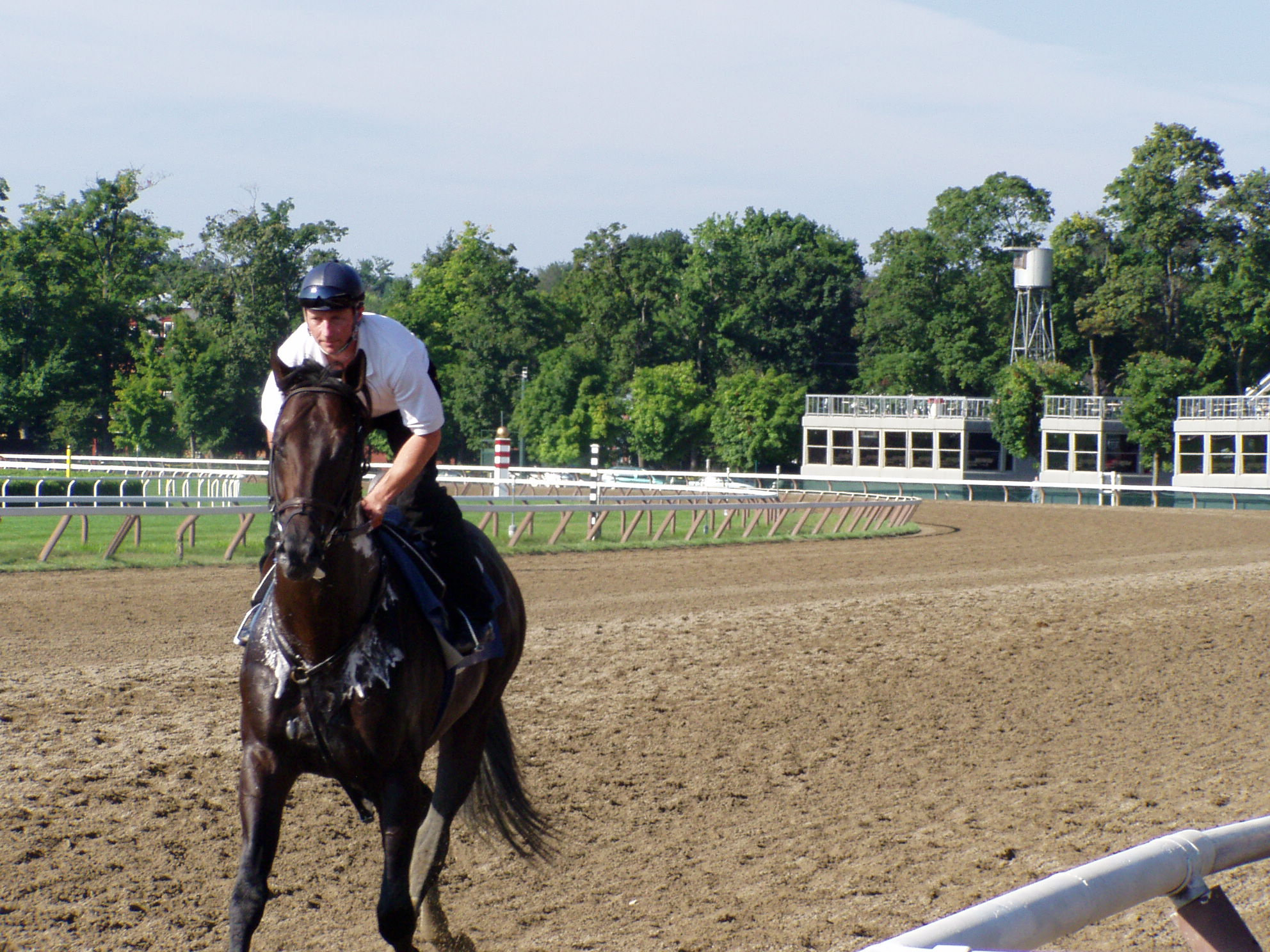
I wasn’t interested in winning really, I just adored the characters behind the scenes; the speaker calling out the race, the girls leaping out of their seats and kissing their betting boyfriends, the waiters in tuxedos serving salads, and champagne, the oldies music, horses, costumes, and the Jockey’s, those little guys who control a two thousand pound animal going thirty-five miles an hour and more.
The next day I took the notes out and wrote a few pages about the track. It wasn’t researched or reported, just the ad-lib observation of a gal with a gangster past. It came so easy, it was like writing about a familiar subject. Rudy read it and said to send it to the local newspaper. I fought him a few rounds, and then finally succumbed to the idea of publishing my writing.
A few days later the editor called and asked me to submit more pieces… and he’d pay me twenty-five dollars a column. He mentioned I’d have a press pass to go to the track galas, and write about the track. I got off the phone feeling empowered and drove to Office Depot to buy a tape recorder. I’d just finished reading the Damon Runyon stories, and so I thought, here’s my chance. I started taking morning runs around the track when the horses are warming-up. It is one of the most exhilarating sensations, to see that polished hide bursting through the entrance to the track, nostrils flared, lips crunching the bite, and those burning brown eyes pointed to the track. In the afternoon I walked around the track with my press pass and knocked on barn doors. The reception was immediate, yes, they would love to be interviewed. So I spent one whole summer writing about the Del Mar Race Track, and didn’t bet a dime. I did begin more research into the horse-racing industry and was eager to see a movie about this spectacular sport. Seabiscuit was a treat because I attended the Premier in Saratoga Spring’s, NY and met the trainer’s grand-daughter. Now I am looking forward to LUCK, premiering this month on HBO.
Sixty-four years have passed since Ben Siegel was murdered, and my father stood in the Beverly Hills police station defending his innocence. I am the link to his truth.
Last week, I received an unrecognized e-mail. It was from a relative of Mr. Robert’s; who was a friend of my father’s in Houston. I met Mr. Roberts on a business trip to Houston back in the 70’s, he pulled a royal flush in the oil business.
This relative discovered one of the Smiley’s Dice memoir columns. He wanted to share some stories with me, and so I responded I would love to hear them. A few weeks later, Susan, a former classmate from Emerson Junior High, sent me a link to a New York Times feature, “Looking For My Father in Las Vegas.” Susan suggested I read it, get inspired, and go back to my own memoir. A week later, I received two DVD’s in the mail from a man I never met. A friend had informed me this man was on a synagogue lecture circuit, and that his subject was Jews in Sing Sing Prison. He was using Ben Siegel and Meyer Lansky as models in his presentation on genealogical research.
The DVD’s went into the drawer, and only recently, I pulled one out and played it. Ben and Meyer were used as subjects to add humor to his presentation. Everyone in the audience laughed at his Siegel/Lansky anecdotes. I ejected the disk, relieved Allen Smiley was not part of the presentation.
In the middle of reinventing a new life, having placed my memoir in a trunk in a storage unit, so it will not be visible or even accessible, the memoir haunts me. A story that has to be written cannot be hidden. About a month ago, a pastor wrote to me, and related this story:
“I am pastor of a church in L. A. I have studied the mob for years. I ran across your name as I studied about your father that night on Linden Drive. I have been approached by a man who claims to have knowledge about who killed Mr. Siegel. The guy was a right-hand man of Mickey Cohen.(and claims Mickey told him). Well, I wondered if you had any preference on the theories that have been put forth. What stories you must have to tell. God Bless you and yours.”
What am I supposed to think? Did the killer confess in his church? This brings to memory another letter I received about a year ago. The name mentioned in the letter was one I had hunted for many years. Harry Freedlander was discovered back in 1995 in the pages of my father’s testimony before the Immigration and Naturalization Service. Harry was a friend to my father back home in Winnipeg. They were childhood chums. When my father stowed away to Detroit, he wrote letters to Harry who informed my grandmother of my father’s travels. A few years later, Harry joined my father in Detroit and began working in the automobile industry. I remember Harry stating to the INS officer that he was very close to Allen’s family.
When an e-mail arrived from the grandson of Harry, the letter remained on the screen for a long time. Truths revealed by government documents, informants, and books are harsh on my father. The companions, friends, and associates are the ones who give me introspection. The grandson remembered hearing stories about my dad, and he wanted to know more about his grandfather. I told him that his grandfather had testified in court to their early friendship. Harry said my father stopped corresponding after he was in Los Angeles.
Several books were released this year with references to dad. The first book arrived compliments of the author, who interviewed me in 2003. I’d forgotten all about it. In Gus Russo’s “Supermob: The Story of Sidney Korshak,” Russo referred to my father in an incident in 1988, with attorney Robert Shapiro, and a lesser know Las Vegas club owner, Gianni Russo, no relation. According to Gus, Korshack told Gianni to see my father in his penthouse apartment on Doheny Drive, after Korshack shot someone in his Vegas nightclub. This is highly impossible, since my father passed away in 1982, and had moved out of the Doheny Towers several years prior.
Throughout the year, I am jabbed, teased, and taunted by the ruminations of strangers on my dad. I feel protective of his legacy. I feel protective of Ben Siegel too. It is part of growing up with gangsters.
Last month, a man who had given me the very first insight into my father passed away. I never met Ed Becker in person. We corresponded regularly. I found my journal marking the first entry of our correspondence. Ed guided me through the labyrinth of half-truths and myths. Without his perspective, the story was all trumped-up headlines. Ed Becker was the one man I could always turn to when I was tangled up in truth. It appears growing up with gangsters is still a work-in-progress.
I was thirteen the summer I moved into my father’s apartment in The Doheny Towers. My mother just died, and my father had weird habits. I didn’t understand why suddenly I had to ‘behave like a lady.’ It seemed like yesterday that I was running with a pack of friends up and down the hallways of the Hilgard House in dripping wet swimming suits, while Mommy was barbequing hamburgers on the balcony for all of us.
My father wasn’t prepared for a teenager; I had to grow up quickly, or pretend I was grown up. I sat on my bed in my new bedroom looking at the drapes. They matched the lime green and royal blue crushed velvet bedspreads. The drapes and spreads were so heavy I could barely lift them, and when the drapes were closed, the room was so black I couldn’t see my feet. My father had the room decorated by a friend who owed him a favor. Friends were always doing us favors.
Every morning I opened the drapes, and wrapped them around my body, pressed myself against the glass, and watched the Hollywood sunrise. Some days there was a coating of thick brown paste that hung over everything. Other days, after a rainstorm, or in the aftermath of a Santa Ana wind, all the soot dispersed. The colors splashed across the Spanish tiled roofs, palm trees, the big dreamy Sunset Boulevard billboards, and the crystal sharp edges of the San Bernardino Mountains. The East was my favorite view from the 12 th floor; because I didn’t know what was out there. It got me to thinking a lot about the East. The farthest I’d been was downtown Los Angeles to the Good Samaritan Hospital.
My father ran back and forth in the apartment barking orders to house maintenance, decorators, and telephone installers. He was adjusting things–furnishings, phone lines, new locks on the door; and he was removing guarded personal items. As I observed all this preparation, he kept telling me, ‘everything’s going to be all right, he has everything in order, new phones, more hangers, food in the refrigerator.’ I had no idea how many adjustments my presence required. Thinking back now, I know he was trying to erase any evidence of gambling, or mafia activities.
My father’s apartment belonged to him as a bachelor, and we did not fit together comfortably at the dining room table because it was really a card table. The hifi ensemble was polished mahogany wood with gold leaf trim. My father liked gold; it seemed to frame everything in the house, even the silverware. I ran my fingers along the corners of his record collection to see whom he liked: Frank Sinatra, Peggy Lee, Johnny Mercer, and Tommy Dorsey. The records were in perfect condition and I wanted to play them.
“ I spent all my life in night clubs with music–I can’t stand it in my home. You can play the stereo when I’m out.”
“When were you in nightclubs all the time?” I asked.
“What? Don’t be concerned with my life; concentrate on yours.”
From our terrace facing west, the view was organized beauty. Every thing was in squares and straight lines in Beverly Hills 90210. I liked to sit on the terrace and look out; imagining all the lives going on at once. Every time I sat down, my father asked me to come inside and do something. He didn’t like me sitting on the terrace, exposed and vulnerable. When he came in to say goodnight, he reminded me to close the drapes. The drapes pestered him all his life; ever since the night the bullets shattered the glass of Benjamin Siegel’s undraped window.
I loved my father’s shadow in the door before I went to sleep. He blew me a kiss, and said, “Sweet dreams my little girl.” He liked me being a little girl at certain times.
I came to live my father in 1966, when he was fifty-nine. He wasn’t active int he oil business, but he received royalty checks every month . He had tiny gold oil-well paperweights on his desk. When his checks came in, he showed them to me and said, “That’s royalty income from my oil wells in Texas.” I heard him talk about his friend, Lenoir Josey, who sponsored him in business. Josey died the same year I was born, but my father wanted me to know the name–Lenoir Josey. I was proud to fill in “Oil Engineer” as my father’s occupation on school applications. None of my friends had fathers in the oil business. I imagined my father was very rich.
When he left the apartment, I studied his possessions. He had a black-and- white photograph of my mother hanging on the wall above the couch. It was one of those glossy modeling photographs that she had hidden from us. My father told me it was published in the newspaper, an advertisement for Bullock’s. After inspecting my own reflection in the mirror, I considered myself adopted. At thirteen, I was flat-chested, with thick frizzy brown hair that I continually tried to straighten, long shapeless legs, and braces on my teeth. My lips quivered when I was forced to smile, and my eyes were so light that the sun bothered them. I despised the way I looked.
There was a swimming pool on the roof garden of the Doheny Towers. On the weekends, a lunch counter opened and served hot dogs and hamburgers. Every Saturday my father went up to the roof to swim, and kibbitz with the neighbors. He cheerily demanded that I join him, because he said, “I want to get to know my girl.” I think he wanted me to watch him as he entertained everyone. He told the best stories. Even tough I didn’t understand most of them–the neighbors laughed like they do on television shows when the applause sign flashes on and off. All of them sat around Allen Smiley and listened. Telling stories was my father’s favorite past time.
The throw of the dice this week falls on chapter One. Like any creative endeavor, the work is organic and has a life of its own. A garden doesn’t always grow with your plans; there are seeds that fall outside of the planter. There are disasters that drift though our arrangements and cause chaos. I am beginning to believe nothing ends how we imagine it. A beautiful day is hijacked by a tornado, a child is murdered while taking a walk with a girlfriend, and a chapter runs away from the author.
The desk where I sit and write is engulfed with books files, index cards citing important events, and characters, note pads, FBI files, and outlines. Period photographs are scattered through-out the room to further sedate any intrusion of the present. I live in a cubicle of my parent’s and famous gangsters.
I was writing a lengthy portrayal of Ben Siegel one day and it occurred to me that he had become a major character in my life. He played a role that someone else should have; a noted author, or journalist, or poet. Ben Siegel changed my history because I had to learn to love him. Learning to love him, meant erasing everything I had read or heard. It is said he was a ruthless killer, a savage, violent, and he loved to kill. I turned my head to look at a photograph of my mother. I was told that she loved Ben too.
Where once I believed my mother was naïve and uninformed about Ben; now I know this wasn’t the case. She knew from the beginning. I‘ve read the news articles of the day, the columns, and I’ve spoken to people who were there. My mother traveled by train to New York with my father, Ben and Esta, and the FBI was in the next compartment. My mother fit into this strangely singular and controversial group of people. A long stemmed Irish Catholic beauty, an original John Robert Powers Model with a future on stage, in film and in print was friends, very close friends with the wives of Ben’s group. I see her in the full frame of who she was, and not the imaginary mother. I like her this way because it reduces the outrageousness of my former years.
Why I continue to seek answers and probe into their lives is because they never told me anything. Children feel the repression of truth as clearly as they do the pain of bruise. The more you hide the more they seek. At my root is the inclination to question the world around me, and to mend the breaks in our lives.
Along the way of the first chapter, I discovered that people like to know how it works, how we write in a state of solitude and selfishness. It seems unnatural until you pick up a book. While a story is moving through the author, they or at least I refrain from answering the phone, checking email, or listening to the voices downstairs. A story or any work of art lives in the artist, it sounds sort of spooky, but that is how it feels to me. So when intrusions come, these disturbances are exaggerated into surrealistic proportions.
I could easily write about the life of the hotel across the street, the many characters that take care of the guests, and the grounds. It would be an easy writing assignment because I am not related to the hotel. But writing about your parent’s, the people who introduced you to the world is like grinding down your memories from stone to powder, and then picking up each grain and examining it’s meaning.
At the end of the day, as other lives intersect with mine, I see people engaged in human activity, the stimulation of common interest comes from living among people and their needs. In writing you interact with your head. The narrative is like water; it can run smooth like a river over all the rocks and debris or it can break into a million bubbles and lose everything.
When it breaks apart like a wave on the beach, you begin again, and the erosion of impatience and self-doubt allows you to continue.
It began last week when I received a phone call requiring me to go back to Los Angeles.
The next day it snowed in Taos. I walked around town on a deserted Sunday morning, just wandering through museums and garage sales. The absence of signs, people, cars, and signals lent the mind a transparency of thoughts. All the things you want to think about are set free.
I looked out at a distant field, scrubbed clean of grass and trees, now just a brown paper bag laid flat. The chill urged me to keep walking, so I continued past the little adobe homes, listening to the barking dogs and the sound of church bells.
It occurred to me on this walk how unfamiliar I was with my surroundings, air so clean it hurt to breath deeply, traditions so ancient they only can be known by ancestral storytelling. I was thinking of how it feels to walk on the sand on a winter day.
The next day, as I crossed over a Southwest Airlines flight to the threshold of LAX, the sounds of silence suddenly exploded into a symphony of discordant blurbs. The Rolling Stones were playing at one kiosk. The television displayed a CNN broadcast. A football game was blaring from the bar, and everyone’s lips seemed to be steadily moving into a cell phone microphone or headset.
The clamp went down, and I was swept into the dance of the talking heads. It’s a familiar homecoming, more familiar than I had suspected. All at once, I recalled the many times my father picked me up at LAX.
I could see him standing in an expectant crowd of awaiting arrivals. He wore those big dark shades and dressed in a suit. He collected my carry-on bag and we rushed down to baggage claim. I did not understand why we were rushing or why he wouldn’t come with me to the baggage claim.
“Meet me out front,” my father said, “just hurry up.”
I asked: “Why are we rushing?”
“Because I said so,” my father said, taking off in long strides, never running.
After I retrieved my luggage, I met him out front. He drove with a peculiar, hunched suspicion, halfway leaning over the steering wheel. It was very recognizable. He never listened to what I was saying. He was too busy looking in the rear view mirror.
“Aren’t we going home?” I asked.
“What?” he said. “What’s the rush to get home?”
“No rush really,” I said. “I just wanted to call some friends.”
“Yeah, well, aren’t you happy to see your Dad?” he said.
“Yes.”
Then, he said something like why you don’t act like it, or lectured me about my outfit, or how my hair looked uncombed. We drove to some delicatessen off La Tijera Boulevard and he’d leave me in a booth with a corn beef sandwich. I was used to being left in delicatessen booths. It was part of growing up with gangsters.
I was not aware of the FBI airport task force. They assigned special agents to sit at the airport and wait to see whom my dad was meeting. When a member of the Mob came to Los Angeles, my father would greet them. They counted on my dad to make all their arrangements.
The FBI knew when Dad was going to the airport because of constant on-site, and telephone surveillance. Dad knew they knew because he had an inside source at the Doheny Towers where he lived.
The source alerted dad when the FBI were parked out front. Sometimes, he liked to play practical jokes on the agents. The delicatessen stop was set up so they followed us to a public place. After we got there, the agent had to sit in a hot car in the parking lot, and wait for us to leave. My father would detain the agent for hours.
As those memories filtered through my mind, I walked outdoors into the path of taxis and limos at the airport. I wondered if the FBI still had a mob task force. It seemed so long ago, so out of proportion with the security measures against terrorism.
That day, I landed at LAX. The sky was underlined in brown. The smog smear made the San Bernadino Mountains look like warped inventions.
I trotted behind SC with my laptop and purse until we were next in line to get a taxi. We shot through the airport tangle of cars, and onto the 405 Freeway. When we passed the exit to La Tijera Boulevard I was inclined to tell SC one of my LAX short stories. Instead, all that came out was, “La Tijera Boulevard.”
“What about it?” SC asked.
“I used to go there with my Dad,” I said.. The story was mine, and I was retelling it to myself as we drove along, amongst the cars, the trucks, and signs of Los Angeles. We can read from our own short stories in all kinds of weather and they can be very entertaining.







 ADVENTURERS IN LIVINGNESS