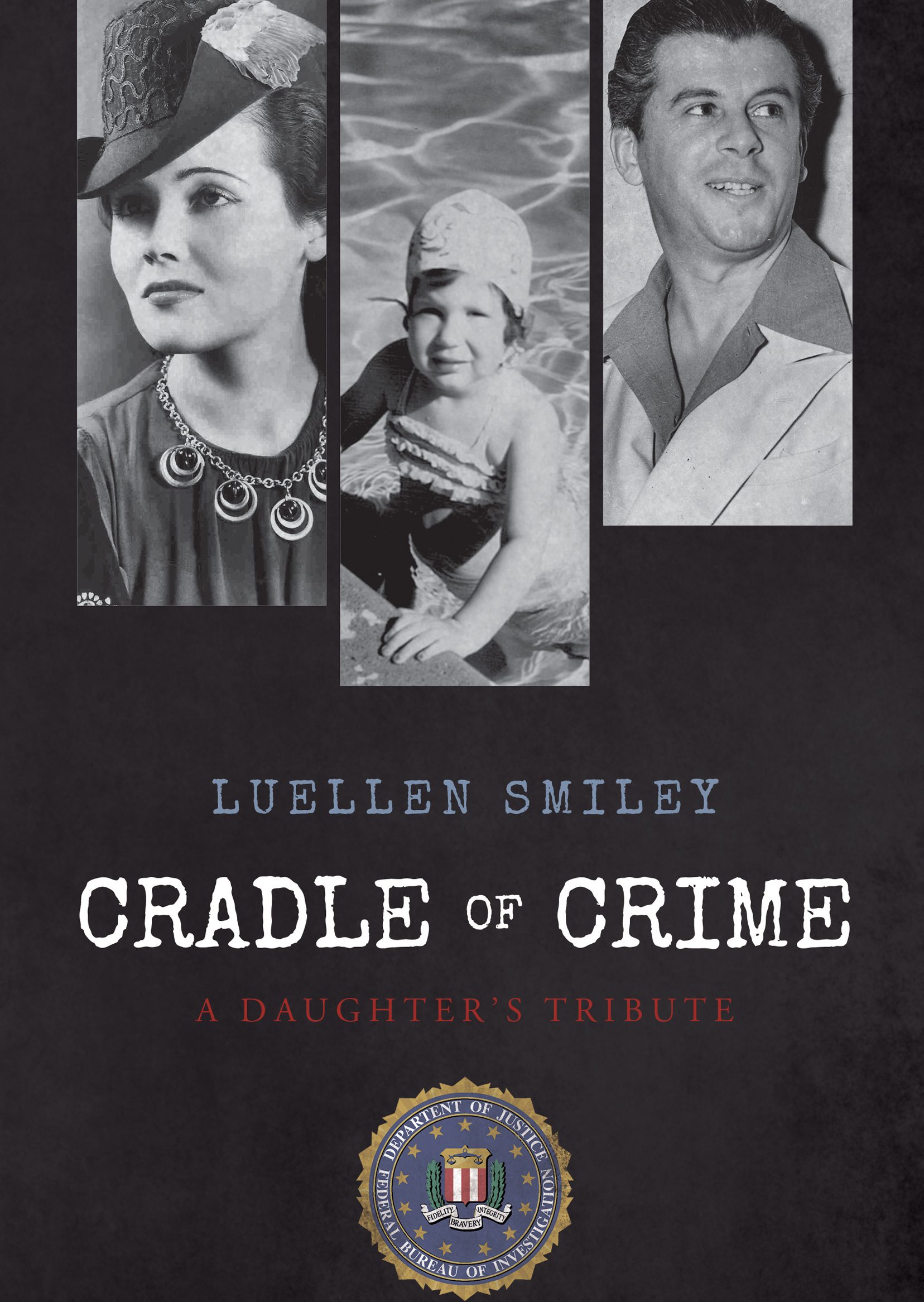
Title: Cradle of Crime Author: Luellen Smiley Print Length: 264 Publication Date: November 19, 2016 Sold by Amazon Digital Services LLC Language: English Formats: Paperback, Kindle Goodreads Genre…
Source: Cradle of Crime #BookReview

Title: Cradle of Crime Author: Luellen Smiley Print Length: 264 Publication Date: November 19, 2016 Sold by Amazon Digital Services LLC Language: English Formats: Paperback, Kindle Goodreads Genre…
Source: Cradle of Crime #BookReview


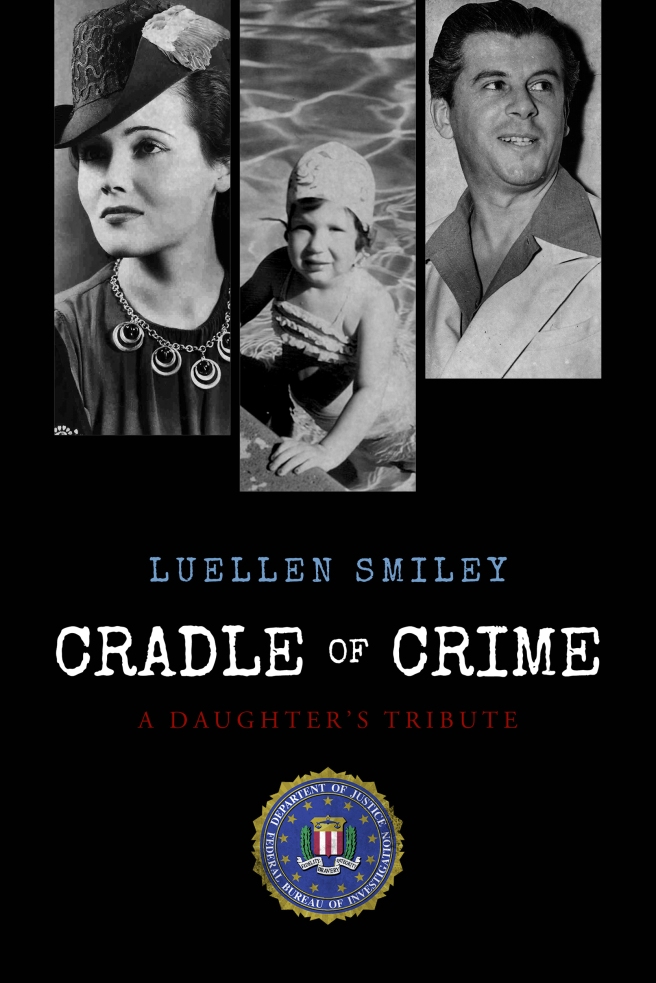
This eye-opening memoir, twenty years in the making chronicles Luellen’s journey into her father’s criminal past, beginning ten years after his death in 1982. Luellen is the daughter of Allen Smiley – Benjamin “Bugsy” Siegel’s best friend and business partner for ten years. Allen was seated next to Bugsy the night he was murdered. Luellen discounted her father’s Mafia association until she was forty years old. Awakened by an identity crisis, she cut through her silence and used government surveillance records, newspaper articles, and FBI files to discover her father’s legacy.

La Posada de Santa Fe, a Tribute Portfolio Resort & Spa
330 East Palace Avenue
Santa Fe, NM 87501
 Here’s the link on Amazon.www.amazon.com/dp/1537456032
| Luellen Smiley (folliesls@aol.com) sent you this via Amazon |
|
|
|
|
SOME OF YOU may have already seen my announcement on Facebook. For those that have not, my memoir CRADLE OF CRIME- A Daughter’s Tribute, is now available on Amazon in the USA, Canada, and the UK.
I began writing my way home in 1996.
If you choose to read I’d love to hear back from you!
SEASONAL AND SENSUAL OVERTURE TO REVERIE.
SUMMER is not a memory yet; my skin too sensitive, and my heart still attached to the moments. I’ve misplaced my journals and so I have to read my to-do list to recall the events. Let’s go back to June; well my head was bent like a candle wick in this memoir. By then I was into the first rewrite, the worst of the next ten. That first one is deceivingly promising, the chapters line up, the suspense tickled, and it was five-hundred pages. The first draft was actually two books, as I dared to try and run the 100 meter in two different directions.
I must have had some standout memories, but I don’ recall June being amusing. Writing about my deceased parents was not summer reading. A year had already passed since I began, and I was now at the last stretch. My sense of completion was annoying. I began to hate the word focus. My body ached for water, in any form, a pool, a river, and the ocean. June was also the month when rejection letters arrived. For a moment, I’d forgotten. Whoa! Stay away from LouLou, her nerves are visible! On the flip, it was also acceptance of those letters. I had to prove to myself that I could take it, and continue writing.
Outside my window, Palace Avenue raised to motorcycles, skateboarders, conversational bicycle riders, and families out for a walk. My concentration was beguiled. So I turned on the fan, the loud kind that screens the room in a hum. I tried to imagine as waves just after they have capitulated into bubbles.
Memorial weekend was gemstone sunlit of color and clarity. I’d decided to break and go to a party at La Posada. Yes, that was my first grasp of summer, the sudden appearance of flowers, greenness of the landscape, flowers, and light. I think it was warm enough to sit outdoors all night. We were not yet ready to kick and scream, it was more of a real memorial kind of party. For our troops who finally are reaching us through the news, the films, and the books.
Most every evening I’d walk across the street to La Posada, have a glass of wine while listening to the chattering guests, age-out themselves by immobilizing a very liberated and young spirit. It’s a beautiful sight. Most people in my experience, come to Santa Fe and strip 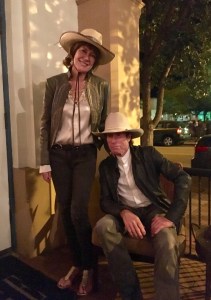 down to vulnerable. They invite conversation and are genuinely interested. I am asked, ‘What’s it like living in Santa Fe?’ To be continued.
IT’S UNLIKE ANY OTHER CITY I’VE EXPERIENCE.D It’s called the city different, it is also the city difficult. She ( I see Santa Fe in the feminine gender) has to be treated gently. Her weather patterns resemble a menopausal woman,her stature demands respect, and she can be congenial and patient.
You can walk this city as if it were a neighborhood. If you do that consistently you’ll meet people, and get to know them. Unless you’re like me, a standoffish fast walker dazed by the outdoors.
If you’re dazed and illusional you can master this city very well, as the drowsy pace and cordiality allow freakish freedom. I ‘ve seen the liberating soul of Santa Fe, teenagers racing down the middle of a commercial street one foot on the skateboard, bad-ass bikers talking with bad-ass cops, women with parrots on their shoulder, dogs in baby carriages, cats in a bag, and women on horseback galloping up Palace Avenue.
At night you’ll see raging midnight ramblers dancing on the sidewalk, and all of this is appealing to an LA transplant. I have driven in my robe, danced in the street and broken the heels on most of my shoes because of the pot-holes. They are always working on a street, but never the sidewalks. I ‘ve been bounced out of the locals night-howl El Farol for accidently pushing a dancer, who knew the manager, who came running after me and took down my license plate.
So many of us are loners, the serious kind, that have to be rigged out of our nests. Luckily I live on a commercial street and have no choice but to be commercially friendly. After nine years, my seasonal behavior is obvious: sprite in summer, blissful in fall, giddy in spring, and withdrawan in winter. I’ve learned patience, understanding, and adopted a mixture of cultural traditions. I’m close to fifty percent certain I’ll miss Santa Fe terribly when I do leave.
Has living in Santa Fe given me more than I’ve given back? Yes, it has and that’s why when I’m asked what’s it like living in Santa Fe, I try to reveal the blessings here and not the bullshit. 
The sunlight shatters the curtain-less bedroom window and burns into my eyes at daybreak. From this unsheltered spot I rise to see a pot of blue sky over the rooftops, and the expectant afternoon showers building up in the clouds. The sky is filled with crows, eagles, and magpies lingering overhead weightless and free-falling, beyond all of us caught behind electronics. The days filled with desert showers that drench the soil and turn the arid dry land green and lush. For this I am thankful. At the end of the day, I am inclined to sit in the courtyard and watch the sky manifest colors unmatched by any Dunn Edwards collection. By the time dinner is topical, I have substituted preparing food, to just snacking, This August underscores the need to sit down, to sort of bob my head to Nancy Wilson music, and do very little. I’m self publishing Cradle of Crime- My Father, Me, and the Mob. 
The memoir began as a compass to my father’s secret and disreputable criminal history. It pointed to a young girl whose survival was wedged between shameless love and immobilizing fear of her father.
As Benjamin “Bugsy” Siegel’s best friend and business partner from 1937 until his death in 1947, Dad acclaimed Ben Siegel. “He was the best friend I ever had.”
Dad sat inches from Ben the night he was murdered. Why did he survive? He ducked! After convincing Meyer Lansky and Frank Costello he would not accept immunity from deportation, and five counts of claiming false citizenship, the Mob honored and protected him.
Faced with an identity meltdown ten years after Dad died I implored his friends, associates, historians, the Freedom of Information & Privacy Act, the Immigration and Naturalization Services, and the Archives of the Department of Justice, to build the branches of my family tree. Along this irreversible journey I suffered disgrace, rage, and Dad’s ghostly disapproval as I delved into the FBI files and discovered the family secrets. Most startling was not his gambling addiction, criminal activities, or imprisonment. I learned my father’s attempt at reformation was thwarted by the FBI. A vendetta by Hoover for not cooperating as an informant. I expose what I’ve learned because I’ve made the family history mine.
Incorporated within stories of discovery are government surveillance records, newspaper articles, court testimony, and criminal activities that defamed his reputation and our family. As the discoveries occur the reader is taken inside the transformation of my identity. Once liberated from Dad’s paranormal disapproval of my investigation, the book was written.
This is a startling, yet inspirational look inside the struggle of a gangster’s daughter to understand her father’s allegiance to the Mob.
There are reasons to quit and more reasons not to. The one reason that hovers above all is that everything we do in life needs revision. We are never through evolving into more thoughtful, loving, or wise human beings. Every day there is an opportunity to revise your valor and conviction.
Revising the position you sit, walk, talk, judge, form opinions, contribute to your home, friends, partners, and discovering what you’ve learned, dreamed, and mastered, is your novel. How to write a chapter when you feel caught; trapped by decisions that are outdated. Antiquities of a former persona.
Changes in life are like photographic images. Looking at old photographs and what I see is someone else. Some are recalled with approval and others are works that led me astray. I’m not alone. Life is a runaway that we have to catch for ourselves.
The puzzle is how to live, where to live, and for whom. It is the same with manuscripts; they improve with each revision.
Our family histories bled through the second generation. Passed on by fathers and grandfathers; a convergence of contrasting truths now seated next to each other on a velvet ottoman in the Mob Experience. Years of distance was shattered, and we can talk to one another, and admire each other’s families;

with the blood and the love. We cannot understand one another if we don’t reveal our personal histories. At some point in life, we rewind, step back into the plot of our childhood, where we were most protected, most attended to, and most loved.
Here’s to you Cynthia, Carl, and Jimmy.
.
SMILEY’S DICE
Growing Up with Gangsters
By: Luellen Smiley
Synopsis
The memoir is written in the Creative Nonfiction genre and is ninety-two thousand words.
Writing my way home began as a compass to my secretive and dishonorable family history. This is the story of a woman whose survival was wedged between shameless love and immobilizing fear of her father.
After my almost perfect mother, Lucille Casey, an MGM musical actress died, Dad gained custody of me. I was thirteen years old. What followed was a nail-biting tumultuous father daughter relationship between Allen Smiley, a Hollywood gangster, and his teenage daughter, that I’ve named Lily.
As Benjamin “Bugsy” Siegel’s best friend and business partner from 1937 until his death in 1947, Dad acclaimed Ben Siegel. He was seated next to him the night Ben was murdered. The fatal outcome was speculation of his involvement fed by the FBI to the media, death threats from Mob associates, and vicious harassment from the Immigration and Naturalization Service.
I’ve learned by this time Dad had amassed a weighty criminal record, was under indictment for false claim of citizenship, perjury, and an order of deportation. After demonstrating to the Mob he wasn’t going to seek immunity offered by the government; they honored and protected his life. Their methods are described in transcripts from the FBI files; amusing, violent,and illegal. Dad served the organization until his death in 1982.
Faced with an identity meltdown ten years after Dad died I implored his friends, associates, attorney, historians, FOIPA, Immigration and Naturalization Agency, and Archives of the Department of Justice, to build the branches of my family tree. Along this irreversible journey I suffered disgrace, rage, and Dad’s ghostly disapproval as I delved into the files and discovered the family secrets.
Simultaneous with the reading is a dissection of my reactions to his criminal activities, gambling addiction, attempt at reformation, and hatred for the government. The vendetta the government placed on him for not informing earned my mother’s silent devotion. In the end they won. She divorced him.
I could be mute about the subject, or expose what I know because I’ve made the family history mine.
Incorporated within stories of discovery are government surveillance records, newspaper articles, court testimony, and criminal activities that defamed his reputation and our family.
As the discoveries occur the reader is taken inside the transformation of my identity. Once liberated from Dad’s paranormal disapproval of my investigation, I break my silence and begin writing columns about growing up with gangsters. This opened the doors to unknown relatives, mob friends, and an identity that suits me well.
A startling yet an inspirational look inside the struggle of a gangster’s daughter to understand her father’s allegiance to the Mob.
Excerpt from Smiley’s Dice.
I don’t know how much more of this I can process. I don’t feel Dad’s disapproval as strongly; this expository involving my mother is deepening my resentment for the government. This is just one binder of two-hundred pages, and I have fifty binders. I’ll rearrange my dresser drawers or hand-wash sweaters for awhile. It’s too early to have a glass of wine! Two days have passed, as my resistance to more reading of these FBI files was due to a suspended state of melancholia.
April 13th- FBI file
“Smiley received a call from —— and told Smiley that he was thinking of going into business with —–who is making twelve thousand a month putting on stag shows. Smiley told him not to get into the business. —told Smiley that he had attended a ball game and noticed that George Raft was there. Raft is now sporting a mustache and his cheeks are all sunken in, making him look like a drowned rat. Smiley did not like this comment.”
“____ asked Smiley how his case was coming along, and Smiley replied,” They are going to ship me to Singapore”
After the forgoing call was made, the conversation continued concerning _______ between Smiley, paramour of Jack Dragna, and Lucille Casey. While Casey was getting ready to go out to dinner, this unidentified woman, became very cozy with Smiley, according to the informant, and stated,
“ Take my advice and don’t talk on the telephone. You can sit right here and they can listen to you from over that hill. I know this because we have been on the other side all the time.” Smiley replied he had an idea of that and she remarked that Smiley was a good guy, and she thought she should warn him.”
Signed R.B. Hood
Special Agent in Charge.
Navigating through my post-work world
Every Day is a Gift!
Entertainment website · Marketing agency · Advertising agency 🎧⽣👠💋
The inner voice where gaps of expression are liberated.
Funny Blogs With A Hint Of Personal Development
Become a Story Hunter!
It's just banter
Larry Harnisch Reflects on L.A. History
Escaping reality or facing reality.
Saratoga Springs, New York - Arthur Gonick, Editor
Space, Travel, Technology, 3D Printing, Energy, Writing
Live Your Dreams Don`t Dream Your Life
Even a bad guy can have redeeming qualities
Books and Lifestyle with Hermione Flavia.
KNOWLEDGE IS POWER / IGNORANCE IS BLISS - YOU DECIDE
Navigating through my post-work world
Every Day is a Gift!
Entertainment website · Marketing agency · Advertising agency 🎧⽣👠💋
The inner voice where gaps of expression are liberated.
Funny Blogs With A Hint Of Personal Development
Become a Story Hunter!
It's just banter
Larry Harnisch Reflects on L.A. History
Escaping reality or facing reality.
Saratoga Springs, New York - Arthur Gonick, Editor
Space, Travel, Technology, 3D Printing, Energy, Writing
Live Your Dreams Don`t Dream Your Life
Even a bad guy can have redeeming qualities
Books and Lifestyle with Hermione Flavia.
KNOWLEDGE IS POWER / IGNORANCE IS BLISS - YOU DECIDE
 ADVENTURERS IN LIVINGNESS