


Maurice did things for us that no one had. It started with small gestures, like inviting us inside every time we passed by his house. Even if he was on his way to deliver furniture he’d scuttle to the kitchen and give us homegrown tomatoes, and oranges, or hand me a bouquet from his flower garden. These were the early years of my story submission rejections. I was so consumed with rejection that the only person in the world that made me feel human was Maurice. He didn’t understand what my torment was about, but he knew how to make it go away. Sometimes all it took was a big hug and a kiss. Maurice always met me with a hug and kiss, though I didn’t realize at the time how much he knew what I needed.
That Christmas I felt the spirit because of Maurice. I went to Sav-On and collected a basket of decorations, and though we had no room for a tree, I did what I could. Instead of wishing I could dash into Nordstroms and shop like a madwoman, I dug a little deeper and searched for appreciation gifts for friends.
By the time the season had ended, I was fixated on Maurice. It is strange to write about him now. The story I wanted to write was about Del Mar, and Solana Beach, California during the thirties and forties. I searched the indexes of the Del Mar Library and the local bookstores and shared the antiquities with Maurice.
We were sitting on his cushy pillowed sofa one evening in 1994, sipping chilled southern comfort, and snacking on saltine crackers and cheese. There is always a subject of interest with Maurice. He is seventy-five years old, lean and tough as a stalk of corn, with blue eyes that twinkle even if he’s not in the light. His wealth came from the uniqueness of how he lived.
“Tell me what you remember about Del Mar.”
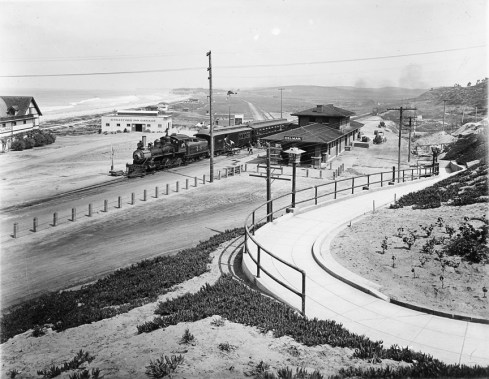 Old Del Mar.
“Oh so many good times, not like it is today. I knew just about everybody, we were like a family.” Sometimes Maurice shared memories while driving around Del Mar and Solana Beach. Suddenly he would start talking, and I’d would listen with childlike curiosity. I recall one evening at the old Cilantro Restaurant while having dinner with Maurice. We sat at a table facing the Rancho Santa Fe Polo field. Maurice began to tell me how it used to be. 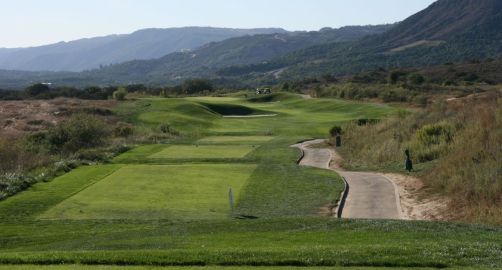 Rancho Santa Fe
“I used to plow those fields there, all the way up to where the hills begin. I worked out there all day, and I loved it. That land belonged to the Conleys’. I remember that the whole field was underwater for one year. Hard to believe–but it was.”
“You plowed?”
“Sure I did! I was a farmer, a dairy farmer, and I delivered milk to Bing Crosby and Dixie Lee. I remember Christmas she comes out and gives me some extra money.–I always loved going there at Christmas. They was always so nice to me, you know. The Conley’s had a hog ranch, they were the ones I worked for. The year it flooded from El Camino Real to the racetrack we lost a bunch of pigs and a cow under the bridge. It only happened twice that I know of.”
“ What was Rancho Santa Fe like back then, when you were a farmer?”
“Well, it was different than today, then it was rich people, I mean really rich. I don’t know where they got their money but they had everything–you know expensive cars, cooks, and maids.” Maurice chuckled, “ I couldn’t understand what the cook did all day. The man my wife worked for, Ronald McDonald, he had a butler, maid, cook, and a big house, a really nice house. But today, anyone can live there, people who just inherited a lot of money. There was just a few families back then– everyone knew who they was. One time a young girl who lived up there was stuck on the road–her car broke down, so I drove her home. You did things like that. There were two really well-known families there, the Clotfelters were one, they had a son, Tom. He stopped by my house at Christmas and brought me a fish, he liked to fish. The other big family was Avery, he had everything. He used to get jobs for the Mexicans in the Ranch. Everyone knew him, he kind of ran the whole town, was really active in the community. Another fellow, Joe White, went around to the homes and put in the meters for the water district. We used to play cards with him and his wife, Marilyn– have a few drinks and have a such a good time. ” Maurice stopped and shaking his head remarked that there were so many wonderful people in his life, and how lucky he was to live in Solana Beach.
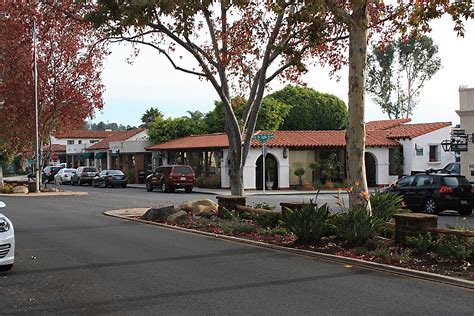
Downtown Rancho Santa Fe.
The Rancho Santa Fe I knew began when I moved there in nineteen-eighty-three. It was a place you heard of right away, and so I drove up to take a look around. Like thousands of others before me, I dreamt of living in the Ranch under a canopy of Eucalyptus trees with a horse stable and a grove of oranges. It was a blissful place to drive on a Sunday afternoon, very few cars on the road and the homes bathed in sunlight. But when I walked down Paseo Delicias, the main road in the village, I felt like an outsider. I did not feel that detachment in Del Mar, or Solana Beach, or even La Jolla. But the Ranch has eyes, it seemed to single you out and therefore no one on the inside made contact with you. You could dine at the charming Mille Fleurs and drop a few hundred dollars but you would not be invited to mingle. I asked Maurice if he wanted to live in the Ranch. His expression was curious as if I was pulling his leg.
“No, I never wanted to live there.”
“Why not?”
” I’m just a regular guy.” To be continued.


Leave a Comment