STILL A MYSTERY WHO SHOT BENJAMIN “BUGSY” SIEGEL .
JUNE 20,1947
Several years ago, I received an email from a reporter in Las Vegas. George Knapp had read some of my memoir posted on my website and asked for an exclusive interview. He asked about my father’s relationship with Ben Siegel “Bugsy” and what I knew about their friendship, and why Ben Siegel was shot. I declined the interview, but George persevered. Three weeks later I agreed to the interview, because my father was not there to stop me.
We met in Del Mar at the Inn Auberge. I showed up with a notepad to remind me what not to say, a photograph of my father when he was a producer for Cecil B. De Mille, and a borrowed calmness that comes when I am approaching an extremely anxious situation.
My first interview about Dad was not anything like I imagined. George approached the subject with respect, and I relaxed and began talking, and talking, and talking. The only time I hesitated was when he asked if I knew who killed Ben, and I had to answer swiftly, “I think Bush did it.” He was not too impressed with the answer; but it saved me from theorizing.
At the end of the interview, I walked out of the hotel without regret. I said what I felt should be told; that my father’s best friend was Ben Siegel. If he loved Ben and my mother loved Ben, than there is a lot more to “Bugsy” than what the public has been told. The interview aired on a Friday night, and my life was no different from before. George got a call from someone who claimed my father once told him, Virginia Hill’s brother was the shooter. It sounds like my father; he enjoyed sending people down the wrong path. He always said, “You don’t inherit friends,” and so I declined to remain friends with family members of his group, because I respected his orders, even after he died.
I doubt any of his mob friends are still alive today. Many people have claimed they knew my father, but in essence, what they mean is they met at Ciro’s, or had a game of cards, or went to the racetrack. My father’s only friends were connected to organized crime. I learned this when he died; three people showed up for the service. He warned me to keep away from reporters, and not to trust anyone. Still, strange incidents followed his death that I was unprepared to handle.
A man I’d never heard of called and informed me, ‘Your Dad and Ben buried a safe deposit box in downtown Los Angeles. You should look for the key, there may be a lot of cash.’ My father was not about to leave this world without telling me he had stashed money in a safe deposit box. I will bet every dollar on that.
Another man, posing as a friend, came to my aid offering help settling the estate. A few weeks later another man I had never heard of, placed a claim on the estate for an old gambling debt of $5,000. The two of them were conspiring. Had I known gambling debts are erased when the bettor dies, I would not have allowed my sister to sell his Patek Philippe diamond and ruby pocket watch, which I suspect belonged to Ben Siegel at one time. The end of my father’s life was as mysterious as when he was living. That is how he liked it, and that is how he lived it.
I had to wait until my father was in his seventies to go to the racetrack with him. He took me to Santa Anita, we sat in the clubhouse, and he watched the track from behind tinted dark sunglasses. He was quiet and observant. He watched me eat and then handed me a twenty-dollar bill to bet on the Exacta. He told me how to bet and which horses to bet. I walked away from the cashier thinking I would be a big winner. Instead, I walked away a big loser. This was a setup, he picked the losing horses, so I’d get the lesson ” Even your old Dad loses at the track, remember that.’ There wasn’t anything exciting about going to the track, he made sure of that. I suppose he was concerned, that I had inherited a taste for betting. Lucky for me; I discovered Dad’s gambling didn’t pay off. When he was with Siegel in the forties, controlling the wire service he’d bet up to $50,000 in one day. And lose it on the next gamble. I don’t bet on sports, or gamble in casinos. I do gamble on life, and aim for the outlandish, improbable questionable odds.
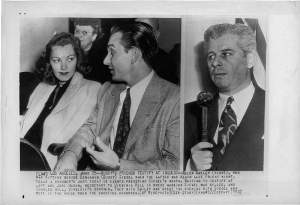
Photo: Leaving Beverly Hills Police Department day after the murder.