
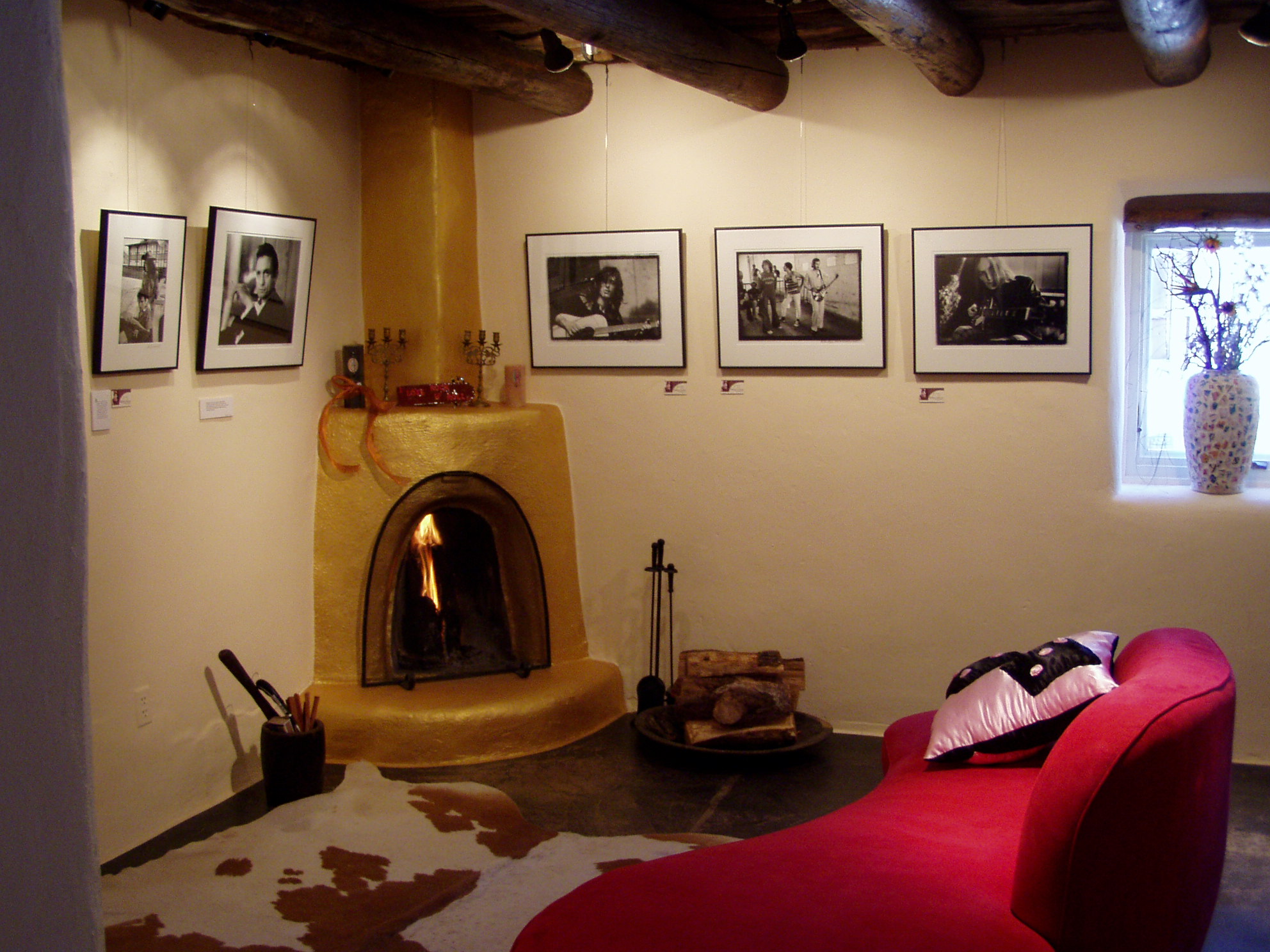
JAGGER PHOTOGRAPH FOR SALE. It is black-and-white and has Mick’s authenticated signature in perfect condition. It is matted and framed and measures 10 in x 11 1/2. For more information, leave a comment.
ASKING $500.00



JAGGER PHOTOGRAPH FOR SALE. It is black-and-white and has Mick’s authenticated signature in perfect condition. It is matted and framed and measures 10 in x 11 1/2. For more information, leave a comment.
ASKING $500.00
I won the 4.5-year lawsuit against the bank’s foreclosure of my Follies House. She will sell at market value. I toast with my FB friends, who hung in as I wedged against impossible odds with your patience and comfort. !!!!!!. The photo is from 2000 when we bought her. An enormous hug to my real estate broker, Scott Varley (aka Superman), and my attorney, who had educated and believed in me when I did not!


SILHOUETTE of a Taos night out in 2006. It begins with the sunset—a bubble-gum pink sash that swirls like taffy just above the distant hillside. The transcending forms and colors in the sky distract me; they silence me, keeping me from turning on the television or answering the phone.

The sunset has settled into my routine. I watch it from the roof garden over our Adobe Home and Gallery every night. In the midst of dressing to attend an art auction at the Millicent Rogers Museum, the sun has vanished. The sky turns Taos blue; a luminous oil pigment canvas blue that appears like an endless tunnel you can walk through. As I descend the staircase and cross over the ménage of piles shoved in a corner to allow SC to paint, I think, “This is going to be my home. I’m still here” Adventures in Livingness
In the courtyard where new flagstone has been laid, and a mud ditch blocks the exit, Rudy hitches me on his back and carries me out the side entrance through Tony Abeyta’s yard. Tony’s yard is piled with sand from our flagstone project, and my high-heeled black suede shoes are not at all practical for crossing New Mexican dunes. This is how the evening begins. Out in the parking lot, we circle around once and stop in Robert’s gallery. He has offered me his turquoise squash seed necklace to wear at the auction. The necklace is from Turkey, and sells for $1,800. Millicent Rogers events always attract women with extravagant jewelry, and Robert knows I have no such possessions. He hands me the necklace and says, have fun.
At times like this, I can forget the faces and routines I lived in Solana Beach and feel swept into a labyrinth of unfamiliar vignettes. There are two police cars in the rear of the parking lot, the church looms like a fortress of wet mud, and SC is listening to The Band CD we picked up in Santa Fe. I slide into the car, ensuring my shoes don’t fill with gravel.
There is very little street light along the desert road, and cars approach you at disarming speeds. For newcomers, the pale yellow line that separates oncoming traffic, roaming animals, hitchhikers, leather-clad bikers, and abandoned pets is of no comfort or value. Boundaries and civilities between people are vague, and sometimes, conversations elope into poetry.
At the Millicent Rogers Museum, the director, Jill, who is there to welcome each guest, greets us at the carved wooden doors. This museum was once a home, like most museums in Taos.Each room is an envelope of Native American jewelry, ceramics, paintings, weaving, textiles, and metalwork sealed with Millicent Rogers’s ethereal presence. By coming to Taos and bridging her New York chic with southwestern individuality, she set global trends in fashion, art, and living. he museum collection includes some of her designs that evolved from her residency in the desert. She moved here in 1947 and died here in 1953. Although she could have chosen anywhere in the world to live, she settled in the unaltered, surreal lunar beauty of Taos.
I wandered through the tightly packed rooms, alternately viewing the guest’s attire and jewelry. The woven wraps, belts, and hats worn by men and women form a collage of individual expression. Almost everyone seems to attract attention by the texture and color of his or her attire. It is a festive traditional look, with southwestern accessories paired with jeans or silk dresses. If you come to Taos, look for a belt buckle, one piece of Native American jewelry, and one piece of art.
When the auction was announced, I admired the same etching as the woman next to me. She remarked that the artist was also the teacher of one of her children. I learned that Ellen had six children and 11 grandchildren. She was petite with curly blonde hair, and I liked her instantly. I told her I was a writer.
“So am I,” she answered.
Rather than talk about her work, she began talking about her daughter, who is also a writer.
“I’m so lucky–all my children and grandchildren are creative and artistic.”
It was obvious that her life was a garden of earthly delights and that she had raised many roses. When the auction began, she vanished, and I quickly viewed the art before returning to the two etchings. They were both sold.
As I was walking out, I bumped into Ellen. She was clutching the etchings.
“So, you bought them,” I said.
“Oh, yes, I had to have them.”
She left me with a beaming smile and a closing remark I often hear: “Welcome to Taos.”
I love hearing that so much I don’t want to stop saying, I just moved here. After the auction, we stopped in Marco’s Downtown Bistro, where we joined an improvisational party. It started when Marco introduced us to his friends, Pablo and Joan, who were visiting from Santa Fe.
The dim, glowing melon adobe walls of the bistro, Marco hugging everyone, Joan’s melodious, high-pitched laughter, Pablo telling jokes, Rudy laughing, and then Philip arriving to tell stories crossed over from strangers in a bistro to a fast-rolling film. The conversation and laughter surfed breathlessly from one person to another.
Joan remarked, “My fifteen minutes. This is the best for me. The first time you meet someone, you’re both talking without effort. It’s so perfect.”
We closed the bistro past midnight. Marco had gone home. Joan decided to stay at a friend’s house. Philip agreed to drive to Santa Fe the next day, and we took Tylenol before bed.
Not every night out in Taos is like Joan’s fifteen minutes, but chances are you will have something to write home about. The beginning of Gallery LouLou Taos, NM




BOOKS FOR SALE FROM MY RESEARCH COLLECTION.
A few book sections are highlighted but otherwise in good condition.

HB $14.00 SB $6.00 + MEDIA SHIPPING. Minimum order of 5.
PICTORIAL BOOKS
From Anais Nin Diaries 1939-1944.
“I respond to intensity, but I also like reflection to follow action, for then understanding is born, and understanding prepares me for the next act.”
JANUARY
SNOW, ARTIC BLAST, ICE, FREEZING. Maelstrom of inconveniences toppling down in every nook and cranny of body, home, and outdoors. I wore a long-sleeved liner, wool sweater dress, rabbit poncho, and over that, a wool wrap, laptop mittens, sherpa leggings, wool socks, and boots. Mornings, eight degrees, afternoons eighteen, and the absence of sunlight grids my spirit. Repetitive lessons in endurance, tolerance, and acceptance. The outer world stenches corruption, propaganda, cruelty, violence, and haranguing reporters. The election year dominates the bunkum reporting.
It’s been almost a month since I texted or called Dodger. Somedays, I enter the memories, a reel of episodes on our cross-country road trips, hiking barren, narrow, unclaimed paths in Baja, mountains and canyons in New Mexico, and lakes and forests in upstate New York. They appear to be aberrations of myself; I am unrecognizable as he is, too.
FEBRUARY
MATURITY has caught up with me, and I am viscerally aware of this pendulum as replacing the nonacceptance of my lifestyle and future to hardened acceptance, which is a relief. I used to be full of follies, gaiety, and impulse; inner choreography is now critical thinking, studied decisions, and a spoonful of distrust. Instead of unleashing all that I think and feel with strangers, the narrative is split between inching closer to listening rather than personal tete e tet. Once a week, I go outing to the social club, where I find conversant strangers, couples, singles, divorces, and a variety of ages, and yet they all have a commonality that I don’t, they seem genuinely satisfied with their lives, one comment this, after asking the bartender how are you, he smiled, slapped the polished wooden bar with both hands and replied, I couldn’t be happier. Then he opened his phone and showed me a photo of a baby boy. His expression soared through my senses, and I adulated with compliments. Another evening, I opened a conversation with a couple next to me, and for the next hour, I learned of their life; children, travel, cruises, especially, ” Oh, you’ve never been on one? You must go, you’re so perfect for a cruise.
” I’m uncomfortable with more than twenty people.”
“ I don’t believe that for a minute.” Wendy was really fit to her name; she wiggled in her seat, her hands never at rest, and her thoughts poured like raindrops. Her husband, Christian, nodded a lot, and when he tried to speak, she ran right over him. A few times, he rolled his eyes at me. They’d been married thirty-five years, looked to be in their early fifties, and semi-retired. I left feeling love, had tipped our kinship, a surprising need to leap from trivialities to more substance.


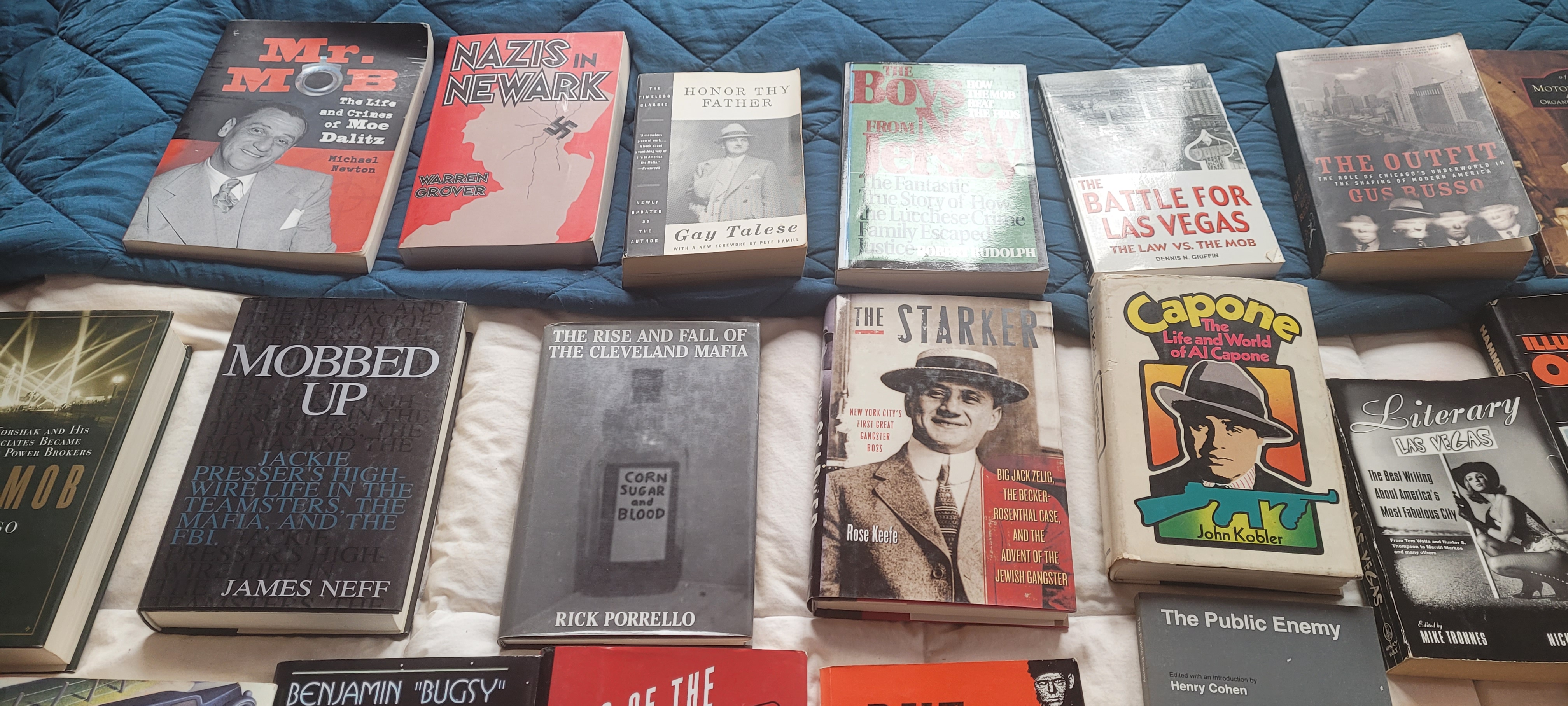
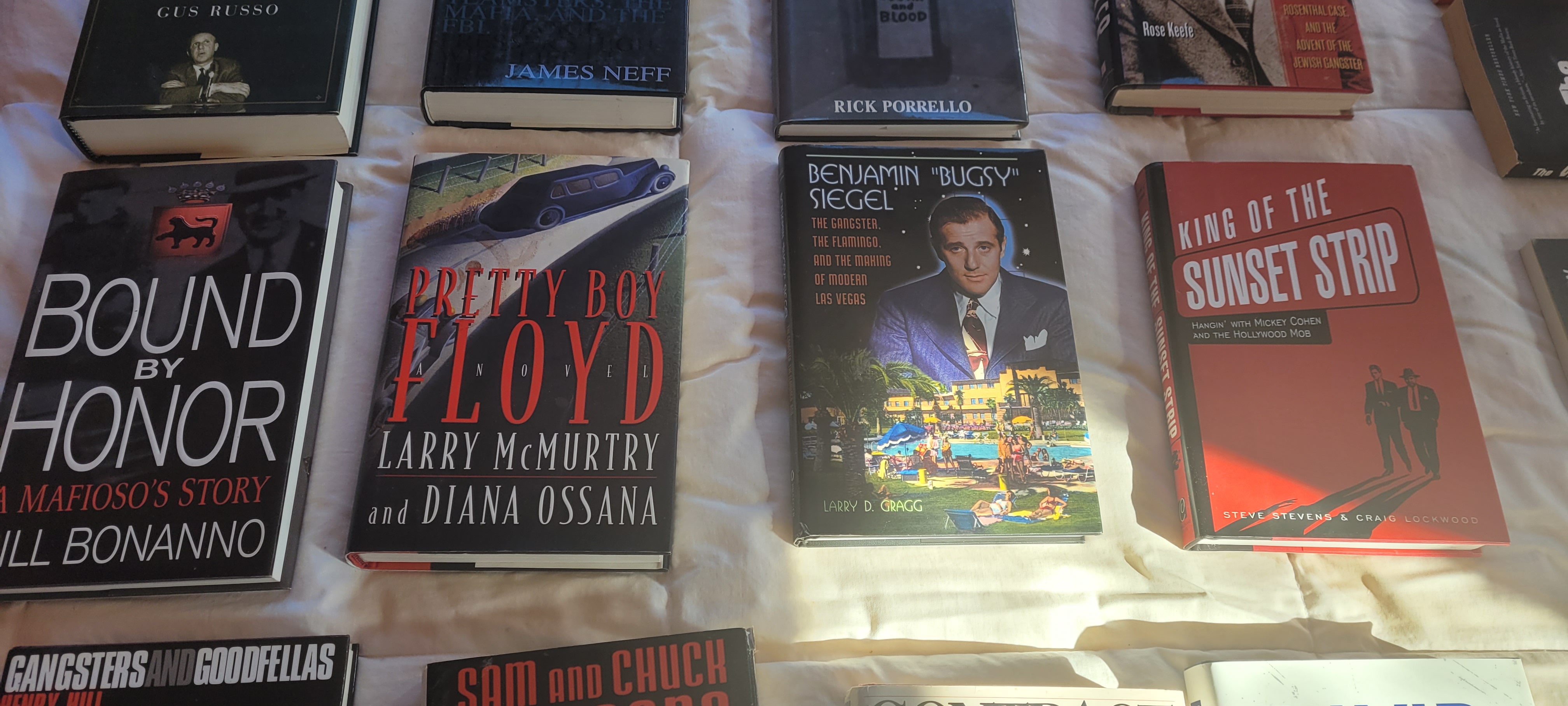
BOOKS FOR SALE FROM MY RESEARCH COLLECTION. BASED IN NEW YORK. PREFERRED SALE OF FIVE OR MORE. HARDBACK $14.00 SB $6.00 + MEDIA MAIL. INDIVIDUAL PHOTOS ON REQUEST.
Luellen Smiley – Some book sections are highlighted but otherwise in good condition. Bugsy Siegel’s book, Mr. Mob & King of the Sunset Strip, sold.
PICTORIAL BOOKS
FABULOUS LAS VEGAS HB – MICHELE FERRARI STEVEN IVES
ORGANIZED CRIME- PLAYBOYS PICTORIAL HISTORY HB RICHARD HANNER
FEBRUARY 3RD 2024 EXCERPT FROM A NOVEL IN PROGRESS
.
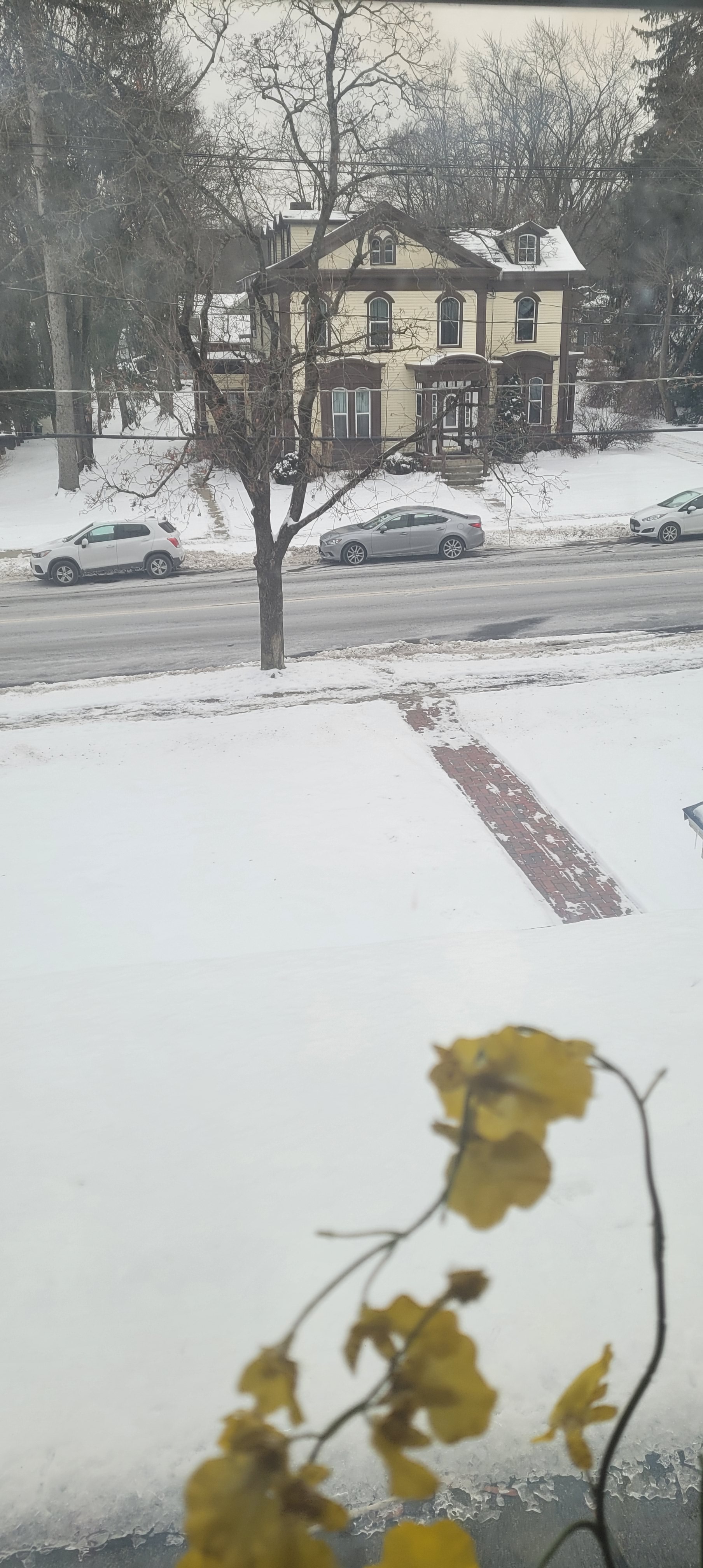
After weeks of metallic gray, the sun broke through, decorating Greta’s room. She is recovering on her bed, floating in Jazz instrumental music, remote in hand and undecided about what to watch. Last night, she socialized at her two taverns’, chatting with Weeds, a man with pockets full, which he offered Greta. For the next thirty minutes, he unplugged a breathless dialogue without inviting Greta, and she knew he was so lit up that he was unflustered when Greta said, ‘ Maybe take a break and eat your food.’ He continued to disentangle his weekly activities, what he thought about the waitress, some local gossip about the bartender who had been fired, where he grew up, and his wife’s battle with lung cancer. ‘ I am so sorry for you both.’ He thanked her and then sealed his tête-à-tête as he ate. Greta took this moment to bid farewell and crossed to the other tavern for crab fritters. The bar was uncluttered, and she sank into the stillness. Her mood flicked into an irritableness, a discourse with the state of her life. The resurgence of the week’s disputes, mishaps, and the approaching day she would be moving, and still directionless. It wasn’t until she was home, swathed in five blankets that she overcame the anxiety until she couldn’t find her phone. She searched all the prominent places, the car, kitchen, entry, and bedroom. ‘ ‘Oh, for the love of God, I left it at the tavern. How humiliating. Maybe I’ll find it in the morning.’ Over the last few days, she has practiced positivity, rearranging her thoughts like a chess board; instead of choosing fear and remorse, she repeated every morning, I’ve come this far; what could be worse than the last five years.
This a refreshing, wonderful story in the fact that I got to see the unfolding of Allen Smiley and Ben Siegel’s story through the eyes of Allen Smiley’s daughter. I got to see the point of view of someone who personally knew Allen Smiley, the other side of him: the family man and her reactions to discovering her father’s past, secrets, and how people viewed her father and the Mafia. To my delight, the author also included journals and files relating to the criminal speculations of Ben Siegel’s murder which helped shape the book’s framework. I felt like a detective myself as I read through the story and found out more and more about her father’s other life.

Excerpt from Robert Rockaway’s book. “BUT HE WAS GOOD TO HIS MOTHER. ”

Another Haganah emissary, Reuvin Dafni, who came to the United States in 1946 to raise money for the Haganah, also met with some well-known Jewish gangsters. Dafni had been born in Croatia in 1913. He immigrated to Palestine in 1936 where he became one of the founders of Kibbutz Ein Gev. In 1940, he joined the Jewish Brigade of the British army. In 1944, he parachuted with other paratroopers behind enemy lines into Yugoslavia and joined the partisans. After the war, he returned to his kibbutz. He did not stay there long. In 1946, the Haganah sent him to the United States to raise funds.
A few months later, the Haganah sent Dafni to Los Angeles. One day, he received an intriguing phone call from a man who identified himself as “Smiley” and requested a meeting. When they met, Smiley asked Dafni to “Tell me what you’re doing. My boss is interested.” Smiley’s boss turned out to be Benjamin “Bugsy” Siegel. Smiley was Allen Smiley, Siegel’s right-hand man.
Smiley arranged a meeting between Siegel and Dafni at the LaRue restaurant. At the appointed time, Smiley and Dafni went into an empty room at the rear of the restaurant. After a few moments, Smiley left, leaving Dafni alone. Soon two tough-looking goons entered and searched the room. When they were satisfied it was safe, they left.
Shortly thereafter, Siegel came in. He sat opposite Dafni and asked him to tell why he was in Los Angeles. As Dafni relates, “I told him my story, how the Haganah was raising money to buy weapons with which to fight. When I finished, Siegel asked, ‘You mean to tell me Jews are fighting?’ Yes, I replied. Then Siegel, who was sitting across the table, leaned forward till his nose was almost touching mine. ‘You mean fighting, as in killing?’ Yes, I answered. Siegel leaned back, looked at me for a moment and said, ‘OK, I’m with you.’ ”
“From then on,” recalled Dafni, “Every week I got a phone call to go to the restaurant. And every week I received a suitcase filled with $5 and $10 bills. The payments continued till I left Los Angeles.” Dafni estimates that Siegel gave him a total of $50,000.
My memoir, published in 2017, Cradle of Crime-A Daughter’s Tribute is old news to me. Not to Charlie. I met him as he was renovating a house across the street. I didn’t introduce myself as Luellen Smiley, just Luellen. I asked if he would take a look at my house for an estimate on painting. He was sweet, a mountain man with a long white beard and hunting boots. Last week, he texted me,” I read your book, my friend and I exchanged Goodreads suggestions, and I told him to read your book.” How did he connect me to my book? I didn’t ask, and now it piques my interest. I’d walk across the street and ask him, his truck is there, so is the ice, and I don’t feel like skating and falling on my butt.
Winter in upstate New York to a gal from Los Angeles is likened to living in the North Pole. Going on five years, my last, I’m not resentful and scouring, but I am not acclimated. Indoors I dress in sherpa from head to toe and wear those finger mittens. Today it is full-throttle rain showers. The street is vacated of traffic and the public, it’s a good day to work on my next book. On my desk are a few writing books, the favorites: Henry Miller on Writing, The Diaries of Anais Nin, and Albert Camus’s The Stranger. I haven’t bought a current book in years, the last one was Sam Shepard, The One Inside. I like Miller’s passage: ” The writer lives between the upper and lower worlds.: he takes the path in order eventually to become that path himself.”
Aging in my seventies delivered opening windows to restoring, rearranging, and repairing my persona, personally and in public. If you’ve read any of my essays, then you know explicit is the vortex that moves my thread. Restoring the brick-and-mortar of truth is at the forefront; the next layer is a confession of what I cannot speak in person to anyone, even my closest pals. The third is abstaining from too swift a pen; I’m always in a hurry: I prepare food quickly, walk as if I’m late for an engagement, and wash dishes with perfunctory interest. Everything when I think about it. I know why that is, my father. His shadow was always behind me as I went about my teenage activities at home, so I rushed to get out.
Last week, I stopped taking the powerful Lorzapam medication for neurotic anxiety. My heart raced when I opened an email from my attorney, when a stranger knocked at the door, or when I entered a public place alone. A new sideways rain shower just filled the window pane above my desk. Here is the fourth restorative: get outdoors! I don’t walk in snow or ice, but good old water rain, which I call God’s tears, is one of my favorite nature adventures.
Admittedly, my writing has granulated since moving here. It is tiny in thought and not always tied up neatly. My persona in public needs to be side by side with wine in a dining setting. What I contribute must be joyous and humorous because one of my favorite human activities is to evoke laughter and smiles. I broke away from my taverns and abstained from alcohol for a week. In the second week, visceral and bodily alarms have gone off. I’m lucid, motivated, and even decisive.
From Anais Nin Diaries 1939-1944.
“I respond to intensity, but I also like reflection to follow action, for then understanding is born, and understanding prepares me for the next act.”

‘
May 10th 2017–FROM MY JOURNAL
Greta got into bed early and started watching Feud, a new series about Bette Davis and Joan Crawford, played by Jessica Lang and Susan Sarandon. The film etches overcoming a middle-aged woman’s obstacles in life: men, finances, rejection, and loneliness.
A knocking at the door, ‘Oh no, I don’t want to see anyone.’
“Police, open up.” You couldn’t cut her tension with a semi-truck head-on. She opened the door to five male Policeman and a Medic.
“ Greta we are here because someone is very concerned about your welfare. I understand you made a reference to taking your own life.”
“ Who called you? It was Aaron right?”
“Yes. He said you made a remark that disturbed him and he wanted us to check on you. Did you say you wanted to take your own life?”
“Not in the way he interpreted. I’m not going to commit suicide I just need a break from tortuous gaslighting.”
” Who is gaslighting you?”
” My ex-partner of thirty-five years and his demonic girlfriend.
“How can you resolve this?”
“I don’t know, I’m trapped.” Then I noticed they were not convinced.
“I think you should come with us for an evaluation.”
“No, that’s not necessary, Really, look at me. I’m enjoying a movie. ” Greta got back on the bed in a gesture of defiance.
“We think it is.” We have an ambulance out front.
“What? Oh God. No, I’m not going.”
“You don’t have a choice. It won’t take long, if the Physiatrist thinks you are not in danger they’ll release you.”
“I’m not going in the ambulance.”
“Okay, you can ride with me in the patrol car.”
“Well, let me put on some lipstick. A girl can’t go to the Psychiatric Ward without lipstick.”’ They smiled, and in her pajamas and robe, she slid down into the back seat of the Patrol car avoiding neighbors’ observance.
The ward was a take-off of One Flew Over the Cuckoo’s Nest. One woman was shaking and mumbling herself out of a drug withdrawal, the nurses were telling jokes, one man was in a hospital gown striding up and down the corridor, talking to himself and Greta seated on a chair watched. In the distance, she recognized Lally, a potential renter of her home.
” Lally, can you come over a minute?”
“ How are you? What’s going on?”
“ Oh God, I said the wrong thing to a friend, and he called 911.”
“ I’m sorry to hear that. Are you here for evaluation?”
“Yeah, can you do it?”
“ No, I’m assisting in another department. Don’t worry… I’ll talk to the Physiatrist so you get through quickly. It’ll be fine. Just wait here.”
I thanked him and ten minutes later I was led into a private room with bars on the bed. A nurse took my vitals, then a Doctor asked a few questions like,’ What day is it?’ and then she left without adding anything very comforting. Another knock on the open door and a petite female tiptoed in. She infused sincerity and concern into that bleak sanitary room, and I opened up the story from start to finish. She used expression, voice, and patience to keep me talking. She didn’t inflame the rage against Dodger, she suggested I find counseling and asserted that I was indeed in a very traumatic situation. ‘ I will call the the department supervisor and suggest you be released.’
The six hours Greta was in the hospital centered on the absence of a phone call or email from Dodger. Aaron must have told him to get the address. It’s about two am and Greta is thinking about her birthday; another sort of ménage of meaning, she feels like ten years have passed rather than one. Another doctor came in and released Greta, with a promise to call for counseling. She slipped into a cab in her pajamas and went home. Never had been so terrified of losing control.
The next afternoon brightened when Audrey showed up with roses, champagne, a gift basket, and a happy birthday balloon. She sang the entire birthday song and danced around Greta as she opened the gifts.

“It is a big deal! I always was taught to celebrate friends’ birthdays with everything,” her smile remained and Greta’s surfaced. She told her the story of the previous night and Audrey just sat there, eyes widened like two camera lenses, and told her. “I know you would never commit suicide.‘ She cradled Greta as they walked downtown for dinner. One of her gifts was five hundred dollars. Greta was so stunned she tried to return it, but Audrey blatantly resisted. At our dining table, she waved at guests and waiters with her long arms, “It’s her birthday.” She reminded Greta of her childhood when her father hired magicians and clowns to entertain at her parties. Greta felt sensationally spoiled, and that’s not always an indulgence, sometimes it is the only path to joy. The end of the evening placed her in front of Facebook where friends posted birthday wishes. It was a blessed day and a reminder that she is loved. Aaron was trying to help, and Greta felt his concern with appreciation. There is no replacement to cure your mental doubts than a visit to the Physiatriscat Ward.
Six years later, upright, achieved, and grateful for that day.
In the mood for pasta tonight, a few hits of green chili to flavor fest the marina, shrimp, garlic, and heaps of asiago cheese, yes sounds good. One step into the kitchen, and there on the electric stove burner is a mouse … I screamed, did you hear me? Then I stomped my feet and it lowered back into the passageway.
” I need emergency treatment, you won’t believe what I just saw,” The receptionist at Pest Control, replied, it sounded like she may be smiling.
” What?”
” A mouse found his way up to the stovetop grill, I mean not all the way, half his body was visible! ” She chuckled, for a full minute.
” I’m more afraid of mice than bears, foxes, or anything. I know it sounds irrational but I didn’t grow up here. “
” Well, let’s get you scheduled… let’s see now, we can get there on Thursday next week.”
” I cannot go in the kitchen..”
” Gee, I am sorry. I noticed that we were there in March of this year.”
“Yes, nine-hundred dollars here! You won’t charge me for this next visit.”
” Well, let me see what I can do.”
Enter, Gary, with a toolbox, and a howdy doody kind of introduction. He appeared as interested in ridding mice as I do shoveling snow. He’s going to retire soon, he says as he pokes around the kitchen, points to the openings, talks some more about retiring, and applies a bit of killer foam behind the stove.
He sets a few traps in the basement as I watch and snap photos.
” Are there any dead ones in the traps from last time?”
” Sure, I see two.”
“Okay, I’ll be upstairs.”
I covered all the stovetop grills with pot tops, ordered disinfectant, and covered every counter with paper towels. I went out to dinner for the next week, feeding on grilled sandwiches and soup. More sightings and drips of mouse visits provoked a second call to Family Pest. They sent out another treatment expert. Gary shuffled in, forty years younger than the previous technician.
My friend JoMarie who is Martha Stewart without a TV show told me to place pine cones dressed with cinnamon. So I listened.

” Mice are difficult, they slip through a fingernail-wide opening.”
“Well, then let’s foam up all those fingernails.”
” I’ll set some traps downstairs. I will move the stove out and see if there is an opening.”
He pulled it out, and alas, a five-by-five opening into the basement.
“ I have to have this blocked off right?”
“Yeah, that’s a good idea, we don’t do that.”
” I figured.”
The next call went to a carpenter, he showed up and hammered in sheetrock as he talked about his six kids. He is twenty-four, I tried to do the math, maybe it’s a sympathy card. He agreed to take care of five more repairs in the house and charged me modestly.
A week later after three canceled appointments I crossed his name off the list and explored more carpenters on the web. This will be the seventh I called. Paul showed up, speaking amicably, obliging, harp-like voice and, ready to work. That was two weeks ago, he said he had a bad cold. I’ve read about Lazy Girl Jobs, but carpenters and handymen? Half the population in my village are in the trades so I’m miffed. Utube is not going to teach me how to drywall ceilings, replace a window, box in a pipe, or bring down heavy antique furniture from the attic down thirty stairs without falling down, and most likely on a mouse.
I’m an elf who spends her days writing, translating legal documents, and fussing over the unfixed. I’d rather be monitoring sunshine, waves, surfers, and seagulls… until then, home away from home are adventures in livingness. DEL MAR, CA.

Navigating through my post-work world
Every Day is a Gift!
Entertainment website · Marketing agency · Advertising agency 🎧⽣👠💋
The inner voice where gaps of expression are liberated.
Funny Blogs With A Hint Of Personal Development
Become a Story Hunter!
It's just banter
Larry Harnisch Reflects on L.A. History
Escaping reality or facing reality.
Saratoga Springs, New York - Arthur Gonick, Editor
Space, Travel, Technology, 3D Printing, Energy, Writing
Live Your Dreams Don`t Dream Your Life
Even a bad guy can have redeeming qualities
Books and Lifestyle with Hermione Flavia.
KNOWLEDGE IS POWER / IGNORANCE IS BLISS - YOU DECIDE
Navigating through my post-work world
Every Day is a Gift!
Entertainment website · Marketing agency · Advertising agency 🎧⽣👠💋
The inner voice where gaps of expression are liberated.
Funny Blogs With A Hint Of Personal Development
Become a Story Hunter!
It's just banter
Larry Harnisch Reflects on L.A. History
Escaping reality or facing reality.
Saratoga Springs, New York - Arthur Gonick, Editor
Space, Travel, Technology, 3D Printing, Energy, Writing
Live Your Dreams Don`t Dream Your Life
Even a bad guy can have redeeming qualities
Books and Lifestyle with Hermione Flavia.
KNOWLEDGE IS POWER / IGNORANCE IS BLISS - YOU DECIDE
 ADVENTURERS IN LIVINGNESS