
DEATH AND LIBERATION COLLIDE


It was her widespread, unrestrained, and contagious smile that I see when I think of her. Her expressive hand gestures seemed like separate limbs from her straight, head-held-high posture. Frankness, unpreparedness, and ebullience made her the embodiment of who I wish I were. 

I was on the phone with a friend when the news alert filled the screen, and a photo of her signature smile. 

“ Oh my God!”

“What?” he asked.

In a voice trembling with shock, I replied, “Diane Keaton died.”

“ Whoa, how old was she?”

“ Seventy-nine. She was the only contemporary actress I related to. I watched Baby Boom last week, so Keaton. It was like watching me if I had the same experiences. “

“ She  was great in  The Godfather, not a lot of people would agree with that, but that’s my opinion.”

“ I never thought of that. I watch it once a year. She was in an interview years ago, and the host asked,” Why didn’t you ever get married?”

With her arms opening like a double door, she exclaimed, “ No one ever asked me!”

Her last post on Instagram is worth reading.”  

And in the same weekend, I think of this. We can’t feel another person’s sickness, or what it’s like to sing if we don’t sing, or fly like a pilot unless we’ve been one. We cannot imagine what it is like to be a hostage of Hamas.

I wandered about yesterday, in the gym, the veranda, and the lobby, and later, had appetizers in the restaurant. Two flat screens, football, the rest couples except the man next to me. I couldn’t help but notice that he was three inches from me at the bar. A shrimp cocktail showed up, he ate voraciously, then a steak and a large flat potato sort of tortilla, a side of vegetables, and he ate enthusiastically, then a lobster plate, with more vegetables, and he ate, and then dessert. I left before it arrived, so I wouldn’t swipe it from him. 

I wanted to say to someone, “The hostages are coming home!”  I didn’t. Diane Keaton would have! She lived with squamous cell cancer or many years. That explains the hats and turtlenecks.


MOTHER’S DAY REMEMBRANCE

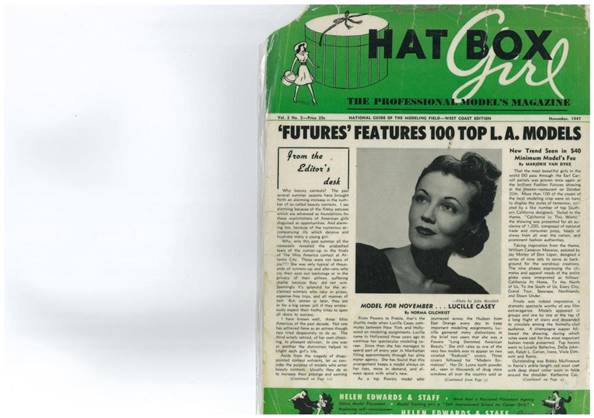
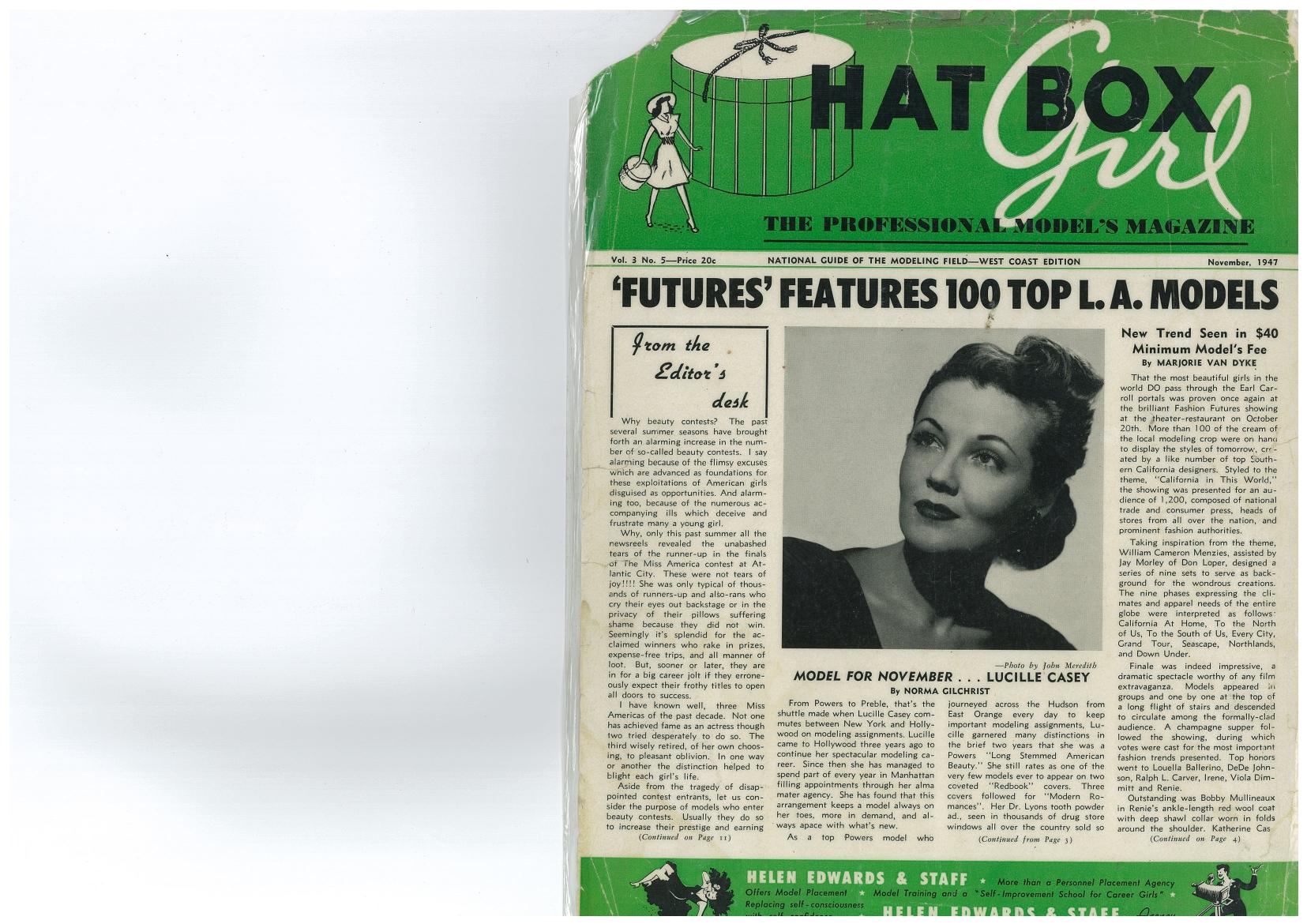
MY BEST FRIEND, Lucille Casey was a woman who threw the dice all her life. She gambled on her instincts as if they were already tested and approved. She never told me much about herself. When I learned of her struggles as a young woman and her chosen life, she became more real than when I’d known her. During the years we were friends, she handed out selected stories, abbreviated and censored.  Being the inquisitive character I am, the shallowness of her stories bated me.  I had to pry the truth out from other people who had known her.  

            Casey’s first gamble was at sixteen years old. She sent in a photograph of herself for the Redbook Magazine modeling contest. If she’d won, the Powers Modeling Agency in New York City would grant her an audition as a model.  Casey was living in East Orange, New Jersey with her mother and sister. Her father had died suddenly, leaving the family without a financier. Casey’s mother was lost without her husband and unsuited to join the workplace. Casey didn’t tell her mother about the contest until she received the letter of congratulations.

            John Robert Powers met Casey in his office on East 56th Street and signed her as a Powers Girl. She was stunning to look at, photographed like a movie star, and was modest. John Powers did not look for aggressive, pouty-lipped fearlessness. The Powers Girls were captioned “Long Stemmed American Beauties” because they were wholesome, beautiful, tasteful, courteous, and virtuous. They were so far from the runway models of today that it is almost a reversal of the industry.  

The models of the thirties were ordained to set the highest example of classic good breeding and education. John not only schooled them in fashion, and individual taste, he instructed them in moral integrity, independence, and community service. Casey went to school at John Robert Powers and became one of the top ten models in New York.  

            She was a blue-black-haired Irish beauty, with emerald green eyes and perfect teeth. She stood only 5’ 7″  in those days that was fairly standard. When I knew her, she was still thin and beautiful but she did not fuss about herself or spend a lot of time at her vanity. As a Powers model, Casey had a long line of gentlemen callers. Powers Girls were invited to all the nightclub and dinner show openings, sporting events, community galas, and fund-raisers.  Social engagements were part of her job. Casey was not a woman of idle chat, in fact, a lot of people thought of her as restrained and unfriendly, maybe even snobbish. I think it was more secrecy. People were always prying into her life because it looked glamorous. There was another side to that glamour she didn’t want to put in the mirror.  

            One evening Casey had a dancing engagement at the Copacabana nightclub in New York City. She was on stage with some other dancers when a certain gentleman noticed her. The next chapter of Casey’s life began that night. At twenty-two years old, she fell in love with a man thirteen years older, of the Jewish faith, who lived in Hollywood. The consequences of her love forced her to change and adapt to a new lifestyle and different people.

            She did not bury or rescind her love after she learned he was Bugsy Siegel’s partner and best friend and that Allen was a part of the Jewish Mafia. She asked him to reform his criminal activities. He agreed, provided she would marry him. We all know at twenty-two a woman believes she can change a man, and a man lets her think she can.  Without that dream, many lovers would not have found their mates.

            Casey did marry her love and spent her life trying to keep her children from harm and Allen from going to prison.  I met her husband just after he tried to reform, and was beaten down by the FBI. I called him Daddy.  

MY FRIENDS ARE HOME


My friends are beside me once again. It’s been five years since  their faces like postcards of my life, are in my room, lifted out of the box. I  can almost see their wisdom, and lessons floating above the birdcage hanging from the ceiling.  I had forgotten how much I depend on them, a collapse of friendship because my room wasn’t really mine, I shared it with guests, and then New Year, rang out like a jazz quartet of answers to puzzling life questions.  I am not sharing my bedroom anymore. And I am not looking for a job. And I am not going to stop wearing tightjeans, and high heeled boots.

Hello Henry Miller, Anais Nin, Carson McCuller, Nelson Algren, John Gardner, Damon…my books are home.


THE MID-LIFE NOVEL WE LIVE


Actress Betty Compson in an evening gown, in a...
Image via Wikipedia

I read in one of my books on writing that the middle of the novel is where most writers face the demon. The beginning is a gallop, the end is a relief, but the middle wiggles in and out of your grasp. The middle of our lives reflects this same obscurity.

The middle of a life span reflects all we have accomplished and all we have left incomplete. This is what they call a mid-life crisis. I get it every year. This year it is more comical. I’ve finally accepted that my constant relocating, reinventing, and being restless are not going to be solved. I am going to keep doing these. At the bottom of the restlessness is the fear of finding rest more enjoyable than movement. This flotation of comedy rotated around me last night while I was standing out on the porch observing the peacefulness. The scenery of Santa Fe is a comforting, ethereal beauty that comes at all times of the day and night, and the flow of people is integrated and festive. All I could think of was where I should go next. The discomfort of mid-life comes from trying to assimilate what you have and what you want.

Many years ago, in the summer of 1987, I was seated in a café in Monaco, truly, and a man that I was traveling with told me, “You have to make a choice.” He embarked on a long discussion about choices we make in life and how everything depends on these choices: how you live and with whom, and what you do. He pointed out to me over my first really authentic Salad Niçoise that I was an oblivious example of a woman refusing to choose. I was more interested in the salad, the yachts, the casino around the corner, and the fact that I didn’t have an evening gown to wear to dinner. I listened without argument or insult, but I was disturbed by what he said. I didn’t understand completely, but he was older and had much experience and conviction. That conversation now fits into the mid-life crisis, the comedy of errors in my life, and maybe in yours, and just how much travesty we can ignore. For my fault, as it is, I do not want to sign, commit, or make final decisions. I want it all to be a temporary placement that allows me the freedom to change.

I have lost track of my European friend, but if he met me today, he would say, “You have not changed at all.” So that is why I was standing there in the darkness on the porch and laughing like a silly girl, because it is true. I have not changed at all.

The choice facing us at mid-life is making a change now, risking losing all we have accomplished, compiled, and attached, or throwing the dice.

Beyond the obvious changes in activity, relationships, and scenery are the internal travels. They are not so easily booked. You cannot wake up one day and say, “I ‘m off to become more compassionate, or more practical, or more generous.” These journeys are taken when other factors play into our lives, such as when we get sick, demoted, or experience a trauma.

It is a very subtle inconsistency. When I unplug all the voices and listen to the one that understands, that is when I write. The middle of the story and the middle of life are the same. We and our characters have to make a choice.

***