
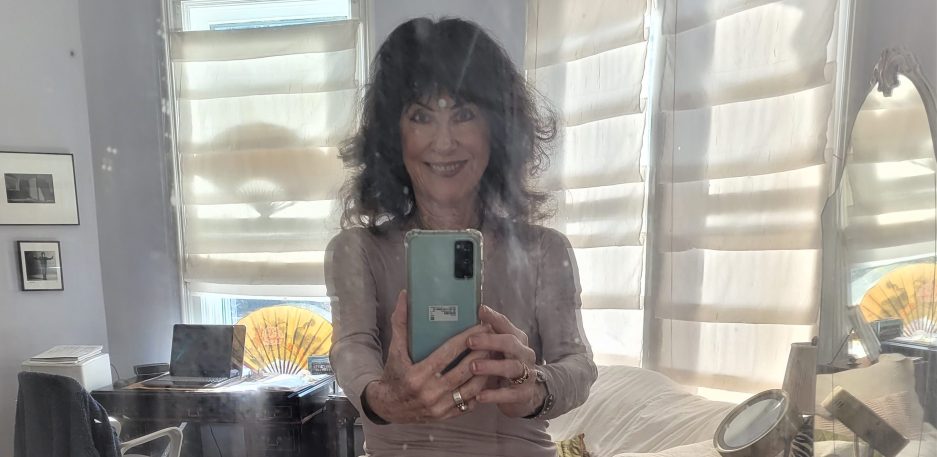
SIDEWALKING TO BREAKING MY SILENCE


SIDEWALKING TO BREAKING MY SILENCE


This is the beginning of the journey, to write my way home.

“The fall was impulsive. All the misguided messages and warnings tumbled over me. When I finally found the bottom of self-defeat, the shelves of my soul empty, I was 43 years old.   Beyond getting married and having children, career, or stability, there were the untold stories of my gangster father and glamour girl mother. The struggle to break my silence began to erupt.  The problem was, they were both dead, and no one knew their stories.

The journey began one day in 1994. I was standing on the corner of Wilshire Boulevard and Barrington, in West Los Angeles.  This was the crossroads of my adolescence; a few blocks from my high school, where I learned to survive silently.

I was in the phone booth, the same booth from which I used to call my father, and report where I was going after school. The fellow next to me was talking on the phone to his agent, about a script.  I was dialing UCLA, Emergency Psychiatric Counseling, inquiring about treatment.  Choking on my tears and the lopsided humor of our juxtapose conversations, I screamed silently.  The next week I found myself inside the UCLA center, seated next to a woman with a clipboard ready to document what I said.  I kept looking out the window. The Hilgard House, where I lived with my mother, was visible from where I sat. I remembered the days we would all go swimming and would later walk in the village, eat cheeseburgers and shop at Bullocks.  I remembered my cats, my friends, my records and my joy.

“You have sadness and pain, how would you describe that?” the counselor asked.

“What do you mean?”

“How do you handle your sadness?” she said, leaning forward.

“By myself, I just live with it.”

“Do you feel pitiful?” she asked.

“Yes. I have nothing.

“Are you eating and sleeping properly?” she asked making a note.

“No, I ‘m not hungry and I can’t sleep. Today’s my birthday.” I said.

“You’ve made a conscious decision to change haven’t you?”

“I suppose.”

She put the notebook away, and with appeasing eyes assured me she would find a therapist suited to my problems.  I walked outside into the light of day. Across the street from the building was where the Hasty House used to be. We used to have dinner there with my grandmother.  I didn’t know if my grandmother was even alive. We had lost touch.  I lost touch.

There were two people to call, Rudy, my ex-boyfriend and Florence, my adopted Jewish mother, whom I had known fifteen years.  My choice was guided by instinct.

“Hi Florence, its Luellen.”

“Darling, how are you? Oh for heaven’s sake it’s so good to hear your voice. What are you doing?”  I didn’t have an answer.

“How are you?”

“I’m fine, fine. Well, you know since the earthquake, the place is a mess and I don’t have time, I’m so busy. Oh, everyone keeps asking me if I’m all right, the girls think I should go to a therapist… did I tell you I was pinned under my oil painting for three hours before the paramedic arrived.”

“You feel all right though?” I asked.

“Well, to be honest, I’m scared– who wouldn’t be all by herself.”

“What are you doing, you haven’t told me a thing?” she said.

“Florence, I quit my job at the Terraces, and moved out of the condominium.  I was supposed to take over an Art Gallery in Laguna Beach; it’s not working out well.  Do you think I could stay…..?”

“Oh would I love it, come right over. I’ll be home.”
That’s how I ended up at Florence’s home in the summer of 1994. We hadn’t spent much time together since I moved back to San Diego from Los Angeles.  Though 30 years separated us, she was the friend that could be mothering one minute and girlfriend the next.

***

“Oh darling you look wonderful,” she cooed.

“You do too Florence.”

“You think so… really?” she said glancing down at her waistline.

“Yes, you look gorgeous.”

“You’re so skinny? Have you lost more weight?”

“A little, you can fatten me up.”

We sat in the dining room, drinking coffee and I answered questions.  I told her selected chapters from the last scene in my life.  I left out the part about PJ’s alcoholic binges and his partner Aaron’s daily dosage of marijuana.  There was the twisted, anti semantic charge between PJ and all Jewish people, and why I fell into a hole with all the alarms of dysfunctional behavior ringing at once.   Florence told me how she survived the earthquake, and how her daughter Madeleine had sensed she was in trouble, and sent the paramedics.  We were both afraid; we needed daily encouragement to face the unsteadiness. Florence put me upstairs in Sam’s old room, her husband who had passed away several years prior.  I flopped on the fold out bed. I was as close as I’d ever come to giving up on myself.”


CHRISTMAS WITH A JEWISH GANGSTER


It you were to ask my father, a man of Jewish faith, raised in a strict Orthodox home, why he celebrated Christmas, this is how he would answer.

“You can’t get away from it, what are you going to do, hide your head in the sand?”  He didn’t voice resentment or personal humiliation celebrating Christmas. My father ignored regulations and conventions for a living, so a religious variance was no different. Half his associates were Jewish, and the other half were Italian. This may account for his interpretation of the Holidays.

In the first weeks of November, I would get a call asking to meet my father in Beverly Hills and pick out the Holiday cards. The meeting began like this every year.

“Is that all you have to wear to go shopping?” examining   my unmatched jeans, and pull over sweater.

“What’s wrong with this outfit?”

“For crying out loud! You look like a gypsy.” After we finish here go to Saks and pick out something for the holidays, you can’t go to Arthur’s like that!”
Then I would follow behind him, twitching with scorn until we sat down to look through the sample books. First, we looked over the messages suited to both Jewish and Catholic faiths. Then we chose a card, a font style, a color, and then he began editing the message. It usually took several hours. He wore his thick reading glasses and studied each sample card, and asked the sales clerk many questions. I remember showing signs of waning interest, and then he’d take off his glasses, stare  directly in my eyes, and say,

“What is it Luellen, am I asking too much of you again?”

“No, I answered. He could feel my impatience with the assignment.

“Which color do you like?” he asked.

“I like the gold.”

“We did gold last year, this year should be different.”

Once he settled on all the details, he ordered two-hundred cards. It never occurred to me that he wanted my participation because I had something to offer. I thought he just wanted company. He could not stand to be alone during the holidays.

Once the cards were delivered, I was told to come over and help address the envelopes because he liked my handwriting. We sat on the same blue and green crushed velvet sofa he had since he moved into the Doheny Towers.  While I crouched over the glass coffee table, he held his guarded black telephone book, and watched me write out each envelope. He compared all the cards he had received from the previous year against his own list, to avoid missing anyone. Sometimes I did not finish until after midnight, and left him sitting there studying and counting the envelopes. Every year, the completion of the cards, was the event that signified the beginning of the holidays.

The next phone call would be to come over and wrap the Christmas presents. I failed in this category, and my sister took over. It was worse than the cards because if her wrapping was unsatisfactory, she had to do it all over.

The next ritual was the outfit, the one I would wear to Arthur’s Thanksgiving party. This had to be classic and colorful. He always said to avoid black, because I should save that for when I’m older. He had to preview the outfit before, and if he disapproved, he would accompany me back to the store to select something else. Appearances were not every thing he used to say, they were number one in making an impression.

All through my twenties, I had to maintain two wardrobes, one for him, and one for me. I’m still dressing one part Al Smiley’s daughter and one part Loulou.

On Thanksgiving Day, the tradition was to arrive at his home at noon to walk.  Like the cards, and the outfit, the walk, wasn’t negotiable, it was part of my tutorial. We walked two hours along Ocean Avenue in Santa Monica. He walked with his head a notch above everyone else, to diffuse any interference. People often greeted him, and he kept walking. If I asked who that was he would say, “A lot of people think they know me, just keep walking.”  He walked with his eyes, as much as his legs. He walked with the intention of continuing to school me on human relationships, right down to meeting a stranger in the street.

“Now, be at my house at 3:00 sharp for Arthur’s.”

“Same crowd going this year?” I asked

“Why? Does the same crowd bore you?”

“No, I’m just asking.”

“Well don’t ask silly questions. Arthur can have any crowd he wants, who the hell cares. He saved my life– many times. He asked us to be a part of his family, you should be grateful; one day you’ll figure it out. Not everyone gets invited to Arthur Crowley’s home.”

Every year we were greeted by Arthur’s slightly tipsy blond bombshell wife, who opened the front door and cooed, “Allen dawling, where have you been?”  She kept us standing there;  as long as her routine lasted. My father said she was a showgirl. When I knew her, the shocking pink skintight outfits were Vegas outdated.  She was Ziegfeld Follies beautiful, and always at least two scotches ahead of everyone else. My father wowed her with compliments; I could tell she needed desperately.

We headed to the bar, where the Crowley crowd was admiring Arthur, dressed in a black tuxedo with a red rose, and mixing cocktails. He beamed like a Christmas bulb.  The home was Beverly Hills garish luxury: sunken living room facing the pool, and heavily decorated with dead animals head, Arthur’s trophies, from big game hunting in Africa. I was informed the display was, strictly for show.

At every party there was at least a handful of token celebrities, a comedian to keep the party alive, old clients that became friends, and mutual friends of my father. Dad was in control of the party. If someone dipped too far into obscenity, or tasteless cynicism, he would close in with a subtle reprimand, and remind them, “Careful, my daughters are here.” He was not a big drinker, but he held his glass up, as if he were, and I watched while all the others got drunk, and my father was the only one left with sober humor.

Each year, as I matured, the people became more transparent and likeable. There was one woman in particular I remember. A woman in her fifties, with a face recently chiseled of time by a surgeon. She hovered over me, with her diamond encrusted hands on my shoulders, and unwound the lament of the rich, older, divorced woman. She was envious of my youth, my uncluttered life, my complexion, and my father. Mostly, she was disturbed by her loss of innocence; there was not any trace of it left.  While I sat there, self-conscious of my inexperience and sheltered life, she symbolized a life of bad experiences, ones she could not take back, and ones that were mixed up in greed, power and money. I asked my father who she was, and he warned me to keep a distance. I tried to explain what I felt, but I did not know how. All these years later, I understand that woman.

Then there was the stainless scrubbed beauty that had been discovered in Hawaii and married a wealthy tycoon. She appeared in the Hawaii Five O series for a few years.  She never spoke; she just sat on the bar stool, smoking and wore her clothes with ornamental style.

During the dinner at the formal dining table, all the guests ate with minimal appetites and talked with dragging dry tongues.  After dinner, we returned to the bar for nightcaps. Gradually the cajoling and antics turned into literary chopped liver.  I left the gathering and sat on the sofa with their young daughter, Princess. She was blonde and fair skinned as albacore. She sat on my lap in silence and apprehension. I tried to influence her mood, but she just stared back at me, in the same manner I had with the divorced woman in diamonds.

The Crowley parties were dreaded every year, except when there were no more. Like my father once said, be thankful you are invited, and understand that they will not always be there.

MOB MEN AS ROLE MODELS


I was marinating chicken breasts and watching the cherry blossom pink sunset splinter into a montage of broken clouds. In that instant, the men whom I now consider close irreplaceable friends — as much as my girlfriends — surfaced all at once.  They hung down like a shadow over the men my father brought home, the gangsters that formed my first impressions of men.

How different these groups are. Do children with fathers who are doctors or stockbrokers perpetrate the same associations as adults? It is a lot more complicated to find characters as defiant, vocal and audacious as the men my father brought home to dinner. That is where my love for men started, and today I still delight in characters larger than life.

Doc Stacher was one I loved. He was right-hand bodyguard for Abner Zwillman, aka Longy, meaning the tall one in Yiddish, the head of the New Jersey outfit. Longy managed Newark all through Prohibition and on up until the 1950s. He and Doc were rumrunners and then became associated with Joseph Reinfeld, who allied himself with the Canadian Brofman Brothers’ distillery. They ran the largest bootlegging operation in the United States.  For protection, they used Benny Siegel. For tactics, they consulted Meyer Lansky and Frank Costello. Doc was just over 5 feet tall, bald as an egg and so heavy lidded he looked like he was on dope. I remember him in white deck sneakers, without laces and bathing trunks, a Cuban Cigar sprouting from his lower lip and a permanent growl forming in his throat.  He saw only one person, delighted in only one person, and that was his daughter, Joanne. She was my childhood buddy, the girl who would walk up to Frank Sinatra and demand that he take notice of her.

Doc was appointed headman at The Sands in Las Vegas. Joanne led me into pranks and casino sprees that drove everyone in the hotel nuts, except Doc. He rarely smiled and was forcibly tolerant of the world when Joanne was in his presence.  I loved him for that. Without Joanne, he was gruff, cantankerous and he made me repeat every word, “Louder, I can’t hear a word you’re saying.”

Doc showed no interest in non-threatening surroundings. He had the eyes of a man who’d seen everything. He was always looking down to the ground, lost in some private thoughts, his hands pinned behind his back. He paced the hotel lobbies and pool grounds waiting for Joanne.

The government tracked him all his life. In 1963, they caught up to him with an IRS tax bill. He settled and, instead of prison, Doc had himself deported to the Sheraton Hotel in Tel Aviv.

The next man to make a lifelong impression on me was Johnny Roselli. He came into my life on the day of my mother’s funeral. He was a man who filled the entire room. Everyone else vanished, even conversations stopped when he walked in the door. It wasn’t the fear, like I’d felt with other men, Johnny’s aura was electric, like a wire ran the perimeter of his body, and if you got too close, you’d be shocked. His power was his defense against the world leaders he managed in politics and crime. He got tangled up with the Kennedys, Castro, Hollywood and Hughes. Because of his high-wire act, he landed in the bottom of Biscayne Bay.

I searched for my own Johnny-style man for many years. I didn’t know he was all wrong for me, for any woman with sensitivity to extravagance and danger. He was my father’s protector, against the inevitable death threat of rival gangsters. I wanted someone like him in my corner.

When I think of how these men filled in the open spaces of my impressionable mind and took shape, it makes me laugh. I didn’t know they were gangsters. What I witnessed was the fearlessness, the enormous generosity between them, the loyalty and trust, and the respect for each other’s families. I thought the ones outside our circle were the losers. They didn’t have the privileges, the money, the connections that we did.

When I finally woke up from the long sleep, it was all right. I walked out of the dream with the same bottomless love for men, but now I choose the good guys,  as long as they’re not too good.


CHILDHOOD CHAINS REMAIN


My family history was brought to life in an unpublished memoir.   The stories lived on during a long arduous game of trying to get published.   Sometimes I read pages to get close to my parents.  I squeeze in between them like a ghost, hear their voices, and see their expressions.  If I remove the outside world, the motor on the clothes dryer, the cat’s tail flapping up and down, I can remember swimming in the pool with my mother.  I see her bathing cap strap pulled down across her chin, her red lipstick, and her one-piece strapless bathing suit. I can see her freckles, and her long slender arms backstroking as she swam.

Early in 1960 my father decided to build a swimming pool in the backyard of our house on Thurston Circle.  I had just completed swimming lessons and asked my father for a pool. Years later he told the story: “My little girl asked for a pool, and I built her one.”   I think he built the pool for my mother.   He was under investigation with the FBI and Department of Justice, and spent most days in court defending himself against a deportation order to Russia.   Subpoenas, arrests, and trials were routine events that tied my parents together against a world of misunderstanding.  After 11 years of nail biting suspense, my mother just wore out.  The pool was built with the intention of removing my mother’s anxiety and sadness.   My father designed the shape of the pool around the original pool at the Garden of Allah, a highly scandalous Hollywood hotel apartment that attracted starlets and gangsters in the early 30’s.  I know this tiny detail from photographs I’ve seen of the Garden pool.   More obscure details surrounding the building of our pool were found reading his FBI files.

My father accused the pool contractor of being an informant for the government.  One sunny afternoon he marched him out of the house. I was hiding behind a drape when the confrontation broke out.  I recall the big shouldered contractor running from my father’s threats.  Most likely an FBI agent was parked outside and  followed the man after he scampered out.

The pool was finally completed in mid 1961.   There are photographs of my mother and I in the pool; her smile is radiant and naturally composed.  She and I swam everyday while my father watched.  He loved to swim too, but he was busy with court proceedings, and meetings.  Before the year ended my mother filed for divorce, the house burnt down, and I was released from childhood. I don’t regret those events any longer.  They were steps that shaped my character, and what brings me back to the topic of growing up with gangsters.

The best memories of my childhood are in swimming pools and restaurants with gangsters and gamblers.  They were part of the family, and when they were around my father was on very good behavior, and my mother defenseless against their irresistible humor, pranks, and generosity.   She just sort of glided in and out of activities, and helped me ride the vibrations.   She didn’t laugh out of herself like I do, and she rarely yelled.   The older I get, the less I seem to be like her.  Maybe the passage of life experiences determines which parent you will take after. Had I married and had children, maybe I’d be more like her. Since I get into all kinds of tricky situations, and throw the dice, I need my father’s strength more.

Over the years, I have forgotten some of the dead reckoning discoveries I made about our family history.  Still nothing compares to reading about my Aunt Gertie.  She was my father’s sister. Until I read about her in the FBI file, I didn’t know she existed. I haven’t figured out why my father left her out of our life. According to the FBI files she was a remarkably loyal sister. Gertie was the one who confronted the federal agents when they arrived at the family home in Winnipeg, Canada.  She pushed my grandmother out of the interview, and spoke for the family.  The agents showed her a recent photograph of my father.   She told them that her brother left home when he was twelve and they had not seen him since.  She could not verify the identity of the photograph because almost twenty years had passed.  The agents left without any evidence and continued to search for the birthplace of my father. Every time he was arrested, he entered a different birthplace.  He named Chicago, New York, Detroit, and Los Angeles.  His origins were discovered through a letter that his mother had written when he was fifteen and confined to a boys reformatory.  The letter was turned over to the FBI, and that is how they discovered his parents lived in Winnipeg.  The government could not deport my father to Russia without verification from his family. Eventually my father won the battle. He was granted citizenship in 1966, two weeks after my mother died.

Gertie died after my father. I don’t know if they corresponded over the years.  I have learned enough about my father to know he was protecting her from further harassment.  Maybe if my father lived longer they would be coming after me.

RADIO INTERVIEW


d7

GUEST ALERT: Daughter Of Reputed Mobster, Making The Radio Rounds

THE MOUTH, NOVEMBER 8TH, 2011 — Luellen Smiley is the daughter of reputed mobster, Allen Smiley. Smiley’s dad was a close friend and confidant of famous Las Vegas mobster Benjamin “Bugsy” Siegel and he was sitting on the couch just feet away from Siegel the night he was murdered. While Luellen Smiley hadn’t been born at the time of the shooting, she’s conducted research on her father’s life and the events leading up to the shooting and wants to dispel the common belief that her father might have been involved in the shooting. Luellen Smiley has contributed artifacts to the Las Vegas Mob Experience and she joins us to discuss her family history. She’s out promoting the fact that the gangsters of old were not trigger-happy murderers and that J. Edgar Hoover was someone who was out to get them in a big way. Not letting them go straight, etc. She also believes that J. Edgar Hoover was behind the killing of Bugsy Siegel. (Bugsy’s killing was never solved). This week, she joined KNPR for chat. LISTEN TO AUDIO HERE To set up, contact Scott Segelbaum HERE

hh h

WAITING


As children our waiting depends on how long it takes Mom and Dad to finish what they’re doing and pay attention to our needs.  It takes hold of us, like a fever, and we resort to nudging them, whining, even sobbing, if we are made to wait longer than we expected. During the school year, I waited all semester for the summer.  In Los Angeles that meant it was hot enough to go swimming in the ocean.  When I lived in Hollywood, I rode two buses, to get to Santa Monica.  The second bus dropped me off on Ocean Avenue, above Santa Monica Beach.   I ran down the ramp that connects to Pacific Coast Highway, and headed north to Sorrento Beach,   another long block away, and when I got there I stumbled in the sand in  my tennis shoes trying to run,  and find the place where my schoolmates clustered,  in a caravan of towels, beach chairs, radios, and brown bag lunches. I couldn’t just run to the ocean, I had to sit and talk and have something cold to drink, and then  I made myself wait, until I couldn’t stand it any longer, and then I ran down to the shore, and embraced the waves, tumbling inside their grasp until I lost my breath, and floated into abandonment.

After I moved to New Mexico, I stopped thinking about the ocean, I had to remove the memories from my thoughts, and so I could continue to experience this spark of the world. The dry sage ocean of pink soil, and radiant blue sky that pinches your eyes when you’re driving,   the sunlight, and the warmth of a desert night  and the white snow on pink adobe.  It has postcard perfection, even now, with fallen leaves spread like trash everywhere, and the trees almost naked, and the dead plants in the garden.  I try not to think of the ocean, the look of the sea from watery suntanned eye lids, or from the bluff at Del Mar, or the splashing of waves around my shoulders as I sink beneath the surface.

I waited, like I did as a teenager, for that summer to come, so I could return to the sea.

Last week,  I stood at the water’s edge in Del Mar,  it was like summer without all the kids playing ball and screaming, hey dude what’s up, and the running of the dogs, and  lifeguards  thrashing the beach in their jeeps shouting, , no swimming, no dogs off the leashes, no glassware,  and no surfing.  They were missing, so as the caravan of beach runners, and surfers. In fact, I was only one swimming, on that first day at the beach.   Before I went into the water, I reclined on a big black boulder, and faced the sea, and let my eyes wander amongst the scenes of the beach on a Tuesday afternoon. In front of me was an older man with graying hair, in a wal-mart beach chair reading. He must be retired, he looked perfected adapt to his spot about five feet from the shoreline.   I thought about that Dennis Hopper commercial, about retirement, and how I still cannot come to grips with retirement, and spending my days on park benches or in cafes watching younger men and women live.

There was one swimmer, on a bogey board, he was far out, and floating along, and I wished I’d brought mine with me, but it was in SC’s van, and the last time I used it was when I lived in Solana Beach.  I also wished I had a new bathing suit, because the one I was wearing was ripped, and the neck straps were tied together in a knot so I could swim without losing my top.   The sun baked my body, and I let it without abatement, without shading my limbs,  or wearing a hat, just enough sunscreen to keep the rays  from trotting over to my skin, and I closed my eyes and I opened them, and this is when the waiting business suddenly felt so important, so much so that I began to think about waiting as an aphrodisiac or something like a good cocktail that you have to make last for sometimes, years, while you wait for that moment that makes you feel immortal, and childlike, and senses sharpened as an animal.

I felt the beach flies, and the tang of salt water on my lips, and the when the seagulls swarmed above the water’s surface, like so many beads of a necklace, I thought, that this is about the most beautiful day I could have, and it’s all because I WAITED, I didn’t give up on the ocean, or my place in it, or believing that I would have my day in the sand, under a faded denim blue sky, with cotton ball clouds floating above me.   I baked until the sweat drenched my pours, and then I raised myself up, and walked slowly to the edge of the water, the flat surface made tiny breaks not enough to shatter my body warmth and I felt the first sting of the water on my feet, and then my knees, and then I submerged, and found that the best way to celebrate this day was to keep flopping backward on top of each wave as it crashed, and I did this for a dozen rounds, until I felt silly and weak, and dented with the surf, and I found that waiting thing again, meant something that I should write about because  all of us are waiting for the election, and the economy to recover, and our real estate to be worth something again, we are all waiting for this big change so we can feel secure and optimistic about the future.  There is something useful about waiting, something predisposed, that gives us the support and substance we need, so when the waiting is over, and we are all flush with success again, it will feel like the first time, it will overwhelm with us with power and joy, like the ocean.

When I left, I had enough jubilation  bouncing through my blood to take the risk of driving by Maurice’s home, the one he left three years ago, when he died under his favorite orange tree.


MY SANTA FE NARRATIVE


***


GALLERY LOULOU 20th Century Photography
The Royals & the Rebels
343 E. Palace Avenue Santa Fe NM 87501

The Santa Fe travel narrative I was going to write appeared in the New York Times the same week.  Sunday Travel Section, “ Is Santa Fe Ready For a Makeover.?”   If you read it, then you know, that mod is flowing through the alleys and walkways of Santa Fe, more so than adobe mud.  My answer is yes, Santa Fe is already under the mask of revival.  My perspective comes from the duality of being a tourist and a resident. I have not lived here long enough to shed the distinctive air of a gambler whose just won the jackpot.  It feels like a home I left years ago.   I still walk through the Plaza in summer once a day to see the groove of live bands on the stage. I snap internal photographs of the conversations, expressions, and festivities surrounding Spanish and Indian Market month. Maudlin hippies slack on park benches strumming on  untuned guitars. Children scatter between the adults, and third generation families sit under trees, sipping cool aid from a thermos, and eating home made tamales.

As you cross over to  San Francisco Street past Starbucks,  you will step over the hillbilly from Arkansas, whose sidewalk show includes, a dog, cat, and several  mice playing nicely. His message is; animals get along why can’t people?  You will never read this sort of description in the travel narrative.  Just before dusk, the city streets empty for an hour, and the shinning light spreads evenly over the adobe walls and rooftops. That is if it is not raining.  When showers greet us they pound the tricky brick walkways, and the lighting and thunder shake the windows, and everything not pinned down blows away.

I stood on the porch and watched, mostly because summer rain is the most romantic of all weather moods. That comes from a distant memory under raps.  If you have a balcony, or find your way to the Rooftop of La Fonda, or Coyote Café, take a seat. Just watch and listen to the operatic electrical storm. They do not last too long.

The best time to walk is early morning. There are several roads to hike just beyond Canyon Road that lead to the Audubon Society. From there, you can choose from a dozen rated hikes from beginners to Aztec Indian strength.   When in Santa Fe walk as much as possible, bring a pocket umbrella, and keep your eyes on the road. There are dazzling surprises everywhere you look.

***

.

ON BOARDWALK EMPIRE


The extravagance of a gangster is not in flatware and double paneled drapes I would like to see their generosity, pranks, deli conversations, it is all too high brow for a gangster.  They need to read Damon Runyon and rewrite the episodes with the boyish behavior that was integral to their courage and bravado.


FOR IMMEDIATE RELEASE

Monday, Oct. 24, 2011

MOB EXPERT POINTS TO ‘FOWL’ PLAY OVER LAS VEGAS MOB EXPERIENCE BANKRUPTCY: ‘IT’S A CHICKEN MOVE’

“Someone is lining his pockets with cash, and it isn’t the family members who contributed the Mafia Collection” says Mob expert LUELLEN SMILEY, of the declaration of bankruptcy filed last week by the Las Vegas Mob Experience at the Tropicana Hotel in Las Vegas.

Smiley’s father, Hollywood gangster Allen Smiley, was featured in the exhibit’s Benjamin “Bugsy” Siegel room as Siegel’s best friend and partner in the 1930s and ‘40s.  Allen Smiley was seated next to best friend Siegel the night he was murdered.

Declaring bankruptcy is “a chicken move,” continues Smiley.  “Family members have been waiting months for payments.  I saw it coming, a month ago.”

The Wall Street Journal, in its bankruptcy blog, reported this week that JVLV Holdings LLC would take over ownership in exchange for putting $2 million to pay off some of the museum’s creditors.  The bankruptcy case comes as investor and contractor lawsuits brew against the projects former developer, Jay Bloom, who faces accusations of fraud that he’s fought in court.  The proposed sale would allow the buyer of the Las Vegas Mob Experience to leave those lawsuits against Bloom behind.

“The Mob Experience brought together both visual and narrative about the gangster history,” continues Smiley. “This was an extraordinary gamble for Jay Bloom but he earned my trust and other family members. I expected to be out there every few months for personal tours, discussions, and interviews, and if he can resurrect this sinking museum, I’ll stand on my head on the Strip.”

Luellen Smiley’s “Growing Up With Gangsters” stories have appeared in the New York Post, MORE Magazine and numerous publications throughout Southern California.  She currently is finishing a feature length script based on her life as the daughter of Hollywood gangster, Allen Smiley   Luellen’s extensive research has led to numerous TV and documentary film interviews regarding the Los Angeles mob scene, and especially Benjamin Siegel, her father’s best friend and business partner.

Luellen Smiley is available for interviews about the Las Vegas Mob Experience and “Growing up with Gangsters,” as well as HBO’s Boardwalk Empire and PBS’ Prohibition.


KABC-TV interview on Las Vegas Mob Experience


www.liliespen.wordpress.com.


Media Contacts:

Scott Segelbaum / Right Brain Agency

610.389.1807 / scott@rightbrainagency.com

Randy Alexander / Randex Communications

856.596.1410 / randex@randexpr.com

Online press kits with downloadable jpegs at www.randexpr.com

###


LIVING WITH TWO MEN PART TWO OF MICE AND MAYHEM


The scent and scenery of August on Palace Avenue is a perfume of Plaza pushcarts selling burritos and beef skewers, afternoon thunderstorms splashing the soot and dust from weekend fiestas,low riders spinning and smoking up Palace Avenue, and the  blasting booty bump bass in tempo with the wheels as they rise and fall to the concrete, the motorcyclists on four wheels, with jet black hair flapping the wind, like long tongues, and the bicycle riders, glazed eyes, and head-phones, detached, and daringthe driver to predict their next turn, sometimes women, in street shoes, and hats, gliding by, smiling independently, and then the two grumpy men. Five days a week they walk to and from work past my house.  One wears a chef’s coat and never raises his eyes from the sidewalk, and The Walrus, whose mustache and face, are griddlded into an expressionless tolerance for all things that happen
I left the porch, went inside, where I felt the absence of John and Rudy.
John was in Los Angeles at a screenwriting meeting; a triumph for a guy whose waited more than ten years to get an assignment. I imagined him in a trendy restaurant, seated at a table, one foot tapping the floor,and his right hand clutching the corner of the tablecloth his own peculiar fetish to feed the nerves during suspenseful situations. He‘d be dressed in the outfit I picked out, but the shirt would be loosely tucked because that’s his style.  Rudy was on his way back to Santa Fe, and eagerly waiting to take out his new Bird, a gal he met at our Baron Wolman book signing. 
 
Absence of their conversations, frivolity, dancing, feasting together, two men who share nothing in common except me, sort of like Jules & Jim, only Rudy and I have been like brother and sister, since 2003. He was the only man I ever trusted before John, and thattook many years, but once he went into the vault of truth and loyalty, I trusted him as I did my mother.
 
Then after so many days, my bounce and blush started shedding. It was as if someone tied me to an anchor and I dragged my litheness from room to room trying to fight it, with chores, writing, and then all the structure started crumbling, and I left the lights on all night, and didn’t empty the trash, or go out on the front porch to wave at the La Posada crew I didn’t leave the middle bedroom, the one with the big screen, and I snuggled the silence with old movies,and half read books, and Gummy Bears.  I was a heap, unlike the temporarily tide pools we fall in and out of constantly, this was a tidal wave.

The window facing west is an aquarium of pine and cotton trees, and between them, there is JD’s Tree Tee Pee, left over from Fiesta week, but he’s too busy working on his winter addition, to bother with it.  I can see the 2nd floor of La Posada, Julia’s room, the daughter that killed herself in the bedroom, and is widely known as the Ghost of La Posada I’ve listened in on these stories, and staff members see her. New Mexico storytelling is checkered with ghost stories. I saw the light as it transcends the hours of the day, and found the most beautiful time was four in the afternoon. The sunlight turned the light peach walls to pomegranate, and I felt like I was inside the fruit. If we stop, we see everything so clearly.

I was waiting for Saturday, when Rudy would drive up in the white van, filled with tools and purchases he’d made over the last three years.  He was officially coming home to stay. He’d completed the New Mexico Contractors License Exam and was going to start renovating adobe homes and gardens and spend his days in the place he loved as much as San Francisco.

It might have been a Carole Lombard movie, that got me untangled from the
Gummy bears and Kleenex, and I went out to dinner Friday night with the gal who introduced the Bird to Rudy.  Sipping wine with faces I like, and food that nourishes brought back a flash of light to me, and I was animatedlike an old person right before they die. You ever see that? 
    
Rudy’s room was tided: new soap, washed towels, the closet rearranged so he was able to unpack all his belongings. I was sure there would be a new rattlesnake head. 
     “I have a present for you.” he said on arrival.
 He brought out an Emporio Armani garment bag, his only brand of clothing, and out came a pair of black silk balloon pants. 
” Thought they’d be good for the Cuban Carnival party.
I fancied them, hugged him, and then he scampered in a hundred directions, as he does, and I returned to myself. Rudy was home. To be continued.
 

MORE ON MICE AND MAYHEM


ADVENTURES IN LIVINGNESS

The throw of the dice this week lands on Part Two of Mice and Mayhem.

“John, I found a place! Let’s go tomorrow to check it out. This will be such an
adventure! It’s next to a riding stable, and creeks, and trees… and DH Lawrence lived up the hill.”

Part Two

Highway
64 toTaos…

My anticipation smoked from the back seat where I sat, listening to Rudy and John
in conversation, the kind that ripples like a stream, as Rudy evokes his fervor
for New Mexican history, the battles, and bravery, the legend of Billy the Kid,
and Geronimo. The summer scenery galloped past as we headed up the canyon
through Pilar, as bobbing rafters walloped the Rio Grande, as tourists snapped
photographs, as hitchhikers and wayward hobos staggered on the death trap
shoulder turn-outs… a sort of carnival that makes driving to Taos interrupt the
mundane repetition of asking myself questions I cannot answer: Why do I gamble?

“Turn left here, Rudy.”  We were on the last turn into the Writer’s
Retreat in San Cristobal.
It was virgin land, spindly wild flowers, unpaved roads, no-name streets, and
the three of us, searching for some sign of life.

“This is it,” Rudy climbed out of the car,
while John and I remained seated, unbelieving.

“Rudy, this isn’t it.” I shouted. He turned
around and on the edge of hysterics, and said, “Oh yes, it is.”

“LouLou, you threw the dice off the table
this time.” John’s laughter stunned the silence as we viewed the three attached
leaning log cabins, with barred windows, beat up furniture, and week old trash,
glaring back, as if to say, “Well, whatta you expect for $600.00 a week.”

John and Rudy went off in the direction of
the barn, and that was when I had the feeling we needed to get out fast before
the owners approached us with rifles or crack needles.

The
image of Rudy and John, poking in the field, exploring the barn, two men that
rescued and wrestled with pieces of my persona, were now joined. For most of
life, I went solo, everywhere. There
was in my mind the resolution I would remain unattached, out-of-love because
“love is more painful than lust,” a phrase I took out of this mornings NY book
review of “A Book of Secrets.”

I wandered into the multifarious pasture where
I was greeted with chickens, goats, and manure, and with a sudden rush of
urgency, I shouted: “Let’s get the hell out of here,” and dashed back to the
car. I could hear John and Rudy’s crackling laughter, and that solidified the
momentary disappointment that follows a lousy throw of the dice.

I followed my interior compass, that has been
known to deliver supreme surprises, and we ended up on Kit Carson Road, in a shower of sunshine,
and cotton balls drifting down like snowflakes.

“Turn there. Look Rudy, San Geronimo Lodge.
We made an offer on it, remember?’

“Wow,
I forgot about that one.”

“How
many places have you guys made offers on inTaos?” John asked.

In the course of remembering the different
times we lived in Taos, and the real estate agents, like Linda from Texas who
accused of us being charlatans, until our friend David kicked in and warned
her, “They’re morons, they’re not that smart,” we landed at the cross bridge to San Geronimo.

“Twelve. We forgot about the Martinezplace; the one I wanted to fix up
into polished efficiencies.” I said.

“What were you planning for the Lodge?”

“The Woodstock House, concerts in the field,
performances in the dining room, musician rooms. There was a grand piano in the
main Salon.”

The
Lodge was devotedly remodeled. The slimy green pool had turned Mediterranean blue, the grounds were riddled with pathways,
the mammoth lobby was now comfortably appointed with antiques, and the grand
piano, well, that was shut-down and used as a plant stand.

The owner, a rugged beauty with brimming
passion for her turf, showed us half a dozen rooms to choose from.

“You must have spent a fortune fixing it up.”
“You have no idea! What we were told
going in, wasn’t what we got.”

I left with resumed faith in my compass, and
knowing we made the right decision not buying San Geronimo.

Decisions about traveling, joining, meeting,
and moving, drop me in the path of mental collision. Instead of applying
academic analysis, calculations, or tried and true pragmatic reasoning, I try
to beat the odds, because I am a gambler.

John and I headed up to Taoswhile Rudy took refuge in a friend’s
casita. I suppose most vacation renal owners have alternate accommodations; but
this is a work-in-progress, like a play that doesn’t have an ending yet.

For the next six days, I wandered from the Geronimo
pool, to the terrace, to Taos on foot, and
during those hours, we rewrote the script in the privacy of our steadily silent
working room, or on the second story terrace, overlooking the fields and the Jemez Mountains.

When Rudy
called and said Mike, our renter, invited us to the reception party at the
house, I called Mike to decline. He turned me down.

“Loulou you have to come, everyone wants to
meet you.”  Everyone is a lot of people;
seventy-five guests inside the house when I am not the host stirred up my
imagination.

When we arrived, the reception party was
sprouting on the front porch, in the driveway around bistro tables, on the back
porch at a buffet table, and in the garden movie theater.

Suddenly, this face comes at me, up close: “Loulou,
I’m Mike. Come-in… What are you drinking? We love it! Come meet everyone.”  Mike has a light bulb personality, one
hundred and twenty volts of unplugged warmth and sincerity. I followed him into
the living room, and was immersed with questions and praise, at rapid
fire.  Within the hour I wilted and
tugged on John and Rudy to cross the street for dinner. “Why’d you leave?” Rudy
asked. He was eyeing a pretty blonde in the driveway.

“I don’t feel it’s right; presiding in our
house while it’s their house. I’m afraid I’ll start cleaning.”

I returned to the party when a vintage Galaxy
pulled into our driveway, and I was abandoned because John led Rudy over to see
the automobile.

By now, the party was surging and as I
recommenced my socializing the trepidation vanished. In every direction were
handshakes and hugs, conversations zigzagging from Mike’s family to Erin’s, the
bride and groom, and their friends, who came from Los Angeles.
But these were not just friends; they were neighbors.

“Neighbors inLos Angeles?” I jested.

“Oh yeah, we live in the Hollywood Hills. We
have parties every weekend. Are you THE Loulou?” I nodded. “I am THE Carlos,
and you must visit us inHollywood.”

“What
do you do Carlos?”

“Everything!
I sing, act, cook, and make trouble!” In every party there should be a Carlos.
The evening crescendo curled into a wave of anticipation when Carlos took
center stage and sang arias, from Turnadot and La Boehme. His bravura tenor
voice raised the guests from every cavity of the house. Strangers out strolling
stopped to listen and guests from La Posada spilled out in the streets.  The house was transformed, in some ways to
former visions of the artist salons I imagined and once held at Follies House.

There
were times over the last two years when Rudy and I discussed selling Gallery
LouLou, leasing it long term, and even renting rooms; options that occupied
sleepless nights, and never materialized. Now we know it is a vacation home, a
party house, a reception salon… all the things that I imagined came together
here, even Rudy and John.

Any dice to throw email: folliesls@aol.com

ARTIST


THE artist must catch every gust of wind, and use it with the velocity the wind does in moving the clouds forward.