HOW ONE SOLDIER CHANGED THE COMMUNITY OF SOLANA BEACH, CA
For many of us, the idea of aging is frightening. We have been led to believe it brings pain, loneliness, and idle time for regressing mentally. Remedies, products, prescriptions, and escapes offer youthful looks, energy, and vitality. The thought of aging is brutal; we pretend we can buy youth. What if you met a man who told you he could do everything today, at eighty-four, that he did all his life without injections, medicine, special diet, or specific training?
What if I told you all his family, including his brothers, mother, and father, is gone? His wife died twenty years ago. That he lives alone and is not lonely. He claims he is the happiest man in the world. Would you want to meet him? He wants to meet you. He would like to be everyone’s neighbor. He has much to teach in a country of strangers about meeting neighbors and making friends. We who know proclaim him an inspiration, a legend, an angel. And to that, he always replies, “I‘m just a regular guy.”
Maurice Roberts has lived in Solana Beach since 1936, and his recollections of the area are intact. I recorded his history and began writing everything down. Next week, I will startthe first in a series of historical perspectives.
Achievement knocked down the barrier of fear. It feels like lifting off from ground level; I am floating like I used to be in the swimming pool, and I am only at my desk reading the news from my attorney. From one beginning to an ending, five years later, after tedious research, unscrambling legal language, and searching for the meaning behind the case references, this journey is over. I won the lawsuit against the bank that attempted toforeclose on my home and Dodger, my ex-partner of thirty-five years, who, for still unknown reasons, pursued the foreclosure.
Agape, eyes widened, nerves settled like snowflakes; the joy of achievement cannot be understated. During this phantasmagoria, life beyond research, consulting with foreclosure agencies, banking laws, and regulations, I detached from my passion for adventure, creativity, parades, parties, and socializing; I sat alone, and resilience shadowed, then enflamed like a log of fire, encapsulated into a daily doctrine. Music by Ennio Morricone, blue note Jazz, the everchanging scenery of seasons, phone conversations with friends who released ambers of comfort, confidence, and advice, and TCM films nuzzled my fatigue.
Some days, I remained in bed, staring at my Icart Ladies of Leisure prints, or sat by my favorite window seat and studied clouds, birds, and leaves. The blossom of tenacity grew into a tree trunk and taught me the art of persistence and emotional strength, which were missing links in my character.
Achievement in fine-tuning relationships, setting down the needle gently instead of plummeting riffs and arguments. In the present, as you all know, if you read the news, our culture has replaced argument and debate with assault and violence. I digress; renewed confidence in my aptitude to fight battles, disputes, and disappointments without Dodger is as solid as concrete.
The next episodic internal journey is regaining my passion for opening the door to interaction with strangers and discovering newness in that engine of life.I hope this admission reaches others who are experiencing depriving themselves of love within and without.
SILHOUETTE of a Taos night out in 2006. It begins with the sunset—a bubble-gum pink sash that swirls like taffy just above the distant hillside. The transcending forms and colors in the sky distract me; they silence me, keeping me from turning on the television or answering the phone.
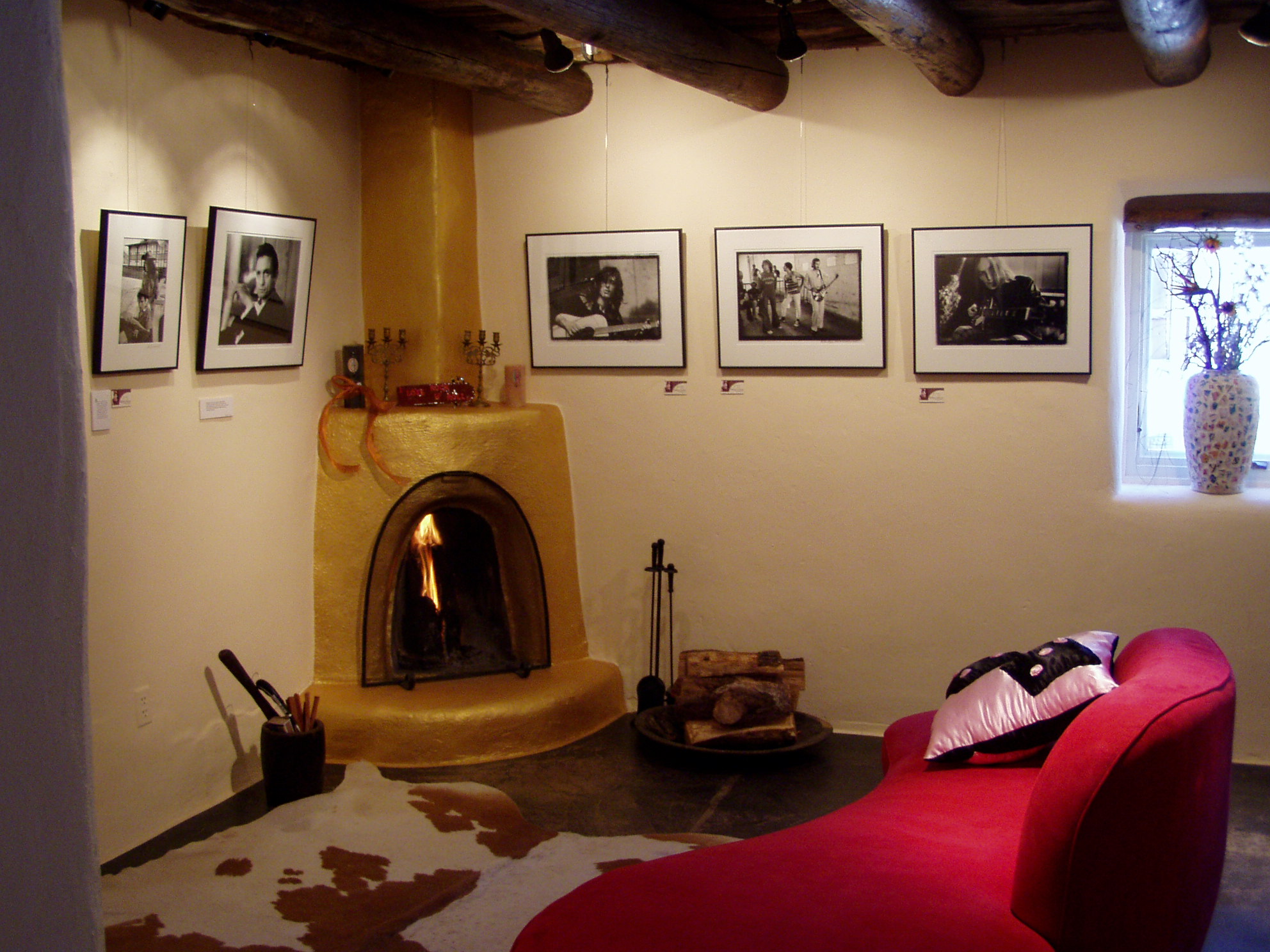
The sunset has settled into my routine. I watch it from the roof garden over our Adobe Home and Gallery every night. In the midst of dressing to attend an art auction at the Millicent Rogers Museum, the sun has vanished. The sky turns Taos blue; a luminous oil pigment canvas blue that appears like an endless tunnel you can walk through. As I descend the staircase and cross over the ménage of piles shoved in a corner to allow SC to paint, I think, “This is going to be my home. I’m still here” Adventures in Livingness
In the courtyard where new flagstone has been laid, and a mud ditch blocks the exit, Rudy hitches me on his back and carries me out the side entrance through Tony Abeyta’s yard. Tony’s yard is piled with sand from our flagstone project, and my high-heeled black suede shoes are not at all practical for crossing New Mexican dunes. This is how the evening begins. Out in the parking lot, we circle around once and stop in Robert’s gallery. He has offered me his turquoise squash seed necklace to wear at the auction. The necklace is from Turkey, and sells for $1,800. Millicent Rogers events always attract women with extravagant jewelry, and Robert knows I have no such possessions. He hands me the necklace and says, have fun.
At times like this, I can forget the faces and routines I lived in Solana Beach and feel swept into a labyrinth of unfamiliar vignettes. There are two police cars in the rear of the parking lot, the church looms like a fortress of wet mud, and SC is listening to The Band CD we picked up in Santa Fe. I slide into the car, ensuring my shoes don’t fill with gravel.
There is very little street light along the desert road, and cars approach you at disarming speeds. For newcomers, the pale yellow line that separates oncoming traffic, roaming animals, hitchhikers, leather-clad bikers, and abandoned pets is of no comfort or value. Boundaries and civilities between people are vague, and sometimes, conversations elope into poetry.
At the Millicent Rogers Museum, the director, Jill, who is there to welcome each guest, greets us at the carved wooden doors. This museum was once a home, like most museums in Taos.Each room is an envelope of Native American jewelry, ceramics, paintings, weaving, textiles, and metalwork sealed with Millicent Rogers’s ethereal presence. By coming to Taos and bridging her New York chic with southwestern individuality, she set global trends in fashion, art, and living. he museum collection includes some of her designs that evolved from her residency in the desert. She moved here in 1947 and died here in 1953. Although she could have chosen anywhere in the world to live, she settled in the unaltered, surreal lunar beauty of Taos.
I wandered through the tightly packed rooms, alternately viewing the guest’s attire and jewelry. The woven wraps, belts, and hats worn by men and women form a collage of individual expression. Almost everyone seems to attract attention by the texture and color of his or her attire. It is a festive traditional look, with southwestern accessories paired with jeans or silk dresses. If you come to Taos, look for a belt buckle, one piece of Native American jewelry, and one piece of art.
When the auction was announced, I admired the same etching as the woman next to me. She remarked that the artist was also the teacher of one of her children. I learned that Ellen had six children and 11 grandchildren. She was petite with curly blonde hair, and I liked her instantly. I told her I was a writer.
“So am I,” she answered.
Rather than talk about her work, she began talking about her daughter, who is also a writer.
“I’m so lucky–all my children and grandchildren are creative and artistic.”
It was obvious that her life was a garden of earthly delights and that she had raised many roses. When the auction began, she vanished, and I quickly viewed the art before returning to the two etchings. They were both sold.
As I was walking out, I bumped into Ellen. She was clutching the etchings.
“So, you bought them,” I said.
“Oh, yes, I had to have them.”
She left me with a beaming smile and a closing remark I often hear: “Welcome to Taos.”
I love hearing that so much I don’t want to stop saying, I just moved here. After the auction, we stopped in Marco’s Downtown Bistro, where we joined an improvisational party. It started when Marco introduced us to his friends, Pablo and Joan, who were visiting from Santa Fe.
The dim, glowing melon adobe walls of the bistro, Marco hugging everyone, Joan’s melodious, high-pitched laughter, Pablo telling jokes, Rudy laughing, and then Philip arriving to tell stories crossed over from strangers in a bistro to a fast-rolling film. The conversation and laughter surfed breathlessly from one person to another.
Joan remarked, “My fifteen minutes. This is the best for me. The first time you meet someone, you’re both talking without effort. It’s so perfect.”
We closed the bistro past midnight. Marco had gone home. Joan decided to stay at a friend’s house. Philip agreed to drive to Santa Fe the next day, and we took Tylenol before bed.
Not every night out in Taos is like Joan’s fifteen minutes, but chances are you will have something to write home about. The beginning of Gallery LouLou Taos, NM
OLYMPUS DIGITAL CAMERA
OLYMPUS DIGITAL CAMERA
OLYMPUS DIGITAL CAMERA
OLYMPUS DIGITAL CAMERAOLYMPUS DIGITAL CAMERAOLYMPUS DIGITAL CAMERA
“I respond to intensity, but I also like reflection to follow action, for then understanding is born, and understanding prepares me for the next act.”
JANUARY
SNOW, ARTIC BLAST, ICE, FREEZING. Maelstrom of inconveniences toppling down in every nook and cranny of body, home, and outdoors. I wore a long-sleeved liner, wool sweater dress, rabbit poncho, and over that, a wool wrap, laptop mittens, sherpa leggings, wool socks, and boots. Mornings, eight degrees, afternoons eighteen, and the absence of sunlight grids my spirit. Repetitive lessons in endurance, tolerance, and acceptance. The outer world stenches corruption, propaganda, cruelty, violence, and haranguing reporters. The election year dominates the bunkum reporting.
It’s been almost a month since I texted or called Dodger. Somedays, I enter the memories, a reel of episodes on our cross-country road trips, hiking barren, narrow, unclaimed paths in Baja, mountains and canyons in New Mexico, and lakes and forests in upstate New York. They appear to be aberrations of myself; I am unrecognizable as he is, too.
FEBRUARY
MATURITY has caught up with me, and I am viscerally aware of this pendulum as replacing the nonacceptance of my lifestyle and future to hardened acceptance, which is a relief. I used to be full of follies, gaiety, and impulse; inner choreography is now critical thinking, studied decisions, and a spoonful of distrust. Instead of unleashing all that I think and feel with strangers, the narrative is split between inching closer to listening rather than personal tete e tet. Once a week, I go outing to the social club, where I find conversant strangers,couples, singles, divorces,and a variety of ages, and yet they all have a commonality that I don’t, they seem genuinely satisfied with their lives, one comment this, after asking the bartender how are you, he smiled, slapped the polished wooden bar with both hands and replied, I couldn’t be happier. Then he opened his phone and showed me a photo of a baby boy. His expression soared through my senses, and I adulated with compliments. Another evening, I opened a conversation with a couple next to me, and for the next hour, I learned of their life; children, travel, cruises, especially, ” Oh, you’ve never been on one? You must go, you’re so perfect for a cruise.
” I’m uncomfortable with more than twenty people.”
“I don’t believe that for a minute.” Wendy was really fit to her name; she wiggled in her seat, her hands never at rest, and her thoughts poured like raindrops. Her husband, Christian, nodded a lot, and when he tried to speak, she ran right over him. A few times, he rolled his eyes at me. They’d been married thirty-five years, looked to be in their early fifties, and semi-retired. I left feeling love, had tipped our kinship, a surprising need to leap from trivialities to more substance.
My memoir, published in 2017, Cradle of Crime-A Daughter’s Tribute is old news to me. Not to Charlie. I met him as he was renovating a house across the street. I didn’t introduce myself as Luellen Smiley, just Luellen. I asked if he would take a look at myhouse for an estimate on painting. He was sweet, a mountain man with a long white beard and hunting boots. Last week, he texted me,” I read your book, my friend and I exchanged Goodreads suggestions, and I told him to read your book.” How did he connect me to my book? I didn’t ask, and now it piques my interest. I’d walk across the street and ask him, his truck is there, so is the ice, and I don’t feel like skating and falling on my butt.
Winter in upstate New York to a gal from Los Angeles is likened to living in the North Pole. Going on five years, my last, I’m not resentful and scouring, but I am not acclimated. Indoors I dress in sherpa from head to toe and wear those finger mittens. Today it is full-throttle rain showers. The street is vacated of traffic and the public, it’s a good day to work on my next book. On my desk area few writing books, the favorites: Henry Miller on Writing, The Diaries of Anais Nin, and Albert Camus’s The Stranger. I haven’t bought a current book in years, the last one was Sam Shepard, The One Inside. I like Miller’s passage: ” The writer lives between the upper and lower worlds.: he takes the path in order eventually to become that path himself.”
Aging in my seventies delivered opening windows to restoring, rearranging, and repairing my persona, personally and in public. If you’ve read any of my essays, then you know explicit is the vortex that moves my thread. Restoring the brick-and-mortar of truth is at the forefront; the next layer is a confession of what I cannot speak in person to anyone, even my closest pals. The third is abstaining from too swift a pen; I’m always in a hurry: I prepare food quickly, walk as if I’m late for an engagement, and wash dishes with perfunctory interest. Everything when I think about it. I know why that is, my father. His shadow was always behind me as I went about myteenage activities at home, so I rushed to get out.
Last week, I stopped taking the powerful Lorzapam medication for neurotic anxiety. My heart raced when I opened an email from my attorney, when a stranger knocked at the door, or when I entered a public place alone. A new sideways rain shower just filled the window pane above my desk. Here is the fourth restorative: get outdoors! I don’t walk in snow or ice, but good old water rain, which I call God’s tears, is one of my favorite nature adventures.
Admittedly, my writing has granulated since moving here. It is tiny in thought and not always tied up neatly. My persona in public needs to be side by side with wine in a dining setting. What I contribute must be joyous and humorous because one of my favorite human activities is to evoke laughter and smiles. I broke away from my taverns and abstained from alcohol for a week. In the second week, visceral and bodily alarms have gone off. I’m lucid, motivated, andeven decisive.
From Anais Nin Diaries 1939-1944.
“I respond to intensity, but I also like reflection to follow action, for then understanding is born, and understanding prepares me for the next act.”
Thanksgiving seeps into a day of light and dark, like a trajectory of blissful silence transitioning to watching the Macy’s Parade, then dancing around my bedroom to old-school hip-hop. Internally feeling more adept than last year, the solitude and absence of friends didn’t snake rattle me, it was more like a day of moving effortlessly between desires without contemplation or sorrow. As the year ends, the comparison of achievements and digressions seemed to evoke a visceral epiphany. I’ve always preferred less chaos and crowds to intimate gatherings, and being alone. Looking in the internal mirror, the reflection released a liberation of abasement, it is who I am, and if refusal of this characteristic triumphs, I will never feel self-affirmation.
Without that, life is an interior war.
I snapped this off a film, I cannot recall which one.
Living in Del Mar from 1982 – 1996 enriched my spirit, health, and distance running. Even though I’ve heard, you can’t go back, I’m striving to break that fact.
As children, our waiting depends on how long it takes Mom and Dad to finish what they’re doing and pay attention to our needs. It takes hold of us, like a fever, and we resort to nudging them, whining, even sobbing, If we are made to wait longer than we expected. During the school year, I waited all semester for the summer. In Los Angeles that meant it was hot enough to go swimming in the ocean.
When I lived in Hollywood, I rode two buses, to get to Santa Monica. The second bus dropped me off on Ocean Avenue, above Santa Monica Beach. I ran down the ramp that connects to Pacific Coast Highway and headed north to Sorrento Beach. I jumped into the sand running to find the place where my schoolmates clustered: in a caravan of towels, beach chairs, radios, and brown bag lunches. I couldn’t just run to the ocean, I had to sit and talk and have something cold to drink, and then I made myself wait until I couldn’t stand it any longer. Then I ran down to the shore, and embraced the waves, tumbling inside their grasp until I lost my breath, and floated into abandonment.
After I moved to Santa Fe I stopped thinking about the ocean, I had to remove the memories from my thoughts, so I could continue to experience this spark of New Mexico. The dry sage ocean of pink soil, and radiant blue sky that pinches your eyes when you’re driving, the sunlight, the warmth of a desert night, and the white snow on pink adobe rooftops. It had postcard perfection, even with fallen leaves spread like trash everywhere, the trees almost naked, and the dead plants in the garden. I tried not to think of the ocean, the look of the sea from watery suntanned eyelids, or from the bluff at Del Mar, or the splashing of waves around my shoulders as I tumbled beneath the surface.
I waited, as I did as a teenager, for that time to come in the fall of 2010, so I could return to the sea. I stood at the water’s edge in Del Mar, it was like summer without all the kids screaming, barking dogs, volleyball and paddle board games, lifeguards thrashing the beach in their jeeps shouting, ‘no dogs off the leashes, no glassware, and no surfing today’. They were missing, and so were the parade of beach runners, and surfers. In fact, I was the only one swimming, on that first day at the beach. Before I went into the water, I reclined on a big black boulder and faced the sea, letting my eyes wander amongst the scenes of the beach on a Tuesday afternoon. In front of me was an older man with graying hair, in a beach chair reading. He must be retired, he looked perfected adapted to his spot about five feet from the shoreline. I thought about retirement, and how I still cannot come to grips with spending my days on park benches or in cafes watching younger men and women live. There was one swimmer, on a bogeyboard, he was far out, and floating along, and I wished I’d brought mine with me, but it was in Rudy’s van. The last time I used it was when I lived in Solana Beach in 1997. I also wished I had a new bathing suit, because the one I was wearing was too loose, and the neck straps were tied together in a knot so I could swim without losing my top. The sun baked my body, and I let it without abatement, without shading my limbs or wearing a hat, just enough sunscreen to keep the rays from trotting over my lily-white skin. I closed my eyes and when I opened them, the waiting suddenly felt so imperial, so much so that I began to think about waiting as an aphrodisiac or something like a good cocktail that you have to make last for hours, while you wait for that moment that makes you feel immortal, childlike, and emancipated.
I felt the beach flies, and the tang of salt water on my lips, and when the seagulls swarmed above the water’s surface, like so many beads of a necklace, I thought, that this is about the most beautiful day I could have, and it’s all because I WAITED. I didn’t give up on the ocean, or my place in it, or believing that I would have my day in the sand, under a faded denim blue sky, with cotton ball clouds floating above me. I baked until the sweat drenched my pours, and then I raised myself up and walked slowly to the edge of the water. The surf made tiny breaks not enough to shatter my body warmth and I felt the first sting of the water on my feet, and then my knees., I submerged and found that the best way to celebrate this day was to keep flopping backward on top of each wave as it crashed, and I did this for a dozen rounds, until I felt giddy, submissive, and dented with the surf. That waiting thing again, meant something that I should write about because all of us are waiting for the election, the economy to recover, wars to end, streets to be safe and our real estate to be worth something again. We are all waiting for this big change so we can feel secure and optimistic about the future. There is something useful about waiting, something predisposed, that gives us the support and substance we need, so when the waiting is over, and we are all flush with optimism again, it will feel like the first time. It will overwhelm us with power and joy, like the ocean.
As children, our waiting depends on how long it takes Mom and Dad to finish what they’re doing and pay attention to our needs. It takes hold of us, like a fever, and we resort to nudging them, whining, even sobbing, If we are made to wait longer than we expected. During the school year, I waited all semester for the summer. In Los Angeles that meant it was hot enough to go swimming in the ocean.
When I lived in Hollywood, I rode two buses, to get to Santa Monica. The second bus dropped me off on Ocean Avenue, above Santa Monica Beach. I ran down the ramp that connects to Pacific Coast Highway and headed north to Sorrento Beach. I jumped into the sand running to find the place where my schoolmates clustered: in a caravan of towels, beach chairs, radios, and brown bag lunches. I couldn’t just run to the ocean, I had to sit and talk and have something cold to drink, and then I made myself wait until I couldn’t stand it any longer. Then I ran down to the shore, and embraced the waves, tumbling inside their grasp until I lost my breath, and floated into abandonment.
After I moved to Santa Fe I stopped thinking about the ocean, I had to remove the memories from my thoughts, so I could continue to experience this spark of New Mexico. The dry sage ocean of pink soil, and radiant blue sky that pinches your eyes when you’re driving, the sunlight, the warmth of a desert night, and the white snow on pink adobe rooftops. It had postcard perfection, even with fallen leaves spread like trash everywhere, the trees almost naked, and the dead plants in the garden. I tried not to think of the ocean, the look of the sea from watery suntanned eyelids, or from the bluff at Del Mar, or the splashing of waves around my shoulders as I tumbled beneath the surface.
I waited, as I did as a teenager, for that time to come in the fall of 2010, so I could return to the sea. I stood at the water’s edge in Del Mar, it was like summer without all the kids screaming, barking dogs, volleyball and paddle board games, lifeguards thrashing the beach in their jeeps shouting, ‘no dogs off the leashes, no glassware, and no surfing today’. They were missing, and so were the parade of beach runners, and surfers. In fact, I was the only one swimming, on that first day at the beach. Before I went into the water, I reclined on a big black boulder and faced the sea, letting my eyes wander amongst the scenes of the beach on a Tuesday afternoon. In front of me was an older man with graying hair, in a beach chair reading. He must be retired, he looked perfected adapt to his spot about five feet from the shoreline. I thought about retirement, and how I still cannot come to grips with spending my days on park benches or in cafes watching younger men and women live.
There was one swimmer, on a bogey board, he was far out, and floating along, and I wished I’d brought mine with me, but it was in Rudy’s van. The last time I used it was when I lived in Solana Beach in 1997. I also wished I had a new bathing suit, because the one I was wearing was too loose, and the neck straps were tied together in a knot so I could swim without losing my top. The sun baked my body, and I let it without abatement, without shading my limbs or wearing a hat, just enough sunscreen to keep the rays from trotting over my lily-white skin. I closed my eyes and when I opened them, the waiting suddenly felt so imperial, so much so that I began to think about waiting as an aphrodisiac or something like a good cocktail that you have to make last for hours, while you wait for that moment that makes you feel immortal, childlike, and emancipated.
I felt the beach flies, and the tang of salt water on my lips, and when the seagulls swarmed above the water’s surface, like so many beads of a necklace, I thought, that this is about the most beautiful day I could have, and it’s all because I WAITED. I didn’t give up on the ocean, or my place in it, or believing that I would have my day in the sand, under a faded denim blue sky, with cotton ball clouds floating above me. I baked until the sweat drenched my pours, and then I raised myself up and walked slowly to the edge of the water. The surf made tiny breaks not enough to shatter my body warmth and I felt the first sting of the water on my feet, and then my knees., I submerged and found that the best way to celebrate this day was to keep flopping backward on top of each wave as it crashed, and I did this for a dozen rounds, until I felt giddy, submissive, and dented with the surf. That waiting thing again, meant something that I should write about because all of us are waiting for the election, the economy to recover, wars to end, streets to be safe and our real estate to be worth something again. We are all waiting for this big change so we can feel secure and optimistic about the future. There is something useful about waiting, something predisposed, that gives us the support and substance we need, so when the waiting is over, and we are all flush with optimism again, it will feel like the first time. It will overwhelm us with power and joy, like the ocean.
My emotional tail is wagging; curled up in my desk chair. I feel almost as if I was born in this chair. It’s cushioned me through a cyclone of adventures in livingness.
This piece of writing was handwritten on a tablet back in late January. I’ve made some minor additions and deletions. My control over my writing is identical to my control over how I live. Acting on impulse, expanding the mundane into a musical, feasting on all the emotions, and fabricating thorny Walter Mitty encounters. I don’t even think of applying proven methods; I make up new ones.
This plateau of solitude and especially with yourself; with all your flaws. Integrity is more critical; be proud not just for yourself, but because someone out there needs you. Sometimes, solitude feels like a draft, and no matter how many sweaters I put on, the seclusion tugs at my bones. There are not a lot of senior soloists that reside in my village, the majority are family mothers, fathers, and grandparent saints.
If I am drawn into a canvas of what seems my destiny, I draw the opposite silhouette. I am the light against the dark. The green light in my head reminds me that I have some passion for almost everything that God and man created. I just can’t decide which passion to follow. Should I do a museum, gallery, lecture, cruz the country roads, go to a concert, dance at a club, engage strangers in conversation, watch old movies, or read more of the stacks of books on my bedside table. Should I interview the straggly teenagers in the park or hit up the high rollers? Should I write, submit or edit: clean the laundry room, make a fancy dinner, iron my clothes or clean the refrigerator. Living unstructured is a discipline that threads easily some days, and when it doesn’t, I have to control my passion for daydreaming.
Portrait of Martha Graham and Bertram Ross (1961 June 27) (Photo credit: Wikipedia)
THIS WEEK LANDS ON poets, writers, musicians, photographers, directors, visual artists, composers, choreographers, actors and the untitled and unrecognized that squeeze in between. Kipling, Salinger ( my all-time favorite) The Rolling Stones, Mozart, Chopin, Opera, Salsa, Beatles, Stieglitz, Nicholas Ray, Kandinsky, Johnny Mercer, Martha Graham Balanchine, and James Dean. I left out about seventy-five of my favorites.
Composition VI (1913) (Photo credit: Wikipedia)They were all lovers before they were artists.
OUR ARTISTS IN HEART travel mentally and physically through life with all the windows open; awaiting a sight, sound, or feeling that draws them to their art. The feelings are what count on our life ledger. I have to thank Billy, my first love at fifteen. He was an artist of music, Gothic charcoal sketches, comic humor, and life. He opened my window to the arts.
That life ledger is always in the red because an appetite of feelings, and emotions eventually depreciates the spirit. Some of us rise above, and the flow of printed green paper comforts that spirit, but emotions continue to dominate all the success.
I have to write this in short sequence, as I am moving between a rigid reckoning of a forever ending TO ONE MY LOVES.
With last names like Smiley and Funk, you know there’s bound to be something creative going on in the imaginations of this Ballston Spa duo. The couple, both natives of San Diego, Calif., purchased a house at 63 East High St. last May. Luellen Smiley and Rudy Funk have turned a once-ramshackle 1860’s structure, now known as The Follies House, into three furnished apartments oozing with zany charm. Smiley’s brochure touts the place as a “playful vacation residence designed to inspire.” On the wide front porch, a sign offers visitors “Free Records,” paying homage to one apartment’s main decorative inspiration: classic stage musicals. Called the Broadway suite, its walls are adorned with record covers, programs, ballet slippers and even a dance costume. There are dice on the end tables, a life-sized poster of Humphrey Bogart, colorful paper parasols and peacock feathers. For tenants who bring their own films, there’s a projector screen and, tucked into an alcove, a working Victrola. Vintage Broadway memorabilia is everywhere. Then there’s the nearly ceiling-height replica of a bass guitar. “This was actually a costume someone wore,” said Smiley, pointing out the head and arm holes. “These are the kinds of things we like, the really unusual andunheard of.” Growing up in California, Smiley aspired to be a dancer and maintained an interest in the arts.
THE FOLLIES HOUSE
In recent years, she became keen on the idea of renovating and decorating an older home, although the village of Ballston Spa was not first on her list. “When we first came here, I wanted to be in Saratoga, and when I drove through Ballston Spa I said, ‘I’d never want to live here,”‘ Smiley said. “But then we rented here, and I didn’t want to go back on the road. We loved this street. We think this village is really starting to happen.” The couple went to work feverishly last spring to ready the apartments in time for the track season. While not a bed and breakfast, the apartments are designed for temporary tenants — people new to the area or vacationers. Smiley’s off-season rates are $800 a month for the Broadway Suite and $700 for the Boomers Pad. The one-bedroom Boomers Pad is designed with vintage ’50s and ’60s furniture. Smiley said she and Funk combed area antique shops, including those in the village, for many of the offbeat pieces, including the vinyl records and oversized pink sofa. The house’s history mirrors the eclectic style the couple hasbrought to the home. “It was built by a man actually named Dr. Doolittle as a wedding present for his daughter,” Smiley said. “You can see the little touches everywhere. There are butterflies and sun rays carved into the woodworking and doorknobs. It’s a love house. It was built with love.” Smiley said she and Funk have combed files at Brookside History Center looking for old photographs of the house in order to decide what color to repaint the facade. “The exterior of the house is next on our list, and while we haven’t located any photographs, we’re thinking pastels,” Smiley said. “Inside, we used a lot of pistachio and pink.” While Funk commutes to and from California for business purposes, the pair weathered their first winter this year, relying on the kindness of neighbors for jobs like snow-blowing. “We’ve never seen winters like this,” Smiley said. “I’m from the other side of the world. But this is a very supportive community. That’s one of the things we love about the village.”
Smiley has immersed herself in the closely-knit community, joining the Ballston Spa Business & Professional Association, the local chamber of commerce, and helping promote an upcoming Art Walk. The Follies House recently was given a beautification award for significant improvements during the past year. In her brochure for potential tenants, Smiley points out area highlights including the Saratoga Performing Arts Center and destinations within the village, such as the museums, the glassworks studio, Art Ink., and the new gallery and loft spaces on Low Street. Smiley said she also recommends people take a stroll along East High Street, a historic district known for its Victorian homes. “I’ve seen little villages, big villages — but what I see here is the most beautiful village,” Smiley said. “The potential is here. There’s a sense of magic here and the transformation will happen. I’m certain of that.”











 ADVENTURERS IN LIVINGNESS