

As a child I understood in a subliminal fashion that my father was unlike other neighborhood fathers who left each day to go to the office. My father worked from our home in Bel Air, California, and hotels: The Beverly Wilshire Hotel, the Bel Air Hotel, The old Beverly Glen Terrace, and restaurants: La Dolca Vita, Matteos, Copa de Ora, Scandia, La Scala, Purinos, Chasens, and building lobbies, parking lots, telephone booths, and race tracks. Sometimes he talked about a really big deal he was working on, and other times he said he was returning favors. The exchange of favors between mafia associates was written about way before I came along, by Damon Runyon and Mark Hellinger.
Deals and favors are what I understood as my father’s business. This kind of business made him available to me during the day, while other father’s had left their homes to go to an office. From the outside looking in, we were a stylish Westside family, with colorful friends, members of Sinai Temple, and frequently seen in the company of established doctors, Oilmen, and attorneys. My mother went door-to-door as a Red Cross Volunteer, and my father’s charity supported the United Jewish Federation Fund.
Our next-door neighbors were movie actors: John Forsythe, Burt Lancaster, James Garner, and Peter Morton, the legendary founder of the Hard Rock Café. Peter was a few years older than I, and I loved his mess of tousled curly brown hair, and his gentle birch brown eyes, slanted into the curve of sadness. I waited for him on some mornings to walk me to the bus stop. I remember he looked after his little sister, and maybe I needed looking after too. The memory of his kindness is sealed. Most of the families in the circle had children, and it was only natural that we played together. When Dad’s name was inked in the Los Angeles Times for Mafia activities, all the kids quit meeting at my house, and many friends at Bellagio Elementary quit coming to our house.
In the foyer of our home, there was a wall mirror and a wall-mounted table. That is where my father kept his grey fedora and trench coat. I remember the times he dashed out of the house with the coat and hat.
“Daddy, why are you wearing your coat and hat today; it’s not raining?”
“I have to be ready for anything, little sweetheart. Daddy never knows what the weather will be like out there.” The answer was a riddle, like almost everything my father taught me. A simplistic statement on the surface, and a double-down meaning hidden inside. That is how he communicated with me, and it had a purpose like everything else.
When I was five years old, my father took me out driving in his powder blue Cadillac. He made regular stops to meet a guy about something, had the car serviced and washed, visited a friend, stopped in telephone booths, and Schwab’s to see if there was any action. He loved to sing in the car, with all the windows rolled down, and his arm wrapped around the back of the leather seat. He was as relaxed driving his car as he was lounging at home on the sofa. He drove with one hand while he sang,
“Que sera sera.” When I asked him what it meant, he said,
“Whatever will be will be, the future is not ours to see, Oue sera sera–that’s the song of life, sweetheart.” He didn’t pay attention to stop signs, signals, or fellow drivers; he perceived them as second in line. Once a policeman stopped us as we were driving out of Thurston Circle, and my father opened the car door, got out, and moaned, “Oh my God, Oh God, I’m having a heart attack!” I watched him and yelled out, “Daddy, Daddy–what’s wrong?” but he kept howling. The policeman didn’t take notice at all. “I’m having a heart attack, let me go officer, I can’t breathe you SOB. You’re going to kill me!” By this time, I was crying and making a lot of noise in the front seat. The policeman then approached my father and handed him a ticket while my father continued to wail, “HEART ATTACK.” After the policeman drove away, my father got in the car, steely-eyed and swearing. “Stop crying. Stop that right now! Can’t you see I’m all right? Daddy just pretended to have an attack. That stinking cop is always hanging around here. He should be ashamed of himself. Policemen have better things to do than give tickets.”
“ You’re not sick?” I mumbled.
“ No, of course not. Don’t tell your mother about this, sweetheart; she doesn’t understand these things. Remember now what I told you, when I say something, you listen, and don’t question it. I have reasons for the way I do things. ”
Adults try to deceive children with whispers, false identities, and lies, but a child has a superior emotional vision. From that day on, I was always watching my father closely to see if he was acting or playing it straight. The memory is like a sealed stamp; even the narrative is almost exactly as I’ve written.
The outings gave me a chance to meet dozens of men and women who exaggerated their feelings for me with overt gestures that I sometimes recognized as acts. Picking out genuine friends developed into a sense I couldn’t necessarily ignore. It got in the way of my comfort around many of my father’s associates later on in life. Nothing seemed to please him more than to present me to his friends, and wait for their praise, “You’re lucky to have such a beautiful little girl, and so well behaved.” I remember this line because it is the same line I heard throughout adolescence. My behavior was conditional on my father’s mood. If I misbehaved, spoiled my dress, or broke something, it would ruin everything. My father would blame my mother, she would retreat from the living room, and I would be left alone. This was the second of the lessons, I learned very young, not to make any mistakes. ‘One error can ruin your whole life’, he told me on all the occasions that I erred.
Today, it’s not too surprising that I am ready to sit in the front seat with a man of choice, while he drives around and shows off his driving and leadership skills. It’s not that I just don’t get excited about driving myself, it is one of those childhood activities that evolved into a life long course of pleasure.
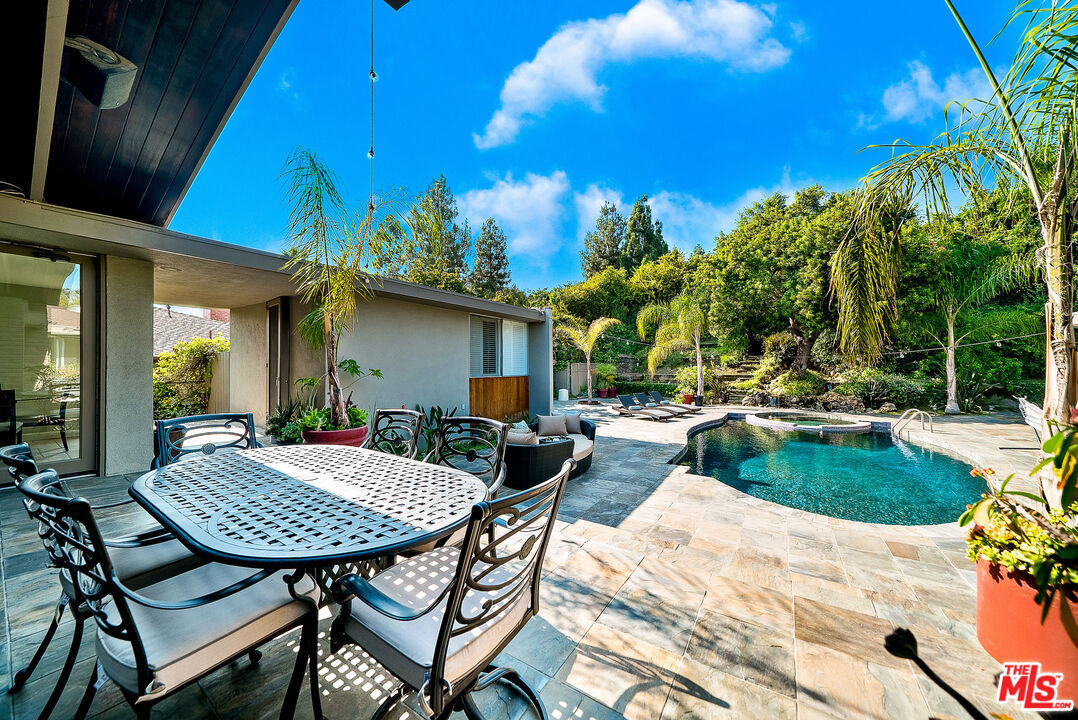
When now, I have finished this personal essay I began two years ago, I went looking for images. A photo of the house I grew up in at 11508 Thurston Circle popped up. Our home burned in the Bel Air fire in 1961, so I viewed the photos of the house built on the lot after Dad sold it. All postmodern, nothing like ours, except this photograph I chose, the swimming pool he built, another childhood activity that evolved into a life pleasure. The house is listed for sale at $2,075,000. Dad bought our home for $50,000 in 1955. Not one place I’ve lived compares to the idyllic life in Bel Air, and that is why I keep moving from city to city, and home to home, like a rolling stone.


 ADVENTURERS IN LIVINGNESS