beijing bamboo walkways and dog pyschology (Photo credit: rejon)
in beginnings. Starting over, and rewriting a life you’ve lived many years is the same as re-writing a secret story. It takes the same blind courage. About half between forty and fifty years old, you hear people say, “It’s too late to start over,” It’s not true. Behavioral change is essential to living a full life.
In the middle of the night I woke up as if it was morning. When I looked out the window, an almost full moon, white as a laundered tablecloth, was staring back at me. It said, get up and write. I retreated to my corner of the world; a tiny room bathed in blush pink and gold, and I wrote. The moon watched.
Our nest, is something we build on our own to give us permission to explore, and then question, and we go back to our little nest, and add a bit more certainty because the dinner was great, and the party lasted longer than we thought, and someone smiled at you in a special way, and then you saw a rainbow.
Some things happened last week; that liquefied into a mirage, of an opinion I inhabited. I directed this opinion with outdated information, and second hand narratives by writers in print. I believed what I’d always believed; that actors aren’t like you and me. I was wrong! Some actors are like you and me. They have open hearts, and inquisitive minds, they drink beer, and dress without designer labels, they like to hang out, and not talk about the movie business, they have interests beyond their Imdb star rating, and they answer questions, if you ask them. Unless we infiltrate what we criticize, we’re adding to the hypocrisy of the human condition.
I read in one of my books on writing that the middle of the novel is where most writers face the demon. The beginning is a gallop, the end is a relief, but the middle wiggles in and out of your grasp. The middle of our lives reflects this same obscurity.
The middle of a life span reflects all we have accomplished and all we have left incomplete. This is what they call a mid-life crisis. I get it every year. This year it is more comical. I’ve finally accepted that my constant relocating, reinventing, and being restless are not going to be solved. I am going to keep doing these. At the bottom of the restlessness is the fear of finding rest more enjoyable than movement. This flotation of comedy rotated around me last night while I was standing out on the porch observing the peacefulness. The scenery of Santa Fe is a comforting, ethereal beauty that comes at all times of the day and night, and the flow of people is integrated and festive. All I could think of was where I should go next. The discomfort of mid-life comes from trying to assimilate what you have and what you want.
Many years ago, in the summer of 1987, I was seated in a café in Monaco, truly, and a man that I was traveling with told me, “You have to make a choice.” He embarked on a long discussion about choices we make in life and how everything depends on these choices: how you live and with whom, and what you do. He pointed out to me over my first really authentic Salad Niçoise that I was an oblivious example of a woman refusing to choose. I was more interested in the salad, the yachts, the casino around the corner, and the fact that I didn’t have an evening gown to wear to dinner. I listened without argument or insult, but I was disturbed by what he said. I didn’t understand completely, but he was older and had much experience and conviction. That conversation now fits into the mid-life crisis, the comedy of errors in my life, and maybe in yours, and just how much travesty we can ignore. For my fault, as it is, I do not want to sign, commit, or make final decisions. I want it all to be a temporary placement that allows me the freedom to change.
I have lost track of my European friend, but if he met me today, he would say, “You have not changed at all.” So that is why I was standing there in the darkness on the porch and laughing like a silly girl, because it is true. I have not changed at all.
The choice facing us at mid-life is making a change now, risking losing all we have accomplished, compiled, and attached, or throwing the dice.
Beyond the obvious changes in activity, relationships, and scenery are the internal travels. They are not so easily booked. You cannot wake up one day and say, “I ‘m off to become more compassionate, or more practical, or more generous.” These journeys are taken when other factors play into our lives, such as when we get sick, demoted, or experience a trauma.
It is a very subtle inconsistency. When I unplug all the voices and listen to the one that understands, that is when I write. The middle of the story and the middle of life are the same. We and our characters have to make a choice.
Adventures in beginnings, starting over, and rewriting a story you’ve lived many years is the same as re-writing a story. It takes the same blind courage.
About half between forty and fifty years old, you hear people say, “It’s too late to start over,” It’s not true. I hope it never feels like that when I wake up. Just thinking about it makes me run in circles. Behavioral change is essential to living a full life. In the middle of the night I woke up as if it was morning. When I looked out the window, the moon was white as a laundered tablecloth, staring back at me. It said get up and write.
I retreated to my corner of the world, a tiny room bathed a blush pink and gold, and wrote from beneath the goose down comforter. The moon watched. Now that the lights and decorations are placed in the cartons, the wrapping and ribbon tossed away, a landfill of disturbing, distressing, and terrifying global news is dumped on us. I do not understand the external world of political and international power, wealth, and motivation.
I fled that world a long time ago when I learned that men who controlled the paths of others were dangerously self-serving. I recall my father sitting on that green velvet sofa, holding the remote in one hand and watching a news program. He turned it off and said to me, “Luellen, everything that goes on is fixed; you cannot hide your head in the sand and think otherwise.” I nodded my head in understanding, while internally I thought my father was suffering from his usual psychosis. Eventually I crossed over, and forfeited my interest in politics. The forces of evil have shattered that glass of indemnity.
This year is not about vapid resolutions catering to our comfort, it is about survival. It’s about transforming behavior and habits, excesses and denial. Doing it in a group, makes us feel less traumatized. Imagine, all the thousands of people paddling the same current; forcing back the mortgage lender, relinquishing precious possessions, driving a car with a shattered windshield, wearing coats without any down feathers left, and wondering when the pink slip will arrive. Alienation and neurosis are at the root of people’s aggression and discontent. It can lead to unexpected violence, and then to massacre and war. It is a collection neurosis that grows worse every year.
The inner world, where each of us faces a truth no one else knows, is ruptured. All I can think of is bringing a little bit of light to someone you know is in darkness.
The throw of the dice this week falls on chapter One. Like any creative endeavor, the work is organic and has a life of its own. A garden doesn’t always grow with your plans; there are seeds that fall outside of the planter. There are disasters that drift though our arrangements and cause chaos. I am beginning to believe nothing ends how we imagine it. A beautiful day is hijacked by a tornado, a child is murdered while taking a walk with a girlfriend, and a chapter runs away from the author.
The desk where I sit and write is engulfed with books files, index cards citing important events, and characters, note pads, FBI files, and outlines. Period photographs are scattered through-out the room to further sedate any intrusion of the present. I live in a cubicle of my parent’s and famous gangsters.
I was writing a lengthy portrayal of Ben Siegel one day and it occurred to me that he had become a major character in my life. He played a role that someone else should have; a noted author, or journalist, or poet. Ben Siegel changed my history because I had to learn to love him. Learning to love him, meant erasing everything I had read or heard. It is said he was a ruthless killer, a savage, violent, and he loved to kill. I turned my head to look at a photograph of my mother. I was told that she loved Ben too.
Where once I believed my mother was naïve and uninformed about Ben; now I know this wasn’t the case. She knew from the beginning. I‘ve read the news articles of the day, the columns, and I’ve spoken to people who were there. My mother traveled by train to New York with my father, Ben and Esta, and the FBI was in the next compartment. My mother fit into this strangely singular and controversial group of people. A long stemmed Irish Catholic beauty, an original John Robert Powers Model with a future on stage, in film and in print was friends, very close friends with the wives of Ben’s group. I see her in the full frame of who she was, and not the imaginary mother. I like her this way because it reduces the outrageousness of my former years.
Why I continue to seek answers and probe into their lives is because they never told me anything. Children feel the repression of truth as clearly as they do the pain of bruise. The more you hide the more they seek. At my root is the inclination to question the world around me, and to mend the breaks in our lives.
Along the way of the first chapter, I discovered that people like to know how it works, how we write in a state of solitude and selfishness. It seems unnatural until you pick up a book. While a story is moving through the author, they or at least I refrain from answering the phone, checking email, or listening to the voices downstairs. A story or any work of art lives in the artist, it sounds sort of spooky, but that is how it feels to me. So when intrusions come, these disturbances are exaggerated into surrealistic proportions.
I could easily write about the life of the hotel across the street, the many characters that take care of the guests, and the grounds. It would be an easy writing assignment because I am not related to the hotel. But writing about your parent’s, the people who introduced you to the world is like grinding down your memories from stone to powder, and then picking up each grain and examining it’s meaning.
At the end of the day, as other lives intersect with mine, I see people engaged in human activity, the stimulation of common interest comes from living among people and their needs. In writing you interact with your head. The narrative is like water; it can run smooth like a river over all the rocks and debris or it can break into a million bubbles and lose everything.
When it breaks apart like a wave on the beach, you begin again, and the erosion of impatience and self-doubt allows you to continue.
Free your mind and the rest will follow; the words from EnVogue’s latest release played all day on the radio. Every time I got in the car to hunt up real estate listings, I heard that song.
I worked in an industrial building along an industrial highway in San Diego. I shared a warehouse with twelve men, eleven of them tall, weight trained football on Sunday guys, who ate at expensive restaurants amongst a club of commercial real estate agents, where they’d be noticed. They were pretty decent guys, except the partners who each had severe a case of ego malnutrition and competed for attention like two tottlers. Greg was the only short one in the bunch, and he wore a rug, manicured his nails, and surfed on the weekends. He was always talking about his Karate black belt, and how he knocked guys out. He rarely laughed and when he did he sounded like a chirping bird. Greg used to give me his wife’s unworn clothes and waited in my living room while I tried them on. It was sort of strange, but he never played the trump card and asked for anything in return.
One day in the summer of 1992 I called the office secretary.
“Gail, I’m not coming in for awhile. Will you forward my calls to my home?”
“Are you all-right?”
“Oh yea. I’m fine.”
“What should I tell Sam?”
“Tell him I’m on leave of absence.”
I lived in a little cottage house in North Park. It was all white with a picket fence and a squared grass yard where my dog played. The front room was small but the carpeting was new, so I could curl up on the rug and watch the clouds from the windows.
I threw my nylons and navy pumps in the garbage, and folded the business suits into boxes. I knew I wasn’t going back, but where I was headed was a throw of the dice.
Mornings I ran through Balboa Park before the crowds arrived, and got to see the zoo keepers feeding the animals, and the actors going into The Old Globe Theater. I filled my senses with virgin light and morning silence, unfamiliar sensations to office workers living with florescent lighting and partition walls. In the afternoon I lounged around in sweats watching music videos, reading magazines and dancing.
I watched some new music videos, maybe EnVogue or Bobby Brown, and tried to imitate the hip-hop moves on the carpet. It was like watching a cat in the snow. I called all the dance schools, and no one was teaching hip-hop. I didn’t know back then my mother was a dancer; so this impulsive and implausible scheme to start a dance troupe startled me as much as everyone I told.
The last lease deal I did was for a group of soccer players from Jamaica. They needed a space to open a reggae dance club. They told me they’d called other agents and no one would take their business. I found a disheveled warehouse and struck a deal for them. They fixed up the warehouse themselves, with colored lights, and some tables, but Rockers was really about the dancing. I walked into the club one night, and they were all doing their part; greeting customers, spinning vinyl, and serving drinks. I danced with Leroy, the leader of the group, and watched him unfold from the waist down. He danced so low to the floor, he appeared boneless.
“Leroy, I’m going to start a dance troupe. You guys inspired me.”
“What kind of dance?’
“Hip-Hop and jazz funk.”
Leroy covered his mouth with one hand and laughed.
“What’s so funny?”
“You’re a business woman; I didn’t know you was a dancer.”
“Well, I took lessons a long time ago.”
“Hip Hop?”
“No, Jazz. I’m going to find the dancers to teach. I know there out there.”
“Yea, they out there all right; lots of them.”
“Well see! I’d like to use your space, pay rent of course, when you’re not open.”
“Well that’s all right. You don’t need to pay me.”
I hugged him, and he shook his head. “I don’t think there’s much money in teaching hip-hop.” he said.
At the community college I posted a sign for dancers, and observed some classes. When I got the call from Piper, he asked me to come see him teach at the Church on University Avenue. I drove over one night, and found Piper in a little room upstairs, teaching Jazz Funk to one woman. He was tall and lanky with a smile that creased his whole jaw. He came over, shook my hand, and said, ‘How you doing? I’m Piper.’ He wore an immaculate shield of confidence that defied his nineteen years, and moved at the intersection of Michael Jackson and James Brown. The groove spiraled through his body.
“I’ll help you get it started; if you’re not a trained dancer you need help.”
So Piper and I met every week and finally landed on a group that incorporated Jazz-Funk, Hip-hop and Afro-Cuban. I named the company United Steps Dance Productions, and the Jammers were the hip-hop troupe.
I’ll never forget the look on the partner’s faces when I told them I was starting a multicultural dance troupe. They just stared at me blankly. Then within weeks all five of my unclosed lease deals were signed at the same time. I walked out with enough money to live six months. That was real security in my mind.
Piper and I held our first audition at Rockers. When I opened the doors that morning, dancers were already lined up outside. They came dressed in street clothes; wearing scarves, baseball caps, loose pants, and tank tops. I watched them leap, kick, split, and turn inside out for the job. I knew that I was in the right spot. One dancer walked out, stood still for a moment, and then leaped into a break-dance pop-lock routine that silenced the crowd. “Him Piper, definitely him.” He’s bad, yea he’s real bad.” At the end of the auditions, Piper mocked me.
“Lue, we can’t sign every dancer just cause they hip-hop. Anyone can do that.”
I can’t hip hop and it’s my company.”
“Yea, and you’re crazy. I swear, Lu you’re crazy.”
We agreed on pop-locker Vince-Master Jam, and Monique, a young Afro-Cuban dancer. That was the beginning.
When Vince and I met, he told me he lived in Escondido.
“But that’s an hour away.”
“It’s cool, I’ll be here. Just give me the chance.”
Vince showed up twice a week at night for his class. Many times, we sat in the cold damp club, listening to music and Vince tried to teach me to pop-lock. I apologized for not having students and he looked at me, and said, “ Don’t worry Lue, will get it going on.”
Our first performance was at the Red Lion Hotel. I hired a video tech to record the performance. We got a free dinner and a hundred dollars. We had a good crowd, and everyone loved them. Afterwards in the dining room, they were talking, laughing and elbowing each other. Piper was ranting about Monique taking too much time, and Vince was telling Piper to chill because Monique was so good. I sat there just listening, with a big smile on my face.
The Jammers belonged to the no smoking, no drinking, no drugs group. For the first few months, they taught on tiled floors under a leaky roof, without any heat. But they kept coming back to teach and their dedication moved me to find a better location. We relocated to a well-heeled Health Club downtown San Diego and the classes filled up with students, dancers, and office workers searching for a new lunch. They came from all different races; Asian, White, Hispanic and Black. I danced with the classes and promoted our troupe. The Jammers laughed at my attempt to be a soul sister, and I laughed with them. We were reviewed by KPBS magazine, and a photographer took pictures of us and featured us in the magazine.
Searching for gigs proved to be an exasperating struggle. I called department stores, festival producers, shopping centers, nightclubs, hotels and everyone had the same line, “I don’t think hip-hop is right for our clientele.”
When I ran out of money I took a job managing a condominium project, where I lived rent free. After a time of observing the Jammers self expression, I asked myself, what is mine? I still refused to get on stage. Vince used to bawl me out because I made Piper introduce the group.
After two years Piper moved to Los Angeles to launch his dancing career, and I let Vince take the troupe where he wanted it to go. He turned it around, adding twelve dancers and broke more ground in San Diego. Monique developed into a serious stage actress and we all lost touch. They were the sparklers in my life; like that star you think you’ll never hold. I left the Jammers a different woman. They put the rhythm back in my spirit and soul.
When I recently located Vincent on an Actors website, I called him right away. He is a missing link in the chain of my life. Without that adventure, I might still be imitating the kind of business woman I wasn’t. We met in Los Angeles, and watched Vince perform in a club. He kept his vision and now acts on television and video. “ Lue, now you have to find Piper.”
It was Piper, who said to me one day after reading some of my poetry, “ Lu, you’re not a dancer. You’re a writer.”
Any dice to throw Email: folliesls@aol.com
I rose at 3:00 AM to turn the heat on, pick up my writing journal, and discern the week’s theme.
The house is unfamiliar at this time, as it is my first middle of the night experience here. I wonder for a moment if I should boil water for tea or coffee, and settle on decaf. Alice and Bugsy follow my footsteps, circle their feeding table, and then begin to cat play. Bugsy gallops around in circles and Alice watches. Their presence kindles the stark rooms. While the water boils, I step outside to the porch I hear the distant sound of pounding surf and sit down to listen. The moon is shaved from the fullness of the previous night, and reflects my own disposition.
The street is hollowed like a tunnel, the light of day is shining in some other distant country, and the sky is appears tinted with primer. Somewhere someone is dressing for work, breathing by the tick of the clock until he must report for work.
The draft of sleep lingers in my eyes, and my feet shuffle on the cold tiles, while I grind the beans and think through the remains of the week. There are themes to our lives. Sometimes a year, sometimes one single day launches the theme, or it may just tumble into our path unexpected and replace whatever we were holding on to dearly, and deliver something unpleasant, like sickness, or separation. The sensations leading up to my theme jilted my creativity, and the pages I wrote were jammed with contradictions, maybe they still are.
Thoughts begin to form and ruminate, what is important? The theme of my week began when I was informed a Frog’s member I knew only slightly died very suddenly. From that day on, conversations, books, and televisions shaped the theme.
I see what is in front of me, and I am dissatisfied with the surroundings. The temperature, color, textures and placement of furnishings is flawed, and I have abated good temperament, creativity, and affection. I have tried to replace my incompleteness with substitutes: new shoes, scarves, and half a dozen books. Ah Hah! I have caught the intruder, the inconsequential arrangememt of new stuff.
Several more incidents aided my awakening. One came while reading Mark Twain’s “Following the Equator, A Journey Around the World.” It is a first person narrative of his lecturing trip on a sea voyage around the world bound for Australia and New Zealand. His diary pages are as powerful as water sprung from a fire hydrant; and I flowed into the adventure with him. A few days later while I was vacillating between reading and watching television I channeled onto a movie, “Shadows Over Tuscany.” Harvey Keitel emerged as a familiar character; a writer who has stopped writing. Along with the added irony of his resplendent surroundings in a villa over Tuscany, he still could not write.
I have settled into a corner of the sofa by the light, and now Alice is purring into my robe. Writing with pen is so different from keyboard, journaling is always with pen, but columns are on the keyboard. The next incident occurred in conversation with a woman who relayed her elated experience from meditating. She asked me about my own source. I understood that to mean what tranquilizes all the peripheral complaints, mental pains and wounds that lie dormant or at least manageable. Without thinking of the tormented hours, I thought of the comforts of exhibiting my life on paper.
The shallowness of that answer makes me uncomfortable. I return to the porch for one more gulp of landscape that I share with the stars.
The street is unfamiliar, a temporary scene like a bus stop, and I am merely waiting to move on. The neighbors are strangers, and stories do not blossom here. My desk is sealed into a corner of the bedroom, and too small to stack all my photographs, books, notepads, and dice mementos.
It is not the act of writing with pen and paper moving along at a steady rhythm; it’s the activation of the heart and mind, collaborating to unravel the relevant from the irrelevant. To reach this state of matrimony a writer needs not a Tuscan Villa, or a Moorish Castle, but experiences that flake off the skin, or recall of the experience that gives it relevance. A story is flickering at my source, asking to be written and I’m avoiding the introduction. Fear is shining like a spotlight on one end, and insecurity is the temperature that stifles my pen. It is not the cold tiled floor, and cramped desk.
I wrote a novel in a 99 square feet room that SC and I shared for a year and a half.
If I continue to roam around the task of writing this story, the intensity of irritation will escalate, my neck and shoulders will not loosen, my walk will be feigned, my smile forced, my heart longing for padding, my ego striving for recognition in the wrong places, and my soul roaming the hallways at 3:00 in the morning.
My spineless spirit that sends me out shopping for shoes, scarves, and earrings will finally halt. I will return to shopping for inspiration, courage and confidence that I can write the story. folliesls@aol.com
On Sunday afternoon, while I was sitting in the bridal room at Neiman Marcus, I was in a head on collision with the past and the present. I was not in the bridal room to buy a wedding dress; I was there to store my mink coat. While I waited for a sales clerk, I imagined myself in the chic trench coat with diamond buttons hanging from the rack. If I did have to choose a bridal gown, it would have to be something unconventional, like my mother chose. She wore navy blue taffeta to her wedding. If I did get married, I would have to save my coins for a long time to pay for the reception. Where would I get married? At one time, I dreamt of the Bel Air Hotel, but that was in the 1970s. With inflation, the wedding would cost no less than $100,000 today. By the time, I saved that much, I would be 100 years old! Besides the hotel is not the same. The last time I dropped by, I was chased out of the river walk for taking photographs of the swans. Just before my father took ill in 1982, he told me my wedding would be at the Flamingo in Las Vegas. I remember it, as if it was yesterday. We were walking together in Holmby Park, where he walked his five miles everyday. Very often, he stopped at the public phone booth and made a few calls. He whispered so I could not hear his conversation. I know now he was laying his bets for the day. I waited on the green lawn watching the older men and women playing Croquette. When my father returned from the phone booth, he looked perturbed. That meant he lost money on that day’s sporting event. We walked a long time in heavy silence until he decided to break it.
“You know, I’m very proud of you.” He said looking straight ahead.
“You are?” I was stunned.
“Of course I am! I hope you don’t think any different. I have not said it often, because I’m coaching you all the time, so you will be independent, and know how to look after yourself, after I’m gone. I don’t want you to fall into a rut with the wrong fellow, like so many women. It can ruin your whole life.”
“But I haven’t accomplished anything really great…. like you.”
“What the hell are you talking about!” he stopped in the middle of the path. “I made more mistakes than you ever could. Are you kidding sweetheart, I broke all the rules, and made some new ones, and I’ve paid. Like I’ve always said, you make your bed, and you lie in it. I’m proud of the career you made in real estate, without any help from me. Now you have to concentrate on the right fellow. When you do get around to finding the right one, we’ll have the wedding at the Flamingo.
“The Flamingo? Do you still know people there?” I asked timidly.
“Of course, I was a major stockholder … at one time.” Then he cleared his throat, and I wondered if he was choking on the memories. “That’s where Mommy and I had our wedding reception.” I thought of the photographs of Mommy cutting the white cake. It was the first time he ever mentioned my wedding. It was the first time, he seemed to say, okay find a fellow, and I’ll let you go. I sensed his detachment from everything around us except for me.
“I would like that. How long has it been since you were there?”
“I didn’t want to set foot in that place after Benny… (Benjamin Siegel) I didn’t care if the whole place burnt to the ground. There’s no reason why you can’t have your wedding there. I can still arrange a few things.”
The vision of father, my future husband, and me was an aberration without incident or purpose at that age. However, he was dreaming that the day would come soon. When the sales clerk finally appeared, I was glazed over, in some marbled state of melancholy, clutching the mink coat on my lap. The mink is the oldest garment in my closet. My father gave it to me in 1978.
It’s as if it happened yesterday. My father called one Saturday and asked me to meet him at Mannis Furs in Beverly Hills. When I arrived, my father was seated in a chair, facing a three-way mirror. Manny rushed over to greet me. “This is my daughter, Luellen, “Manny bowed and kissed my hand. In the other hand, he was holding a mink jacket. “Try it on for size,” my father ordered. I hesitated, and looked at him for explanation. It never occurred to me I would be trying on mink coats. He was always asking me to meet him in shops, and restaurants. He held meetings wherever he knew people, so I assumed he had a meeting with Manny.
“Go on—try it on. I didn’t say I was buying it, I just want to see what it looks like.” Manny tucked me into the mink coat, and pulled the waist sash through. He stroked the fur up and down, and then I did the same. The coat was solid, like a cloth wall that buried my body in warmth. I stood before the mirror and watched the transformation.
“Turn around, “my father ordered. I took a few steps in a half circle and slipped my hands into the pockets, and turned around slowly as I’d seen my mother do. Suddenly his eyes welled up with tears and he took out his handkerchief.
“If you dressed in a proper outfit and not those silly jeans all the time, you might look like something!” he barked.
“Well I didn’t know I’d be trying on minks today.”
“What the hell did you think you’d be trying on, pianos? For crying out loud! “I don’t know what you’re thinking sometimes. Take it off.” Manny untied the sash and took the coat. My father was in a mood, it was my fault again. I shouldn’t have worn jeans. Why did he start crying? Manny disappeared, and my father stood in front of the mirror to affirm his reflection. After he took off in his Cadillac, I stood in front of Manny’s and looked at the mink coats. He never mentioned it again, but I knew the coat was going to show up one day. Six or seven months after that first meeting at Mannis, the mink appeared at Chanukah.
“Daddy, this is so extravagant, I won’t have any where to wear it.”
“Oh yes you will! Just wait and see. If you quit going out with those misfits and find yourself a decent fella you’ll have numerous occasions. That’s the reason why I gave it to you, so don’t misuse it!”
When I left Neiman’s I was drenched in his memory. The mink coat has outlived all of my possessions. Every time I put it on, I’m reminded of his wisdom. It’s not the expense or signature status. When I put it on, I feel transformed. I discovered the bill of sale from Manny’s, and the balance due, after my father died. I called Manny and asked him for more time, to pay it off. He told me to forget about it, my father had brought in so much business to the store.
Last year I called Manny to see if I could have the coat remade into a vest; as the sleeves were too short. ” It’ll cost you the same as the mink,” he told me. I had the holes repaired, and the coat glazed and will pack it in the suitcase for the trip to New York, now thrity two years later with a decent fella.
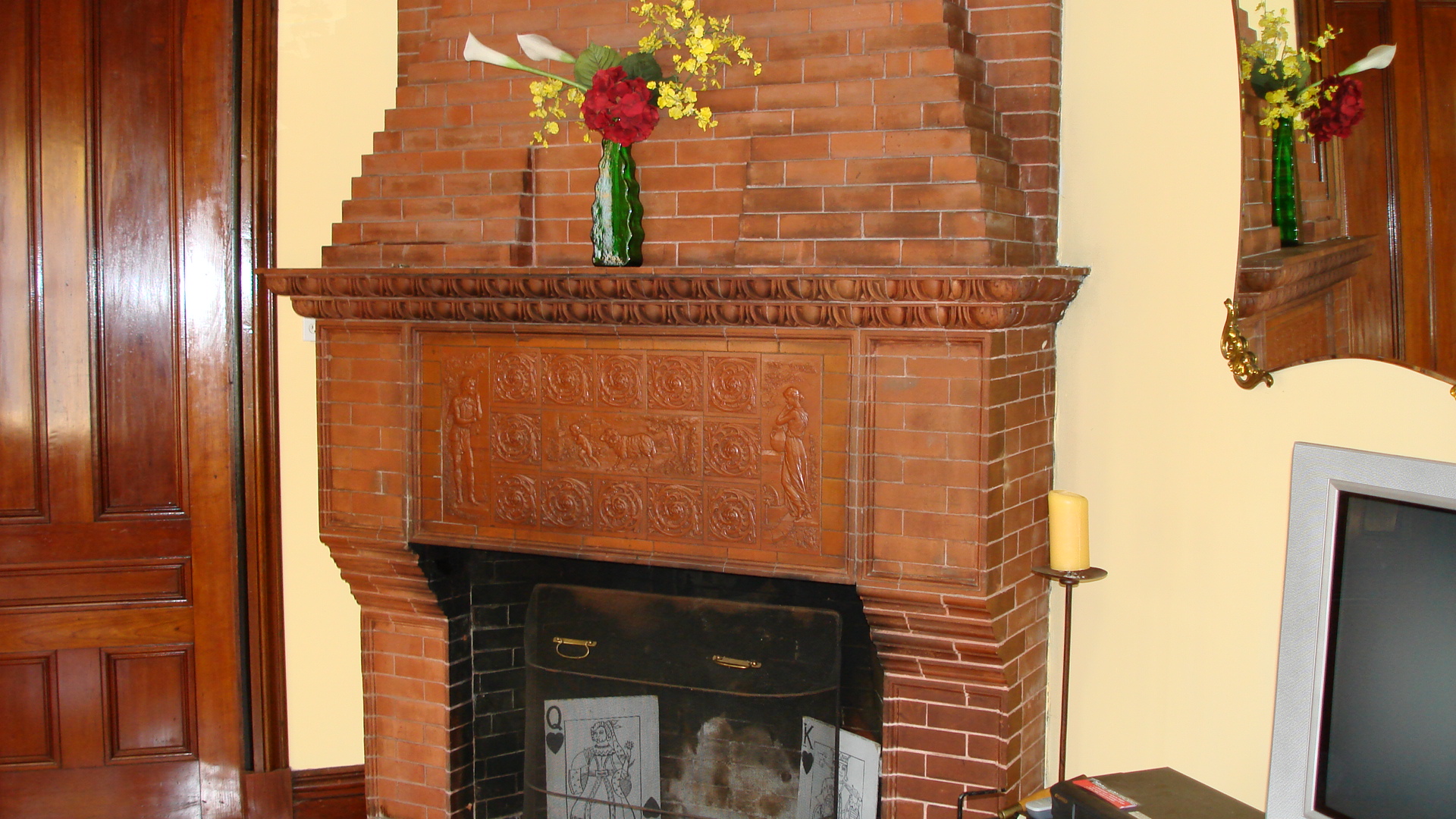
Every morning I rise at dawn to sit in the parlor. Here I watch the sunlight illuminate the, “Cat on a Hot Tin Roof” movie board in the hearth, and drink a cup of coffee in silence. I feel at home. These are the most precious moments of the day, the moment of peace before throwing the dice.
I can see out the window to the street, and this morning a handful of eggplant leaves on the tree next door have been autumnized to a transparent sheen of bronzed gold. The silence following summer has descended down over the rooftops of the people that live on East High Avenue. The sky is seared with streaks of white, and bubblegum pink clouds drift just above the rising of the sun. The moment is a peaceful stroke to a summer that has been indeterminate, chancy and without design. We came here with the intention to sell the house, and we leave without any such idea.
In the moments SC awakes, I hear his footsteps on the creaking wood floor. I close the journal and go in the kitchen to make buttermilk pancakes. When we are in Solana Beach, we eat bran muffins, usually in short order, between telephone calls, and conversations about things that it is too early to discuss. These mornings he lingers on the porch and reads the paper, because he has the time. If my body is willing, I will run down to the stream by Kelly Park, and look for the blue heron. Along the way, I pass by the quiet man with the three beagles, and a mother walking with her children to the bus stop. I will pass the funeral parlor and look the other way, and when I see the Federal Express Truck, he will wave because he knows I am the woman that receives mail addressed to Soaring Crow.
The front porches I pass are the opening pages to the home stories of people inside. If there are children, the remains of their toys will be scattered about. If they are elderly, they will leave their gardening shoes by the back door, and if they are a young couple, they will be in the midst of home repairs, a roof that needs fixing or a new coat of paint. I have observed just one campaign poster board in the neighborhood. It seems to have gone out of style to post your politics on your car or in front of your house. In the front yard of one home, a banner is pitched in the ground that reads, “Remember our Troops.” I have not asked, but it is probable they have a son serving in Iraq. The hanging flower planters have been replaced with mums and corn stalks. Some scatter straw on the lawn. I used to giggle at this September tradition, now I am almost giddy about arranging my seasonal display in the yard.
The run back through town takes me by the high school, a brawny brick building that looks like the setting for a chapter from “Catcher in the Rye.” A teacher passes by, dressed in a conservative suit and pumps, and smiles. She looks wholesome as apple pie, and I wonder if I ever looked like that. On chilly mornings, the fireplaces may be smoking, a scent as perfect as my favorite perfume. Our own fireplace is inoperable until we reline the chimney, which explains why the movie poster is in the fireplace.
By 8:00 a.m. the yellow school buses are chugging up the street and the children, gathered at our corner; bob up and down in innocent bursts of energy celebrating the beginning of a new day. I arrive home about this time, and stop to watch the quaintness of the moment. The habitat of these surroundings strips me bare of my Hollywood entertainment, Southern California roots. I am nourished by quaint tradition and scenery, and that is one answer to this mystery I call home.
I eat cider donuts when I want and instead of working out three or four times a week, I take long walks, past the Sunny Side farms to see the young foals and mothers in the corral. I dress in style-less shoes and pants, whenever I feel like it, without fashion consciousness. I do not watch the television and prefer to go to bed early and read Carson McCullers novels. If I wake up in the middle of the night, I can sit on the porch and look at the hands of a storm forming in the sky.
People come to my house without notice, and sometimes just walk in and yell my name. My favorite Broadway hangout knows who I am, what kind of wine I like and that we like to sit on the patio. Sometimes I meet strangers who have heard of the Follies House, and I feel a twinge of acknowledgment.
It does not matter what everyone else calls home, it is simply the feeling of peace, security, and acceptance. That is how you know you are home.
JIM MARSHALL AT THE OPENING OF GALLERY LOULOU TAOS. 2006
“Americas ‘true romantics will be the jazz musicians and jazz writers, living by their lyrical emotions, senses.”
From The Diary of Anais Nin volume Six.”
The throw of the dice this week lands on mysteries of character. We all have our closet of masks that we reach for when we need to camouflage our fear, insecurity, disdain, or judgment.
I wore a mask the day I went to pick up Jim Marshall at the Albuquerque airport. I didn’t want to appear unprepared, inexperienced, or effusive. As soon as I recognized Jim taking his last step off the escalator, my mask cracked. I ran to him, hugged him, and clichés poured out of my mouth: I’m so happy to see you, how was the flight, welcome to New Mexico. He nodded, smiled with closed lips, and asked,
“How long does it take to get to Taos?”
“An hour and a half.” Jim’s lips tightened.
In the car, Rudy and I whisked up conversation, but the results were drippy. Jim stared out at the window. We were in the valley of lunar like scrub rush, broken down sheds, and absentee human life.
“WHERE THE FUCK ARE WE?” Jim growled
“We’re almost there, another half-hour.”
“WHERE THE FUCK ARE THE PEOPLE?”
I tried, unsuccessfully to assure Jim, there were lots of people in Taos. I read his mind; why did he make the decision to exhibit his iconic rock and roll photography in a gallery in boon-dust Taos. How much longer before he can unwind with a scotch, and call home for a taste of civility. Who are these morons driving this car anyway?
Inside the B & B suite we’d rented for Jim, I breezed across to the adobe terrace, and opened the curtains, “You like it?”
“THERE’S NO FUCKING HAIR DRYER?”
“You can borrow mine.”
“Are you hungry Jim?”
“No.”
“I have a bottle of your favorite scotch.” He picked it up, and looked for a glass. I ran to the bathroom and brought him a glass.
“See you tomorrow. “ He growled.
“What time?”
“I’ll call.”
The next day, I waited for Jim’s call. Instead I heard from Dave Brolan, Jim’s operator to the world; friend, translator, mediator and stabilizer.
“Dave, is Jim all right?”
“He’ll be all right. He’s tired and cranky. He’ll be fine tomorrow night.
“What can I do anything?”
“No, just take care of your opening business. I take care of Jim.”
I sighed deeply, and returned to the chaotic events preceding the grand opening of our gallery. Jim agreed to exhibit along with Baron Wolman and Michael Zagaris, because they hadn’t been together in a long time. I was about to ease-drop on history, with three distinguished rock and roll photographers.
My heart raced ahead of me, until 6 o’clock when Jim and Dave walked into the gallery.
“How are you Jim?” I followed behind him as he viewed the exhibition.
“Looks good.” He said. Then he was swallowed up into a crowd of guests. He stood patiently for photographs, greeted strangers with a boyish smile and brotherly handshake. He sat down at my desk and began to sign books for a tickly line of buyers. I filled his glass with scotch and he said, “Thanks sweetheart.” My heart returned to my chest. The evening transcended into a kinetic overture of rock n roll music, reminiscing of the sixties, and feverish excitement. Around midnight, after being the center of 250 to 300 Taosaneos, Jim said, “Let’s eat.” It was snowing and pitch black outside.
Our party of seven charged in and rearranged the vibe of the banal atmosphere. Once inside the dining room Michael Z, was exhibiting impersonations of Jim, while we all laughed. Marshall didn’t twitch, or sneer; he accepted being the force of raucous laughter.
A young professional looking man approached our table.
“I apologize for interrupting. When I got to the opening, you all were leaving. I’m really sorry I missed it; I’m a huge fan of your work Jim.
“How did you know we were here? I interrupted.
“I followed you.” He said.
“Join us.”
That night and the next three nights, Jim was host to a crowd of fans that followed him around. I watched the mystery of his character, revealed, untouched, in focus, on what the photographs brought back to him. He was anointed by their admiration, without becoming inflated.
At the airport, Jim took me into his arms, “You did good LouLou.”
Two Years later.
I am in Santa Fe, and my social life is Camus strange. While I try to sell my photographs and write, my life is stifled by the absence of friends and parties. Jim called one afternoon.
“Loulou, my friends just moved to Santa Fe. Take down their number and call them.”
I called these new friends of Jim’s, and a week later, a man drove up, and leaped out of his car.
“Hi LouLou, I’m Jock.” He sat down, but his spirit was an unbolted kinetic burst of energy.
“I brought this for you.” He handed me a beautifully hand crafted book of his Cuban Series photographs.
A month or so later, I received a party invitation from Jock and his wife, Annaliese. The evening was lyrical, as friends circulated between the portals, while Jock mixed molita’s and Annaliese served Cuban food. That night, I was introduced to their friends. Now, a year later, I consider them my friends.
I called Jim after the party.
“I called to thank you.”
“What for baby?”
“For introducing me to Jock and Annaliese. Now I have friends.” Jim chuckled.
Jim passed away March 23, 2010. He was a romantic and lived by lyrical emotions and senses.
For all of us that claim we honor support and appreciate the troops, take a look at what your supporting. For someone like me, who has never experienced combat, and known very few who did, I bow my head. This film is a book, a documentary, a closeup photograph and everything that it takes to get the point across.






 ADVENTURERS IN LIVINGNESS