Comfort….
From writing by hand at my tiny Eurasian desk facing the window to the west; framed by time and familiarity into the branches of JD’s pine tree, the black silky toned crows basking like prowesses on the branches, and waiting for La Posada to empty the day’s leftovers in the garbage cans. The silky drape of the winter sky sometimes adorned with lacy clouds, like today, softening the southwest blue to a faded jeans shade. From my desk, I write, without thoughts predefined, just a drain of emotional threads from my heart…
This year isn’t like last year, the absentee man, fussing with the fireplace, making me afternoon espresso, or drying dishes. It is not at all like last year, with Rudy and John intercepting my division of attention, laughing at the kitchen table, eating my blueberry pancakes.
I had the song of Judy Garland’s rainbow in my heart. It was a time I will never forget, or regret, because I was a very lucky lady for several years. Unabridged ecstasy poured out of body, and spread over my attitude, abundant spirit, mood, facial expressions, and my dreams were filled with amusement instead of nightmares.
That’s why now, is so different. The camp has closed, and I wander into these new woods unsteady, and steadier, juxtaposed between, acceptance and anger.
In the last few months, I’ve written my heart out, read Shepard, Colette, Durrell and my Creative nonfiction magazines. I’ve studied, and prepared for radio programs, and collected a bundle of columns to adapt into short stories. I started buying chocolates and jelly beans, so I treat myself, on breaks, when it’s too cold for my frail body to walk around town or up Palace Avenue to see the new for sale listings.
My steps inward resulted in accomplishments, break-troughs’ and a comedic sideshow trying to open boxes, make repairs, until Rudy shows up again, and rake the leaves, stuff that is mundane. More distant relations, and mafia threaded strangers knocked on my door, bolstering my faith in breaking the silence that ruled me, I let rule me. Stepping inside the truth I must face isn’t nearly as harmful as pretending.
Mob on television, in the news, (gross sales global figure of $850 billion) websites, and bloggers, movies and books. They’re all coming out of the closet to inform, turn themselves in, give advice, consult on their own films, sign on for pubic speaking at Library’s, documentaries, and advertisements-the world is all mobbed up and it’s time for some horrific homogenization of the gangsters who wouldn’t break the silence.
A gangster daughter is ripped from comfort and innocence into confronting her father’s nefarious gangster life as Ben Siegel’s friend and partner. Ten years after her father took his own life; Lily discovers she must break the code of silence, to free herself from shame and distrust. When that trust is tested against her father, who controls her mentally, Lily is faced with standing up to him.
I moved in with my Dad when I was thirteen years old. My mother had just passed away, and I arrived with innocence and untrained cooking skills. Mom was an Irish Catholic meatloaf and corn-beef cook. Dad was a Russian Orthodox raised moderate vegetarian, and decided to hire a chef to teach me how to cook.
I came home from school one day, and found Caesar in the kitchen. He was a stand-in for Paulie in the Godfather, only he had curly black hair, and apple red cheeks. Caesar was dressed in a black suit, white shirt, and an apron that fell short of fitting him. Dad instructed Cesar to teach me how to make salads, baked fish, and spaghetti with oil and garlic. Everyday after school, Caesar was in the kitchen preparing dinner for us, and I stood beside him, observing his chubby knuckled fingers, slice and chop vegetables. We started with what Dad ordered; a meal in a salad, and later coined it Farmer’s Chop Suey. The salad was not just prepared, it was a decorated masterpiece when he finished. During the preparation, I noticed beads of sweat on Caesar’s face, and a jittery nervousness, surfaced just before my father arrived home, “What do you think? Will Dad approve?” He asked. I assured him Dad would love the salad. Cesar and I became pals, and waited anxiously for Dad’s arrival. He wasn’t all that agreeable. Fastidiousness and perfection are common traits amongst gangsters. Usually, Dad remarked there wasn’t enough garlic, or there were too many croutons, and Caesar would swiftly correct the complaint.
After Cesar went home, Dad would talk to me about food, and how everything starts in the stomach, and how the vegetables have to be scrubbed, and the seeds removed. Three or four times a week Dad dined out, and he didn’t order salads. He frequented Italian restaurants, and his favorite was Bouillabaisse, with a side of pasta. I never saw him enjoy any food as much as Borsch with sour cream, and smoked white fish. That was his favorite childhood meal. His father was a Orthodox Butcher, a very scared skill that requires a thorough understanding of Kosher preparation.
About six months had passed, and I came home one day and Cesar wasn’t there. Instead I found my father in a rage. I asked about Cesar and he told me it was none of my business, and to start preparing dinner. After my first salad preparation, Dad applauded my presentation, and assured me everything he was teaching me would serve me later on in life. He explained he had to be harsh and demanding, because he wanted me to be able to take care of myself properly.
I developed into a moderate vegetarian and have used that salad as a blueprint for most of my meals. Now I create a variety of salads, and a lot more ingredients: like white beans, garbanzos, walnuts, tuna, or shrimp, artichokes, sun-dried tomatoes etc. My friends call me a free-style cook because I only use recipes when I’m making soups or stews.
I was very fortunate to grow up with a father who spent hours teaching me what I would need to know in life. This is something you won’t read or see in a film about growing up with gangsters.
My dad was Johnny’s pal, close, like brothers, all through their life. Uncle Johnny
was my hero, he calmed my dad down, and he loved my mother because he knew she was a saint, and he was immensely religious. This is how I imagined his murder.
A blue Ford sedan with tinted windows pulled up in front of a bar in Biscayne Bay. The driver Tony, stared out the windshield looking beyond the boundaries made by man. Two of his men, sat in silence in the back seat. They were staring ahead, in the same mental latitude as the driver, with unblinking surgeon eyes. Tony turned off the ignition, and leaned back. The only sound came from the flapping of the bar screen door.
“Move,” Tony ordered closing his eyes. Abe and Chuck exited the sedan in one long continuous motion as if they were tied together. Tony waited, without changing the position of his right hand on the leather coated steering wheel. He heard the bar door squeak as it opened. He could see Abe and Chuck entering the bar. He did not need to see them physically. This was stored in his memory. The single file procession into the bar, the attachment to the target, and the guarded exit. Tony checked the time on his pocket watch. The minutes went slowly. He lost his concentration, and was tumbling in memories; he filed them in two categories, the ones that belonged to the outfit, and the ones that belonged to him. He slipped back to the sixties, in Las Vegas, when the boys sat poolside at the Desert Inn and bit into olives handed to them by freshly polished show girls in bikinis. Then he saw Johnny, lounging at the pool, his crown of white hair perfectly combed. He was surrounded by showgirls. The dames loved Johnny. He was better than any Hollywood movie star.
Then the door to the passenger side opened. Tony glanced at the blue gabardine slacks, and Gucci loafers. He could smell Johnny, even before he got in the car. His scent was recognizable, as if he’d been born wearing Boucheron.
“For crying out loud boys–I was just getting
an erection. ”
Johnny turned to Tony, the man he met twenty years ago when he was a driver for Santos Trafficante, the Mafia Don in Florida. Johnny slapped his knee and wheezed through his laughter. Tony couldn’t return the glance, or the laughter
“Tony! What’s the long face for, are we going to a funeral?” Tony shook his head from left to right. He gripped the steering wheel, afraid he might put his fist right through the windshield. Johnny nudged his rib.
“Loosen up, you’ll miss the target.” Tony reached into his breast pocket.
“Have a cigar Johnny, fresh from Castro. The same brand you tried to poison him with remember?” Tony’s forced laughter sounded hollow.
“Hell, that wasn’t my idear; you guys are still screwing up the story. That’s your problem, it you’re gonna squeal at least tell it the way it happened.”
“Shut your trap,” Tony snapped. Johnny did not appear to hear the comments, or if he did chose not to recognize the remarks of the backseat thug.
Johnny took the cigar and fingered it. He twirled it around with two fingers, and then placed it under his nostrils and inhaled deeply.
“Doc says no more–not if I’m gonna live without an oxygen tank tucked into my pocket. How ‘bout that? I even gave up the cigars when I moved down here. I can’t afford them anymore.” His laughter came easy, the way it always did.
“Johnny……I,” Tony stuttered.
“Did you hear the joke about the Italian and the Jew?” Tony nodded yes, but Johnny began telling the joke anyway. Tony turned the ignition on and drove away from town, slowly like they do in a funeral procession. They left the parts of the city ruled by law and order. The white villas shaded by palms, and guarded security gates. They descended into the pit of the buried past, the old rail yards, the site of hollow industrial buildings and warehouses. From there Tony entered an abandoned parking lot inside a junkyard, piled high with tin and steel parts. At one time they were valuable, like Johnny. Those days were gone, the junk piled up, just like dead Mafia Dons.
The sky dimmed in these parts of town, the shadows from the freeway overpass blocked the late crimson sunlight. Johnny was quiet now, sitting calmly with his hands folded together in his lap. His facial muscles relaxed, the jokes were over now. His mind was elsewhere.
“The son of a bitch gave me no choice John! I’m sure dead too if I ….” Tony stammered.
“Stop your babbling, I’m not your priest. I got a few orders for you. I want you to get word to Smiley, before anyone, you hear me. Don’t call his home; he’s got a private service. I’ll give you the number when I’m finished. He’ll know what to tell my sister. He’s a born messenger of bad news. Had to do it too many times.”
“How long you known we was coming?” Tony asked solemnly.
“Just as long as I’ve been taking orders. Tony my boy, I didn’t think I’d go out like Brando in the movie. How long has it been now? …forty-five years. That’s a long life in these shoes. The whole mess is running through my head Tony, as we sit here, it’s like a movie rewinding. You want to know the best of it; I mean the one moment worth remembering. The first night I walked into the Mayflower Hotel as a guest of Capone. My first big shindig was a coming out party for Joey Lewis’s big fight. I was so impressed with Ricca back then, I tried to mimic him. Must have looked like a soiled fool. I thought I had a smart suit on until I got to the party, and took a look around. Suddenly I felt like a paisano clown. I said to myself, I’ll never know this again; never will I feel less than the people around me. Capone treated me good in the beginning, all that money he threw around….. It impressed Rockefeller.”
“Johnny it’s getting late,” Tony interrupted.
“Capone was puffed up that night, shaking hands with Walker and the boys at Tammany Hall. We were all one then, the politicians and the boys. I don’t know how the thing got so screwed up.” The car came to an abrupt stop, and the back door opened. Chuck got out and stretched his legs. Johnny glanced at him, “See, no respect anymore. I would have diced his fingers off in the old days. Get out of the car Abe; go polish your piece or something,” Johnny ordered, and then continued his story.
“That was the night Tony, the best of everything all night and I didn’t sleep for a day afterward because I was so swollen with myself. It sounds silly now.” Just as Tony tipped his head in memory’s path, Johnny clapped his hands loudly. Tony shuddered as Johnny knew he would.
“Lemme see the equipment,” He ordered tossing the sentiment out of his voice. He turned his steely blue eyes on Tony and waited.
“They loaded me up, like I was going to a massacre. They’re still afraid of you John. Even now I have to say.” Tony rattled; he’d lost the last bit of dry eyed machismo.
“That’s a relief.” Johnny answered.
Tony got out of the car and hopped around the front to open the door for Johnny. He felt queasy in his stomach like the first time he had a hit. He watched Johnny now, knowing it would be some story to tell. First Johnny scanned his surroundings, like the eye of the camera. He could take in distant angles without moving a muscle. He could estimate the distance of things, the entrances, and exits of buildings without appearing to even look at that direction. He closed his eyes for a minute. They all watched, and waited.
“You fellas been here earlier?” Johnny shouted. The three men exchanged a mutual questioning glance. Johnny shook his head in disgust.
“How can you show up at a location without knowing every rock and puddle? Christ! Am I gonna have to shoot myself? Show me the equipment before I scare you off.”
Tony reluctantly unlocked the trunk of the car. Johnny stepped forward, pushing Abe and Chuck out of the way.
“Looks like a lot of machinery for a seventy year old veteran. Whatta they think, someone’s gonna drop down here with back up and take you boys on. What the hell are the knives for?” Abe and Chuck rocked nervously on their heels. Tony hunched over, as if drawing breath from the ground.
“Tony!” Johnny yelled.
“I‘m sick Johnny …. lemme catch my breath.”
“Yea, you do that, while Abe and Chuck sharpen the knives. Go on fellas get your pieces.”
“Johnny, we have orders,” Tony whispered
“From who? I don’t care if you skin me! I want to know who gave the order!”
“It’s not who you think Johnny, I could hardly believe it myself.” Johnny moved closer to Tony, he stroked his back, and whispered, “I promise I won’t tell pal,” he said squeezing Tony’s balls.
“The order came from the White House; they called Santos, and told him to take care of it. Johnny I can’t go through it, I can’t do it.” Then he fell to his knees and clutched Johnny’s leg, sobbing.
“It’s all right Tony, get up and give it to me the way they asked.”
“We’ll clean you out first shot,” Abe interjected. Again Johnny did not acknowledge the comment. He reached out and put his hands on Tony’s shoulders, and looked him in the eye.
“It’s bad, they got cement don’t they?”
“Oh Christ! let me take this all back. I can’t do what they ask. They want us to chop the legs, get you inside a steel drum, and in the water.” Tony suddenly heaved up, and vomited, sobbing at the same time.
“Jesus Christ Tony, you’re disgusting,” Abe shouted. He took a cigarette from his pocket. Johnny turned slowly around and glared at the bridge of his nose. He locked in on the spot, and gradually walked toward him. He reached for Abe’s pistol, a 357 magnum and holding it in Abe’s hand guided the pistol until it was pointing directly into his eyes.
“If you’re in a hurry, go ahead and shoot me now.” Abe turned sideways. Then he dropped his aim, and walked away. Johnny leaned against the car, and wiped his brow. “Let me alone for awhile; take a walk, all of you.” He ordered.
Tony pulled himself up and wiped his mouth. That was the least he could do, give the boss one last moment. He signaled for Abe and Chuck to follow and they headed towards one of the abandoned warehouses. Johnny waited until they were exactly thirty-five feet off. Then he slid into the car, and turned on the ignition. In a whirl of smoky dirt, he spun the car around three times, and flew past the boys, laughing his head off. He didn’t stop laughing until he reached the airport. He left the car, and ran all the way to the reservation desk of Air Italia. Perspiring and short of breath, he said to the pretty young clerk. “One way ticket please, to Palermo…. Sicily.” Johnny was going home.
John Rosselli (right) checks over a writ of habeas corpus with his lawyer, Frank Desimone after Rosselli surrendered to the U.S. Marshall here yesterday… (Photo credit: Wikipedia)
Reference: All American Mafioso, The Johnny Roselli Story. By: Ed Becker.
We hear our voice utter in youth, in our exuberance for life without doubt. In adolescence we begin to question, every nuance, expression, thought and answer.
Then during our academic or wandering career years it is subordinated, for to-do lists, obligatory appearances, exams, false presentations, social expectations, ambition, competition, and a eagerness to achieve. A distortion of our inner voice emerges.
Until one day, a reminder drops in your lap, and you ask yourself, ‘ WHERE HAVE I STRAYED?
This is about returning to the forever young paradigm.
WHERE TO BEGIN THIS STORY OF A FATHER THAT I ONLY CAME TO UNDERSTAND BY READING HIS FBI FILES, BOOKS ABOUT MOB HISTORY WRITTEN BY LAW ENFORCEMENT AND COLLEGE PROFESSORS, AND DOCUMENTARIES PRODUCED BY FOES OF MY FATHER.
My last year with Dad was 1981. Naive, and unconcerned with where I was headed, or how I’d get there if I figured it out, I was spinning around in an executive chair; waiting for the big hand on the black and white office clock to set me free. Time didn’t pass; I hauled it over my head, in my bland windowless office, under florescent glare. I was trouble shooting for an ambitious group of USC guys as they gobbled up all of Los Angeles real estate. Without any real sense of survival or independence, my life was in the hands of my father.
“Meyer’s coming to see me; haven’t seen the little guy in twenty-five years.” Dad said during a commercial break.
“Meyer Lansky?” I asked as casually as he’d spoken.
“Who else?”
“Why did you two wait so long?”
“It’s no concern of yours; he’s my friend, not yours.” I was twenty-nine years old and still verbally handcuffed.
The three of us went out to dinner, and while the two of them spoke in clipped short wave syndicate code, I
noticed that neither one of them looked at all happy. It was rare to catch my father in public with a friend, without raucous laughter, and storytelling. My attempt to revive the dinner conversation with my own humor,returned two sets of silent eyeball commands to resist speaking.
Several months later I received a call from Dad asking me to come over to his apartment, he had collapsed on the bathroom floor. When I arrived, he pleaded for me to stay close by. “I’ll be all right in a few minutes; I just need to catch my breath. ” I sat outside the bathroom door biting my nails, and waited, like our dog Spice, for my orders. For the first time in my life, he was weaker than I, and my turmoil centered on that unfamiliar reversal of roles.
Growing up the daughter of a gangster meant that I would remain a little girl forever. My father died when I was 29, but emotionally I was still a teenager.
Had I had known that I was seated next to one of the most powerful and influential men in the Mafia, Johnny Roselli, then I would have listened with sharpened ears, and repeated bits of explosive headline blood curdling stories to my girlfriends. That would have placed myself, my father, Johnny and my friends in jeopardy. An informant from the government may tag me on the way home from school, or tag one of my friends, or an enemy of the Boss, may pick me up from school and not bring me back. Everyone is suspect: an informant, or weak enough to become an informant, a loose lipped wise guy, a bragging connected businessman, a friend of a friend, a cousin of a brother, and a daughter of a gangster. We are all potential targets of this organization known as the Mafia, Mob, syndicate, Costa Nostra, or our thing. Growing up in this circle of gamblers, killers, fixers, enforcers, bookies was like growing up in a novel, it was a fictional tale all the way, until the end of my father’s life. There is a drop down board that appears every time I write about our family business that reads,
“ How dare you open my life to the world, what do you know? You know nothing little sweetheart, and that’s the way I planned it. “
“There’s no such thing as the Mafia! If you ever mention that word again, you’re leaving this house!” I melted down to the floor, and he was ominous as God standing over me. I would never mention the word again, I promised, and I would never believe in the Mafia.
I am a diarist. I record life around me so I can understand, as if by understanding I will find peace. Recording the exaggerated emotion and incidents of life began as a young girl when my mother gave me a diary. A good storyteller has to live life differently than the rest of us; otherwise, the stories will be predictable.
My father had those kinds of stories.
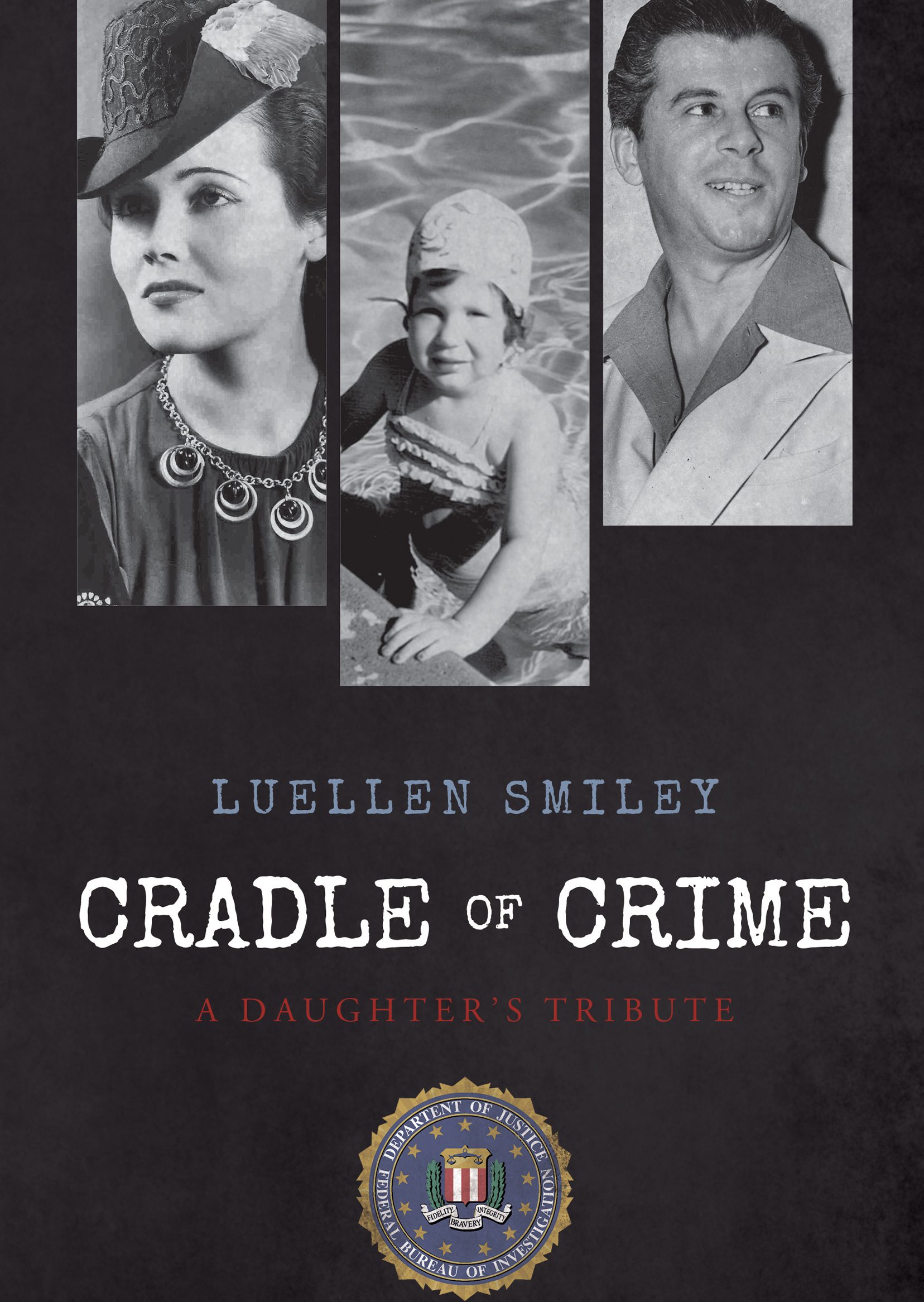
Allen Smiley: Illegal immigrant, Russian Jew, convicted criminal, hoodlum, extortionist, con-man, racketeer, bookmaker, tout, pimp, and high-ranking lieutenant and best friend of Benjamin “Bugsy” Siegel.
“ Luellen, You have to come and get me out of here.”
“Daddy, what’s wrong?”
“Just come down here and get me.
“Daddy you’re in the hospital.”
“I know where I am. They’re coming to get me.”
The phone call had woken me up. It was the first of several that night. I sat up in bed and looked at the clock.
It was past midnight. Why was he up so late? I called the hospital and asked to speak to the head nurse. I told her about the phone call. She said he was hallucinating, and that he’d refused medication. That was the first time I had ever sensed desperation in my father. He was afraid they were coming to get him. Who were they?
Several days later the phone calls stopped. He died as secretly as he had lived. There was an absence of publicity or concern. I knew what to do. He had given me instructions. I was to go to the bank, draw out what money was in the account, and go on a vacation.
“Clear the hell out of town. Reporters may start calling, don’t talk to any of them. Don’t trust anybody; remember what I’ve been telling you all these years. “
I took his phone book, the photograph of Benjamin Siegel, and one of his baseball caps. I packed up his black El Dorado Cadillac, and shot out of Los Angeles. It was the final scene of the first half of my life. I drove south on 405 hwy down to Del Mar. There was nothing waiting for me in Del Mar; no friends, or job, or anything to connect to. I only knew that when my feet touched the Del mar beach, I had to move there.
That summer I went to the Del mar Race Track and sat in the bleachers just like anyone else, wearing a hat, drinking Long Island Iced Tea and trying to see with the blinding sun in my eyes. It was strange to sit with the general public. The few times my dad took me to Santa Anita we sat in the Turf Club. I had no idea my father was part of the historical narrative of Del Mar race Track, and of Del Mar history.
After living in San Diego more than ten years, I returned to Los Angeles for a job offer. One afternoon I visited my father’s walking path along Ocean Park in Santa Monica. He walked from one end of path to the other beginning at San Vicente and ending in Venice. Afterwards we’d stop at the Lobster House for a plate of fish and chips, and a cold beer. While I was walking in his memory, imagining him next to me, I looked up and recognized one of his walking pals, Sonny Barry. He looked like a retired Vegas dealer; dark shades, v necked open shirt, and Beverly Hills signatory gold chain with a Star of David.
‘Hi Sonny, how are you?” I called out.
Sonny turned and looked, raised his tanned arms up in the air, “For crying out loud, Luellen sweetheart.”
“Where have you been—how’s everything, gee you look terrific.”
Sonny called out to another man in the near distance, sitting on a park bench. “ Sandy come look whose here.”
“Luellen, you know Sandy Adler, he was friends with your Dad a long time ago. Sandy Adler, my father had mentioned his name, but I didn’t know how they met or when. He was another man that fit into the mysterious and unspoken years he was partner with Ben.
“Oh well, I haven’t seen you since you were a little girl.”
“You knew my Dad when we lived in Bel Air?”
“ Way before that; I knew your Dad when he was with Benny Siegel—and I knew your mother.”
It was the mention of my mother, who died when I was thirteen that pierced my antenna of interest. Sonny stood back while Sandy took my hand, and said let’s take a walk. We walked along the bluffs overlooking the pacific ocean. He spoke slowly, and paced himself as if the memories were lodged in books and he had to dig into them.
“ I ran the El Rancho hotel in Vegas, and then the Flamingo. I knew your Dad very well, he was some classy guy.”
“ Oh I remember the Flamingo but not the El Rancho.”
“ Well, anyway-where are you living now?”
“I just moved back to Los Angeles, I was living in Del Mar.”
“ Del Mar? I owned the old Del Mar Hotel –in fact your mother and father used to come down and stay there.”
“ He never mentioned Del Mar to me.”
“ He had his reasons; yea they came down during the race meet and stayed at the hotel. I remember them coming down, one time, and Allen got upset with your mother. They were having quite an argument. Your father left, and I walked with your mother on the pier, and tried to comfort her.”
I couldn’t utter a word I just listened. The Del Mar Hotel had burnt down before I moved there. I’d seen photographs of the hotel, and heard stories about the Hollywood stars that stayed there. It was a magical legend in Del Mar, everyone who lived during its glory days talked about it.
It was sometime after that, that I walked in the sand where the hotel had been located. I understood that one day I would begin plucking away at my family history.
I was a child of the fifties; when raising kids was easily defined. Mommy stayed home and made sure the kids didn’t burn the house down. Daddy went to an office to make money to pay for the house, and children waited until they were grown up to find out anything really useful. It was before the generation-gap was coined, or children knew how to be witty and sharp. In our air-tight neighborhood of Bel Air, Los Angeles, we were naïve, privileged, kids; bogged down with falling off bicycles, not being chosen for the school play, and bringing home the most candy at Halloween.
I believed in Santa Clause, the Easter bunny, and if I was good, Mommy would let me stay up and watch the Sunday night Variety Show.
America was threatened by the Russian Communists and Organized crime. Public enemy Number One was New York Mafia Boss, Frank Costello. Frank became super famous when he refused to testify on national television for Senator Estes Kefauver. The Kefauver Committee delivered explosive headlines between 1950 and 1951, as the government unveiled the hidden hand of the Mafia in the United States.
The first twenty-four hours. I stepped out of the cab and into the froth of a seasonally warm Saturday night Halloween crowd. The Chelsea Hotel Bell Captain trotted over to greet me.
“I’ll get those.” He grabbed the bag.
“You go inside.”
The pathway to the lobby entrance was red carpeted; a very old skeletal one that had been stepped on by plaque famous artists, writers, and bohemian debutantes. The Chelsea was built in 1883 as an apartment house. The neighborhood of 7th and 23rd Street used to be the theatre district. The theatre crowd was replaced by the literati, and more recently by film and television celebrity. The hotel is crumbling with novelettes. Even though it has recently been restored, it has the feel of a craggy lady of the street.
The lobby was crusading with costumed ready to party extras. My traveling ensemble and exhausted expression didn’t fit into the scene. I needed to eat, drink, and take off my coat. The desk clerk was very young,
“Your in Room 624–you’ll like the room, it’s a really nice one. Here’s the key.” When I opened the door, my vision parachuted as if the room was expanding the closer I got. It looked staged rather than decorated: minimal pieces, colors that drew the eye in, and nothing to get in the way of feeling insignificant. The walls were bare and the drapes partially opened. I pulled them back to see the city; a jagged puzzle of gray brick buildings staring back at me. I watched the faint silhouette of people moving behind the glass and suddenly felt very alone and uncertain. In haste I added a smudge of lipstick and left the room. The clerk looked up as I came out of the elevator,
“You like the room?” I nodded a bit falsely, because I wasn’t sure I really liked it. The room had more to say to me.
“Where is the closest Bistro?”
“Next door.”
I stepped across the red carpet and into the restaurant. At that moment I landed in Manhattan; the gravity sucked me down into a red leather cushioned booth. Then I remembered why I was here, the next day was the Copa reunion.
Twenty-four hours later Room 624 was mine. Victor, one of three Chelsea staff doorman who zapped formality with the grace of a king met me at the entrance. He had time to wave to half a dozen people passing by, hail a taxi from the middle of 23rd street, open the door for a guest, and still talk to me.
“Hey! How you doing today?”
” I’m rested and on my way now.” A young girl stepped out of the lobby.
“Hi honey,” Victor said,” Where areyou going? I worry about you.”
“Shopping,” she answered unconvincingly. “I like your outfit,” she said to me.
“Thank you. I’m going to an event I’ve waited for a very long time.”
“Oh yea, where to?” she asked.
“Have you heard of the Copa?”
”Sure, the Copacabana.” Victor started to hum the lyrics from the song and I dug out the book from my purse.
“I’m going to a Copa reunion–my mother danced there in the 40s.”
They looked at the photographs of the original Copa for the first time. New Yorkers will stop anything for New York anecdotes, especially history. Moments later the cab pulled up and I waved good-bye. I sat in the taxi and thought about my mother. She was seated next to me; an imaginary yet distinct vision that kept returning.
The moment I walked into the Copafest reception room a voice called out, “Louellen!” It was Kris, the author of the book. We embraced as our first meeting converged with written correspondence over the last year. The Copa dancers inched closer and I was anointed with their acceptance and love.
“This is them–they met at the Copa,” I said and showed them the photograph I had brought. One woman examined the photo and turned to me, I recognize him,” and she pointed to my father.
“And I recognize the man next to him.” It was someone I’d never been able to identify.
“Yep, I knew them. Your mother was beautiful, she was here before me.” Terri Stevens took my hand in hers and led me to the place where she was seated.
“What did you say your mother’s name was?”
“Lucille Casey.”
“Girls-girls! Come over here and meet Lucille Casey’s daughter.” Engulfed in their presence for the next five hours, I had time to talk with each one. I’d written about these women in fictional detail eighteen years ago. Now it was there turn to talk.



 ADVENTURERS IN LIVINGNESS