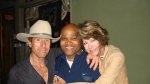
Free yourmind and the rest will follow, the words from EnVogue’s latest release became a sort of mantra.
It was a decision that came at a moment when everything else stopped making sense, except my happiness. I tossed out the two-piece suits, and turned off the world outside. Insulated in my tiny North Park bungalow, I merged into music and dance. During the hottest of summer days I was seated cross legged on the worn carpeting watching MTV and flipping through magazines.
Imploded with music videos, magazines, and dancing; Hip-Hop was the most exhilarating choreography around. I watched the music videos over and over. When I searched the yellow pages for dance classes; no one was offering Hip-Hop. With that, I thought why can’t I be the founder of a dance troupe?
I needed to find the dancers to suit my concept of integrating jazz funk, hip-hop, and Afro-Cuban into a collage workshop.
Piper Jo was the first dancer to join. He came at me with everything he had; talent, faith, intelligence, and belief in this crazy white chick who wanted to hip-hop. Piper played Miles Davis, emulated jazz-funk, and moved like Michael Jackson. He was twenty years old and this was his first teaching job. When I asked him who taught him to dance he answered;
“Michael Jackson and James Brown. I danced in my living room every day. My mother couldn’t get me out of the house. God blessed me with this gift, and I want to share it. So if you put me in your dance troupe I guarantee, you won’t be sorry. NO, you won’t.”
At our first audition Piper said, “How you expect to pick dancers, if you don’t know what to look for. I swear Lue, you are crazy. But don’t worry, I’ll show you. And don’t be picking every guy out there cause he can Hip-Hop, there’s nothing to that. We want dancers with classical training.” He was right.
“Vince Master Jam” was a former break-dancer and studied classical dance. Vince was the coolest; he sat back and waited for his chance, unhurried, relaxed, but when the music came on, he flipped everyone out. He was thirty. Both of them belonged to the no smoking, no drinking, no drugs, group
At that first audition I wanted to select half of the thirty some dancers that showed up. They came dressed in street clothes, wearing scarves and bandannas. I watched them leap, kick, split and turn inside out for the job. I knew that I was in the right spot. Then we added Monique, a startling beauty with Afro-Cuban dance training, and a perpetual attitude of carefreeness.
For the first few months, the Jammers taught classes under a leaky roof, on a tiled floor, without any heat. Piper rode a bus from the other side of town to get to the building. Vince drove an hour each way to teach one class at night. The first few months no one showed up for Vince’s Hip-Hop class. But he kept coming back every week. When I apologized, he said, “ That’s okay Lue. We get it going on, they’ll show up soon– I’m sure.”
They did show up and we moved into a well positioned Health Club downtown San Diego. The classes filled up with students, dancers, and working women looking for a new challenge. They came from all different races; Asian, White, Hispanic and Black. I danced with the classes and promoted our troupe. They laughed at my attempt to be a soul sister, and I laughed with them. We were reviewed by KPBS magazine, and a photographer took photographs of us and featured the Jammers in the magazine. People began to think I knew what I was doing. The Jammers thought I could take them places. I pictured them on the front page of Variety, the problem was I was too early.
I’ve written in the genre of Creative Nonfiction, integrating the events through dialogue, journal entries, and a third-person narrative. Within three locations, Santa Fe, New Mexico, Los Angeles, California, and Saratoga Springs, NY. Greta (me) exposes the mutilation gaslighting abuse inflicts on her emotions, psychology, mental and physical health, and her finances.
WHERE TO BEGIN THIS STORY OF A FATHER THAT I ONLY CAME TO UNDERSTAND BY READING HIS FBI FILES, BOOKS ABOUT MOB HISTORY WRITTEN BY LAW ENFORCEMENT AND COLLEGE PROFESSORS, AND DOCUMENTARIES PRODUCED BY FOES OF MY FATHER.
My last year with Dad was 1981. Naïve, and unconcerned with where I was headed, or how I’d get there if I figured it out, I was spinning around in an executive chair; waiting for the big hand on the black and white office clock to set me free. Time didn’t pass; I hauled it over my head, in my bland windowless office, under florescent glare. I was trouble shooting for an ambitious group of USC guys as they gobbled up all of Los Angeles real estate. Without any real sense of survival or independence, my life was in the hands of my father.
“Meyer’s coming to see me; haven’t seen the little guy in twenty-five years.” Dad said during a commercial break.
“Meyer Lansky?” I asked as casually as he’d spoken.
“Who else?”
“Why did you two wait so long?”
“It’s no concern of yours; he’s my friend, not yours.” I was twenty-nine years old and still verbally handcuffed.
The three of us went out to dinner, and while the two of them spoke in clipped short wave syndicate code, I noticed that neither one of them looked at all happy. It was rare to catch my father in public with a friend, without raucous laughter, and storytelling. My attempt to revive the dinner conversation with my own humor,returned two sets of silent eyeball commands to resist speaking.
Several months later I received a call from Dad asking me to come over to his apartment, he had collapsed on the bathroom floor. When I arrived, he pleaded for me to stay close by. “I’ll be all right in a few minutes; I just need to catch my breath. ” I sat outside the bathroom door biting my nails, and waited, like our dog Spice, for my orders. For the first time in my life, he was weaker than I, and my turmoil centered on that unfamiliar reversal of roles.
“Daddy, you should go to the hospital, I’m calling the ambulance.”
“Nope, no ambulance, I’m not going to the hospital, hang up the phone right now.” I pried the bathroom door open, and crouched down on the floor to hold him in my arms. It was the first time I’d held him like that, he felt so heavy and warm. When his eyes closed I called the ambulance and waited. Two attendants arrived, and immediately took his pulse. “Why didn’t you call sooner, within minutes he would have died?”
“ I couldn’t–you don’t understand, he wouldn’t let me. ” They grimaced at me, and removed him from my arms. Over the next few weeks I learned only that he had a failing liver. The mirage of doctors and nurses flowing in and out of his room, assured me that this was just a temporary set back. Soon he would be back at his favorite table at the Bistro Gardens, dining with young aspiring starlets.
When you love someone whose life is draining into illness, even their hollering and gripe is a relief. For the first time in my life, my father did not frighten me. I don’t know if it was because he was vulnerable, and dependent on me for comfort. But the feeling was ecstasy, the feeling of being inside his world, and not excluded.
“Imagine sending nurses in my room at six in the morning. Boy did I give them hell. They won’t soon forget the name Allen Smiley. They’re not treating me like a social service case. “ His voice came back and the salty blue color of his eyes. I took my father home, and sat on the crushed blue velvet sofa while he made his phone calls.
” Say what’s up buddy, what can I do for you? I’m tougher than you think; my daughter and I are going for a walk later. What can I do for you? When are you going to Vegas? Yea, I see all right, don’t worry about a thing, no I’ll handle it, I insist now, don’t argue with a sick man, you rascal. Don’t send flowers yet, send champagne!”
Within a few weeks, my father was back at his favorite table at the Bistro Gardens wearing tinted shades. His passion for the company of females, was reciprocal, they loved him. He sent them flowers, and picked up their checks. He could wave his magic wand of favors at the studios, or for concert tickets, and the chips rolled. He kept up that pace for six months.
All my life he had made things happen for me, now it was my turn. I collected the telephone messages, walked the dog, and cleaned up the house. It was strange, to putter amongst my father’s things. I opened drawers cautiously, thinking he may have alarms on things. He had a pile of papers stacked on his desk, and unopened mail. His personal toiletries were still in immaculate order, his brushes, and collection of colognes. A heavy sadness, presided over the room. I noticed he was reading “Honor Thy Father.”
During his sickness, he presented a man only slightly off balance. He continued to camouflage his liver failure, like he’d masked his identity all his life. I recognized the anguish in his eyes, but I had to pretend it wasn’t there.
My character changed overnight. I did not hesitate over minor decisions, cower if he yelled, or hide inside myself. Something in him was now part of me. We were fighting together. One afternoon we took a walk in Holmby Park.
“What matter’s in life is that you don’t allow people to walk over you, see. No one looks out for your best interest, except your old father. You’ll see, it won’t be so easy without me.”
“Daddy, don’t talk like that, come on.”
“Why not, I’m telling you the way it is, what do you want, for me to lie to you? Everyone else will lie to you! Now, I’ve told you that I’m donating my body to USC Medical center. I already have it arranged.”
“Daddy, I’m not listening. Don’t talk to me about that,” tears welled.
“You must listen little sweetheart. There’s no expense for you to be burdened with. I wish I put more away for you, but I’ve always told you, haven’t I….that I spent everything I made. I only hoped that things would have changed…. be that as it may, you won’t have any expense.”
Smiley’s Dice Adventures in livingness
The throw of the dice this week lands on the adventures in the making. How could I have known 15 years ago?
Back then I had but a finger-bowl of resources, a blue chair, a desk, and a typewriter. Everyday I wrote into the flame of discovery looking for my mother. My notebooks were sketches of this woman I never knew. The absence of the most ordinary information, like where she grew up in Newark, what sort of neighborhood, what her father did for a living, what schools, she attended, and later on, what experiences she had modeling in New York. The closest I got was by reading John Robert Powers book about the modeling agency he started in 1923. He assigned unemployed Broadway talent to his agency to be photographed for corporate campaign advertising. According to John he was the innovator of the modeling agency concept- beautiful women and men will sell products to the public, the public never would have thought of buying.
I found her name in the index, Lucille Casey. She joined the agency when she was 16 years old. John groomed the models; and assigned disciplinary perfection in dialect, manners, appearance, character, and intellect. Powers Girls married anyone they wanted. They were invited to all the important society events, they were given card Blanche at the Stork Club, and the Morocco and they were transported to celebratory city functions. They met men of all means, character, and class.
After I read the book, I thought about what my father used to say, “ Your mother could have had any man in the world, but she picked me. Don’t you make the same mistake.”
That is a complex summons for a teenage to understand.
I sat in the blue chair and waited for the flares of information to come down to earth. After two years, I had very little to build a full page. My mother’s history was lost, her friends had vanished, or would not talk to me. She did not leave a diary. Her photo album as a model was all I had. What could I see in those eyes, and smile? Perfection. I gave up the search, and switched over to my father. The government documented his daily activities, and what they didn’t hear or see, was exploited in newspapers, documentaries, and books.
There was one woman who was alive, that knew intimate details of my mother, because I had met her, and she made it known to me she knew. That was Meyer Lansky’s wife, who went by the name Teddy. Women have a distinctive look when they are withholding secrets. Teddy always had that look when she brought up my mother. I told her I was writing about my father and mother and she said, “Let them rest in peace.” I didn’t take her advice.
I’ve written in the genre of Creative Nonfiction, integrating the events through dialogue, journal entries, and a third-person narrative. Within three locations, Santa Fe, New Mexico, Los Angeles, California, and Saratoga Springs, NY. Greta (me) exposes the mutilation gaslighting abuse inflicts on her emotions, psychology, mental and physical health, and her finances.